Multi-press molded pallet main base
The Multi-Press Molded Pallet Main Base and the Operator-per-Press Habit
On a multi-press molded pallet main base, take-out headcount has historically scaled one operator per 1250-1600 ton hydraulic press, and a two-press presswood pallet production line has carried two take-out operators per shift. AutoG is the automatic pallet take-out robot from EMP that pairs one six-axis arm with two 1250-1600 ton presses, so two press stations run on one robotic offloading cell and the take-out station headcount stops doubling every time another press is added to the floor.
Why the AutoG One-Arm Two-Press Configuration Fits the Multi-Press Layout
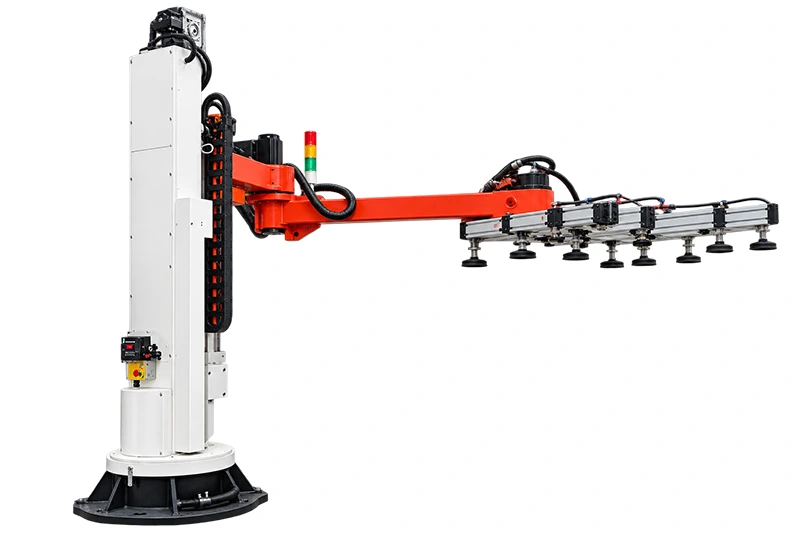
AutoG is the automatic pallet take-out robot and the dedicated take-out station of the fully automatic presswood pallet production line. It is a six-axis articulated robotic arm with a multi-suction vacuum gripper head, designed to enter the press opening on the open-mold signal, lift the pallet off the platen at roughly 80 degrees Celsius, and transfer it straight to the stacking position. The configuration that fits the multi-press main base is the one-arm two-press layout: a single AutoG arm is mounted between two 1250-1600 ton presses and serves them alternately. The arm waits while press A is in the closing and pressing stage, swings in when press A opens to unload, stacks the pallet, and then moves across to press B while press A is closing again. On a two-press line this means one robotic offloading cell instead of two manual take-out stations, and on a four-press line two AutoG arms replace four manual stations. Because the 4 to 5 minute press cycle on each 1250-1600 ton press is longer than the time the arm needs to pick, transfer and stack a pallet, the same arm keeps pace with both presses without leaving either one idling. The differentiation here is the 1 to 2 robot-to-press ratio: one automatic pallet take-out robot alternating between two presses is the configuration that turns a two-press main base from a two-operator station into a one-cell station, and that is the configuration the direct competitors do not describe as clearly.
What the One-Arm Two-Press Configuration Looks Like on the Floor
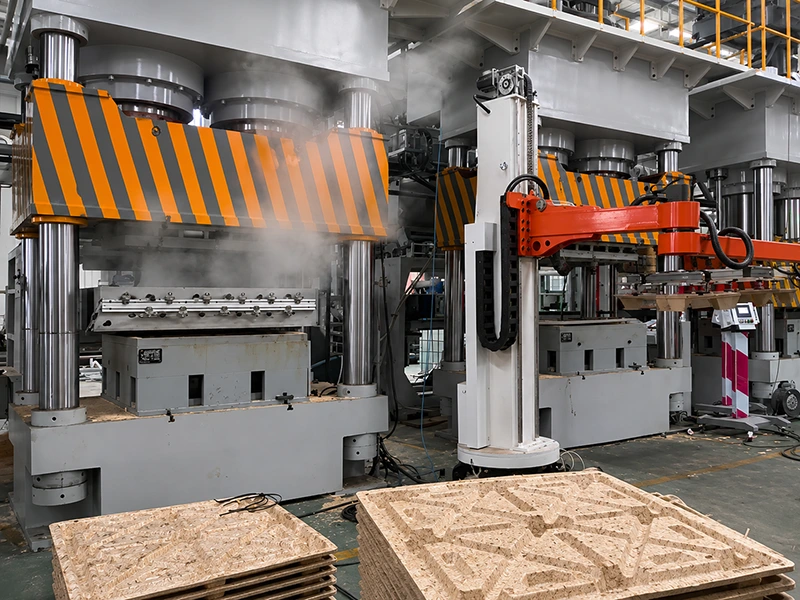
The first image shows the AutoG arm itself: a column-mounted white-and-orange body with an articulated boom, a multi-suction vacuum gripper head at the end of the arm, cable management chain along the upper arm, and a stack light on the column. That is the mechanical package that swings between the two presses. The multi-suction head is what lets the arm lift a freshly pressed pallet off the platen at roughly 80 degrees Celsius without waiting for it to cool, and the six-axis articulation is what lets the arm reach into the press opening, lift out, rotate, and place the pallet on the stacking conveyor without a secondary manual lift. The second image shows the configuration in context: a multi-column 1250-1600 ton hydraulic hot press line with the robotic loading arm mounted at the press side, the safety enclosure with striped guarding, and the press opening ready to be unloaded. The arm is not a separate island; it talks to the press through the line PLC and times its pick to the open-mold signal, so the press does not wait and the arm does not reach into a closing press. The stacking conveyor, the press, and the AutoG arm share one control layer, and that is what lets one arm serve two presses instead of being parked in front of one. Floor footprint shrinks accordingly: the take-out cell between two presses takes the place of two operator-stations, the operator-station guarding goes with it, and the press danger zone stays fenced rather than being walked into on every cycle.
Result: Cutting Take-Out Headcount per Pair of Presses Without Halving Output
The headline number on a multi-press main base is take-out headcount per pair of presses. With manual unloading, two presses means two operators on the take-out station per shift; with the AutoG one-arm two-press configuration, two presses mean one robotic offloading cell. That is the capex efficiency framing the direct competitor literature does not describe clearly: one automatic pallet take-out robot equals two 1250-1600 ton presses equals two take-out operators removed. On a four-press main base, two AutoG arms replace four take-out operators; on a six-press line, three AutoG arms replace six. The press takt the line was quoted on stays intact, because the 4 to 5 minute cycle on each 1250-1600 ton press leaves the arm idle time, and the vacuum-suction pick at roughly 80 degrees Celsius removes the manual cool-down wait that was eating into that cycle anyway. The operator stops standing inside the press danger zone on every cycle, the MDI fume exposure point leaves the roster, and the line moves from a manned take-out station to an attended robotic cell that the line PLC drives. The two operator-stations become one robotic cell, taking the take-out headcount per pair of presses from two operators to zero on a per-press basis, which is the operating-cost step the multi-press main base is sized for in the first place.
- Names the automatic pallet take-out robot and the one-arm two-press configuration as the answer to the multi-press molded pallet main base labor-cost drift.
- States the capex efficiency as one AutoG equals two 1250-1600 ton presses equals two take-out operators removed on a presswood pallet production line.
- Cites the 4 to 5 minute press cycle and the roughly 80 degrees Celsius take-out temperature as the constraint that lets one arm serve two presses.
- References both the AutoG arm structure image and the multi-press line image with the operator-station to robotic-cell outcome.