Presswood Pallet Line Build
The First-Time Builder Profile: Greenfield Presswood Lines Start With Press Cycle, Vacuum Timing and PLC Hand-Off, and No One on the Team Has Seen Any of Them Yet
A first-time molded wood pallet operator usually buys a 1250–1600 ton press, a separate six-axis arm, a vacuum gripper and a PLC cabinet from different vendors, then has to make them talk to each other with no prior cycle, vacuum or signal-mapping experience. The AutoG automatic pallet take-out robot from EMP lands as part of an integrated press + take-out + palletizing + PLC scope, so the line that ships out the first pallet is the line that was engineered end to end.
What Breaks When the Buyer Becomes the Integrator: Standalone Six-Axis Arm plus a Third-Party Press, Vacuum and PLC
When the press, the six-axis arm, the vacuum end-effector and the PLC are bought from four different vendors, every I/O mapping, every gripper geometry check and every safety interlock becomes the buyer's homework. The arm vendor ships a generic palletizing cycle that does not see the press open close signal; the vacuum gripper supplier does not know the molded pallet contour; the PLC programmer writes ladder logic against a press schematic rather than a robot controller; and the buyer ends up acting as systems integrator for six to twelve months while the line idles or runs partial batches. Safety logic for the 1250–1600 ton press danger zone is where the project usually stalls, because each subsystem carries its own safety relay, light curtain and stop category that no one has cross-wired. A standalone arm sourced away from the press vendor also has no contractual answer to who fixes the line when the take-out and the press disagree on what "cycle complete" means.
What AutoG Brings When It Lands as Part of the Presswood Line, Not as a Loose Robot Arm on the Floor
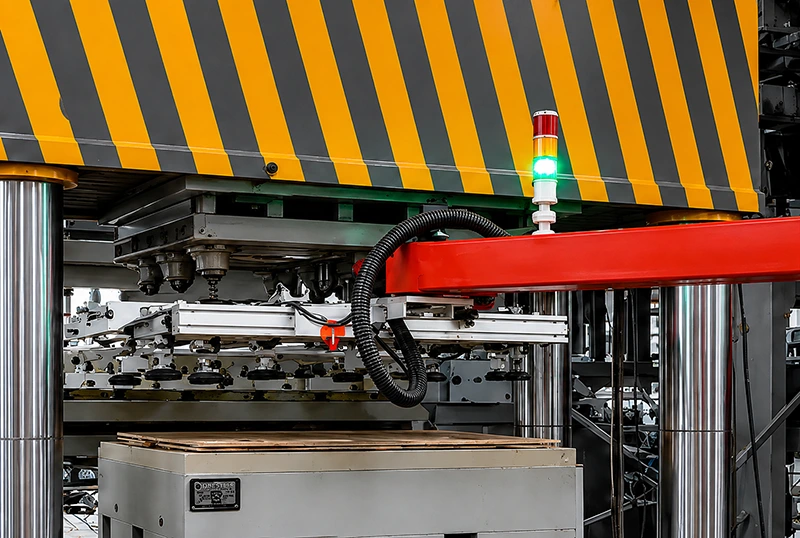
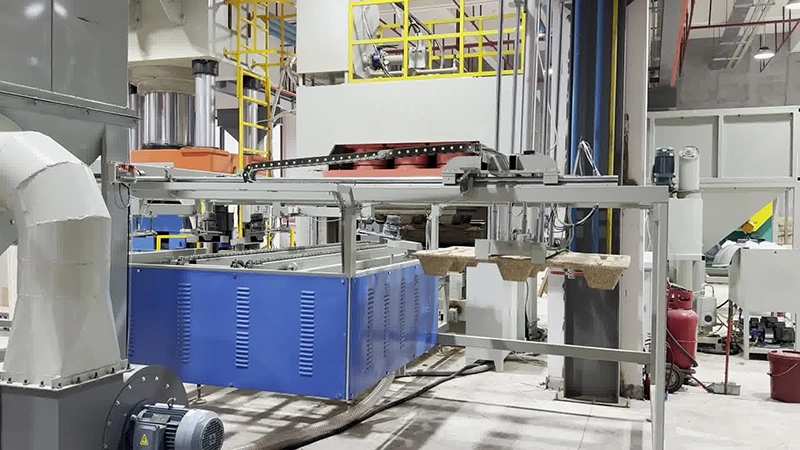
AutoG is the automatic pallet take-out robot that EMP ships inside its presswood pallet line scope, so it is delivered already mapped to the press open close signal through the same line PLC. The unit's six-axis articulated arm carries a multi-cup vacuum suction end-effector that is sized to the molded pallet outline, lifts the freshly pressed pallet at roughly 80 degrees Celsius straight out of the mold, and transfers it to the stacking position without a secondary manual lift. One AutoG arm tends two 1250 to 1600 ton presses in alternation, which keeps the line running while the two presses alternate their open close windows and removes an operator from the press danger zone at every mold open. Because AutoG is delivered together with the press, the vacuum generator, the safety guarding and the PLC I/O arrive pre-validated, and that single-scope delivery is the reason a first-time builder gets a working take-out station instead of a robot that needs another quarter of on-site integration.
Turnkey Delivery: One Contract, One PLC Map, and First Pallet Out Sooner on a Greenfield Presswood Line
A turnkey presswood pallet line contract from EMP scopes the press, the AutoG robotic offloading, the vacuum gripper, the palletizing station and the PLC integration as one delivery package, with one commissioning sequence and one safety file reviewed at the same time. The line PLC handles the press open close handshake, the mold open limit switch, the vacuum permit signal and the pallet-on-stacker handshake before AutoG is allowed into the press danger zone, so the buyer does not have to retest that logic on site while the press is already hot. Compared with buying a standalone six-axis arm and asking the buyer's own team to integrate it with a third-party 1250 ton or 1600 ton press, the turnkey path cuts months of integration, leaves the press danger zone unmanned from day one and lets the line run its first shift on the cycle the press was sold on rather than the cycle the integrator eventually finished writing. To scope a turnkey presswood pallet line that includes AutoG as the take-out robot for a greenfield site, contact EMP for an engineering review of your site layout, target output and shift plan.