Pellet plant · cost per ton · export compliance
The Pellet Plant That Competes on Cost per Ton, Not on Machine Specifications
A pellet plant does not really compete on machine specification. It competes on one number against coal and heavy oil: cost per ton. That number is set at the chipping stage ahead of the mill, dryer and press, and it is where a wood chipper machine either protects the margin or hands it to an outside chip supplier. EMP Shred is a stationary electric drum type wood chipper built in three tiers: X-215 at 45 kW and 4 to 5 t/h, X-216 at 55 kW and 6 to 8 t/h, and X-218 at 110 kW and 8 to 12 t/h, all cutting toward about 35 mm chips. This page follows one export-oriented pellet plant decision end to end: where the industrial wood chipper sits in the line, why the old routes stop working, which structures carry the load, and what the plant still has to verify on manning, spare parts, CE documentation for Europe, the EU Machinery Regulation 2023/1230 switch, and the ENplus boundary. Where EMP has no measured kWh per ton figure, none is invented.
Why Outsourced Chips, Manual Sawing and Diesel Mobile Chippers Stop Working
The old routes are still in service on real sites and each one loses money in a different place. Outsourcing wood chips and sawdust keeps capex off the balance sheet in year one, then converts the whole raw material line into a price the plant cannot negotiate. Manual sawing and splitting of branch wood, slabs and edging replaces a purchase cost with a labor cost that rises every year and cannot be scaled with tonnage. A diesel mobile chipper brings its own fuel bill, its own engine service interval and its own emissions into a plant that already has a 380 V supply on site. Running a hammer mill with no chipping stage ahead of it pushes irregular lengths straight into the grinding chamber, so grinding capacity is spent on re-sizing what a first-stage cut should already have sized. A stationary electric drum wood chipper answers each of those four directly: raw material becomes a controlled internal input rather than a purchased one, feeding is hydraulic rather than manual, the chip screen keeps oversized material inside the machine until it passes, and the drive is electric on the plant supply.
Feed Rollers, Knife Roller and Chip Screen: What the Structure Actually Does
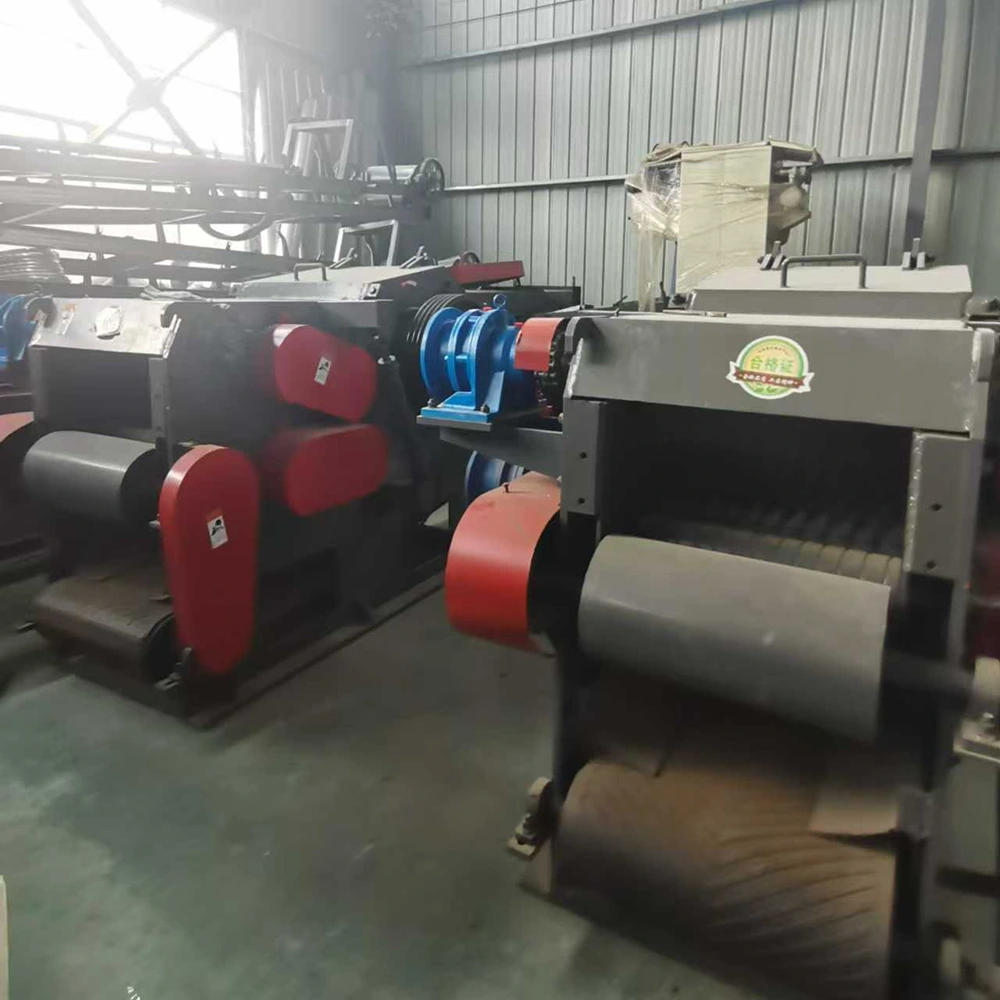
Shred is a welded steel housing carrying a knife roller, an upper hydraulic feed roller, a lower pressing roller and a sizing screen beneath the rotor. The upper feed roller floats inside its hydraulic range, so branch wood, slab, edging and irregular offcuts of different thickness are pulled into the cutting circle instead of bouncing on top of it, and the two feed roller groups are synchronized by chain and sprocket so material is forced through at a controlled rate. The knife roller carries fly knives fixed with dedicated bolts and clamping blocks, and the same hydraulic system lifts the upper feed roller and opens the housing, which is what turns a knife change and a knife gap adjustment into a planned task instead of a workshop project. Material that has reached size drops through the screen, and anything longer stays in the cutting circle and is cut again. Published figures: X-215, knife roller 600 mm, feed inlet 400 by 180 mm, maximum feed diameter 160 mm, 45 kW main motor, 4 to 5 t/h; X-216, knife roller 650 mm, feed inlet 540 by 240 mm, maximum feed diameter 200 mm, 55 kW main motor, 6 to 8 t/h; X-218, knife roller 800 mm, feed inlet 680 by 310 mm, maximum feed diameter 300 mm, 110 kW main motor, 8 to 12 t/h. Chip length is listed at about 35 mm across the three models, feed speed is adjusted through a variable frequency drive, the control cabinet is 380 V soft start, and start and stop sit on a wireless remote. Two honest limits belong in this paragraph. The published total power figures of 49.4, 61 and 118 kW have not yet been confirmed to include the lower pressing roller and hydraulic pump motors, so size the transformer on the main motor rating and have engineering confirm the balance. And no capacity number is comparable across suppliers without the moisture, density, species and chip length basis the test was run at, which EMP has not published yet, so ask for the test basis before a t/h figure goes into a bankable model. The two photographs on this page show a machine feed and drive end with its belt guarding, and a close-up of the mixed fibrous material that comes out of a first-stage cut. Neither image measures capacity, power or contamination handling.

Manning, Spare Parts, CE Documentation and the ENplus Boundary
Labor and maintenance decide whether a low-manned chipping station is real or only a slide. On this platform the maintenance access is structural: the hydraulic lid opens the housing over the knife roller, fly knives are unbolted and replaced in place, the knife gap is adjusted from the same side, and the sizing screen is a replaceable item rather than a fabricated one. EMP has not published an operator headcount for the chipping station and this page will not invent one. What can be said is that continuous hydraulic feeding and remote start and stop take hands away from the infeed, and that the parts worth keeping on the shelf are fly knives, bearings and screens, which is the practical definition of maintenance planning on this kind of line. Kit and capex sit on a Chinese manufacturing base, which is why the platform is quoted in 45, 55 and 110 kW tiers instead of as a project-priced European package; actual price and spare parts lead time are commercial figures that have to come from a quotation. On compliance, three boundaries are stated plainly. CE marking is not mandatory for a pellet plant selling inside Thailand, but a route into the European market needs a CE file, and EMP supports that documentation route instead of claiming a certified machine it cannot evidence, so the phrase CE certified is not used here. The regulation underneath that file is also moving: Machinery Directive 2006/42/EC is repealed on 20 January 2027 and replaced by Regulation (EU) 2023/1230, so the file and the risk assessment should be tracked against the new regulation now rather than rebuilt after the switch. ENplus is a certification of the pellet product, not of the equipment that produced it, so the only equipment-side claim made here is that uniform 30 to 35 mm first-stage chips give the grinding, drying and pressing stages a stable feedstock, which is a precondition for holding pellet quality rather than a substitute for the pellet certification. Last, the figure every buyer asks for: kWh per ton for this platform has not been published and is not estimated on this page. Divide the main motor rating by the tonnage tier the plant will genuinely run, adjust for load factor and material, and confirm the test basis with engineering before that number enters a cost per ton model.
- Power and capacity are published as 45 / 55 / 110 kW and 4 to 5 / 6 to 8 / 8 to 12 t/h; kWh per ton is left for the buyer to calculate.
- Chip length about 35 mm and the feed inlet, roller and motor figures come from EMP data; no measured chip quality or downstream energy saving is claimed.
- CE support is offered for European export routes only, no CE certified claim is made, and Regulation (EU) 2023/1230 replaces 2006/42/EC on 20 January 2027.
- ENplus is a pellet product certification, not an equipment certification; uniform feedstock is the only equipment-side contribution claimed.


