Molded pallet line for wood waste recyclers
The offtake risk a wood recycler actually carries
A wood recycler's tonnage does not fail in the yard, it fails at the gate: when the biomass plant that takes most of the Grade A and Grade C wood stops taking it, the same material that was income becomes storage and a disposal bill. This page follows one answer to that single point of failure, a wood pallet hydraulic press line that turns the same Grade A and Grade C waste wood into finished molded pallets inside the recycler's own fence, and states plainly which stages the plant has to own for the press to hold its cycle.
Why a bare press is not the answer, and the line is
A wood pallet hydraulic press is the stage that converts prepared wood fiber into a finished, sellable pallet, but it only does that when the fiber arriving at the mold sits inside the process window. In the molded pallet line the sequence is fixed: crushing to 5 mm and finer, drying at roughly 150 to 180 degrees Celsius down to 8 to 12 percent moisture, MDI adhesive mixing, then hot press molding in the press, which forms the pallet in one pressing. A recycler's existing collection, sorting and chipping stages sit naturally in front of that sequence, so the new work is the drying, glue mixing and pressing block rather than a complete plant. If moisture or particle size is out of range the press cannot compensate, which is why this is a line decision and not a machine decision.
Structure and tonnage evidence behind the press
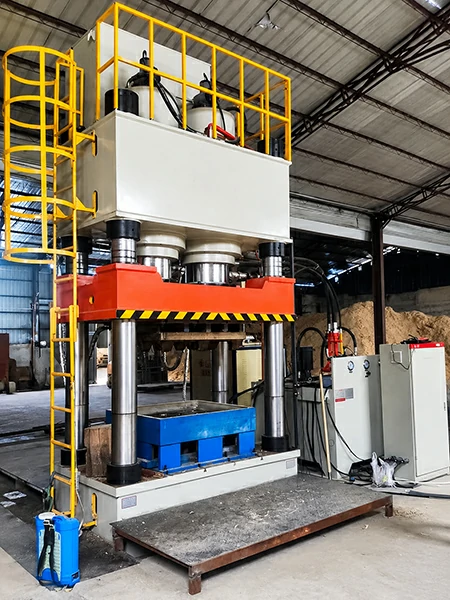
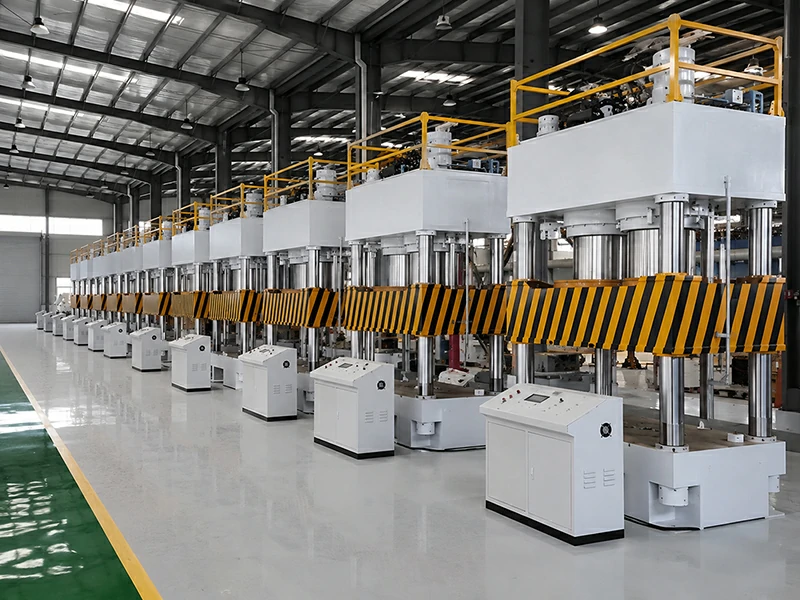
The press platform is a three-beam four-column hydraulic press of the Y32 type, with top beam, slide and worktable as the three beams and four solid columns carrying both guidance and frame locking. Y-1250, Y-1600, Y-2000 and Y-2500 cover 12500 to 25000 kN main cylinder force, with effective table sizes from 1700 by 1400 mm up to 2500 by 1700 mm, slide strokes of 700 to 900 mm and servo motors of 55 to 75 kW, so a recycler can match the first press to the waste wood throughput it handles today and add capacity later instead of buying a plant sized for tonnage it does not have. Published cycle figures are about 3 to 5 minutes per pallet at one caliber and 180 to 240 seconds at another. Mold changes are what switch the same press between nine-leg, grid base, Japanese and stringer pallet types, and a larger table can run pallets smaller than the table itself. The two photographs on this page show what the buyer is actually specifying: the guide pillars, safety railing and separate hydraulic power unit on the machine, and the line arrangement of four-column presses with guards and independent control cabinets.
What the plant gets: an offtake that runs when the boiler does not
Once the line runs, Grade A and Grade C wood leaves the gate as finished molded pallets instead of fuel-grade chip. A molded pallet is a one-piece hot pressed wood product, so it is nail free and splinter free and it sits outside the ISPM-15 heat treatment and fumigation route that applies to solid wood packaging, which is what export buyers pay for. Reference load data for a 1200 by 1000 mm molded pallet is a 2000 kg dynamic load and an 8000 kg static load at about 12 kg, and the pallets nest at roughly four to one, which cuts empty return volume and warehouse space. Material that used to be refused by a terminal now has a second use inside the plant, and end-of-life molded pallets can be crushed and re-fed. What the plant still owns is floor area, clear height, connected electrical capacity, the drying and glue stages ahead of the press, and the sales work of finding pallet buyers instead of one chip buyer.
- Tonnage, table size, stroke and motor figures are taken from the published Y-1250 to Y-2500 parameter table for this product.
- Cycle time is quoted from both published calibers, about 3 to 5 minutes per pallet and 180 to 240 seconds, and no single figure is presented as the only one.
- The line stages stated are crushing to 5 mm and finer, drying at about 150 to 180 degrees Celsius to 8 to 12 percent moisture, and MDI adhesive mixing; no drying or crushing performance is claimed for the press body itself.
- No double station press, wood plastic composite pallet machine or wood pallet nailing machine capability is claimed.


