Particleboard and MDF chip preparation
A Panel Plant Intake Is a Mixed Stream, Not a Log Yard
A panel plant intake is not one material. Small-diameter logs, slab wood, edgings, sawdust, shavings and offcuts arrive on the same yard, and the mix carries nails, staples, wire and grit. This page follows that intake through the first cutting stage on a drum wood chipper machine: the X-215, X-216 and X-218 drum type wood chipper at 45, 55 and 110 kW, covering 4 to 5, 6 to 8 and 8 to 12 tonnes per hour and cutting a first-stage chip of roughly 30 to 35 mm for the flaking stage that actually makes the board-core particle. Two boundaries are stated plainly. The published Shred parameter table lists no metal separation device, so nail and stone bearing material has to pass upstream magnetic separation and destoning before the knives, and the chipper does not produce the finished particle, it feeds the stage that does.
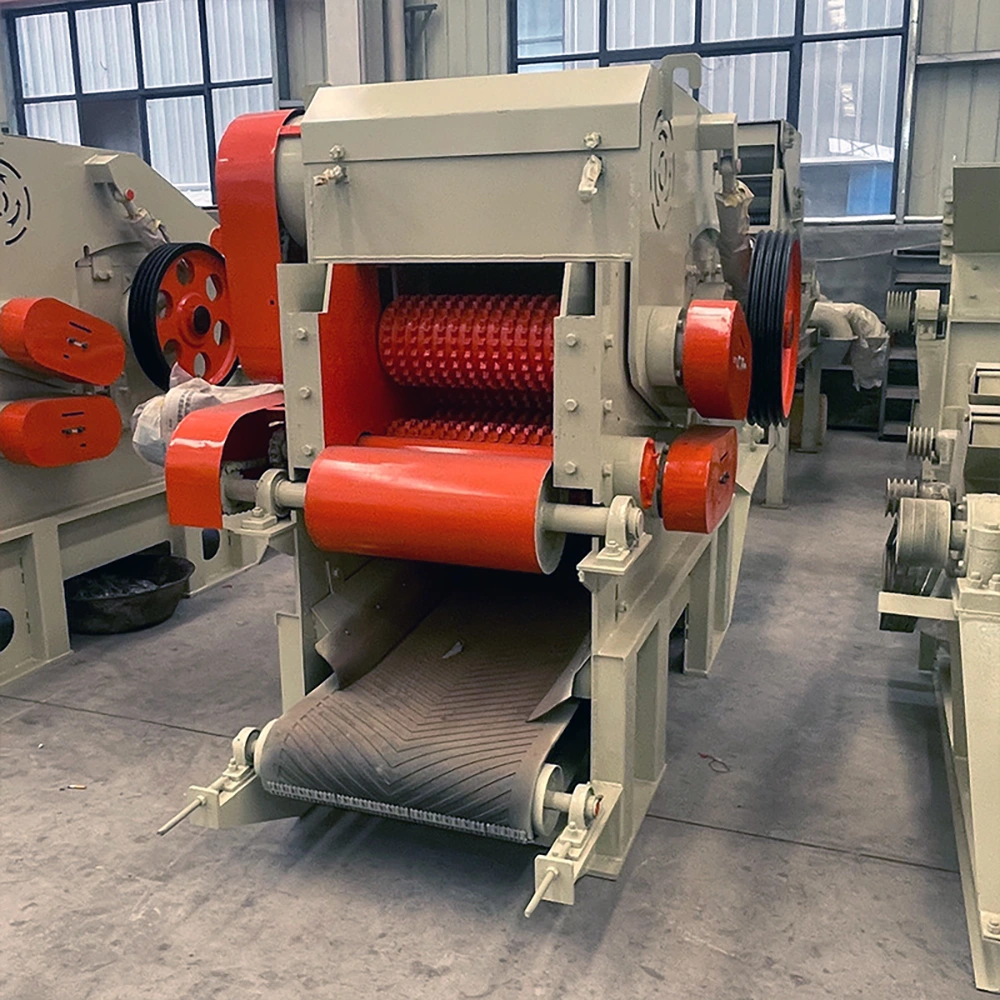
Where an Unstable First Cut Shows Up in the Finished Board
Three arrangements are common before a plant commissions its own chipping stage, and each one moves the problem rather than removing it. Plants that buy chips on the spot market inherit whatever length distribution and contamination profile the supplier sold that week, with no intake record behind it. Plants running a disc chipper on mixed and irregular material fight a geometry that wants a fairly consistent piece fed against a rotating disc, and the result on slab wood, crotches and knotty offcuts is a wider length spread. Plants with only a hammer mill ahead of drying lose the staged reduction entirely, so the mill absorbs every geometry variation in the stream and the finished ton carries more fines and more power. In all three cases the visible failure is downstream. The flaking stage runs on an uncontrolled infeed, the dryer sees uneven particle moisture, and the press turns that scatter into density variation across the mat, weaker internal bond and a surface that needs heavier sanding to reach spec.
Why Drum Cutting Geometry Suits Irregular, Knot-Bearing, Mixed Feedstock
A drum type wood chipper cuts with a horizontal knife roller carrying bolt-fixed fly knives against a counter knife, while hydraulic feed rollers hold the material and push it into the cutting circle, so chip length is set by knife projection and roller geometry rather than by how the piece happens to be dropped in. That arrangement tolerates a feedstock that arrives as logs one hour and as slab wood, edging and offcuts the next, and it keeps knots and irregular cross sections in the cut instead of rejecting them back out of the infeed. Behind the knife roller sits a chip screen inside the housing: material that reaches the aperture leaves on the discharge conveyor, oversized pieces stay in the machine and are cut again, which is what holds an output window rather than an average. For a panel plant the value is not throughput on its own, it is that a defined first-stage chip of roughly 30 to 35 mm reaches the next stage, so the downstream equipment sizes a chip and not a mixed stream. Blade grade, hardness and knife life are not published for this platform, so no replacement interval is quoted here.
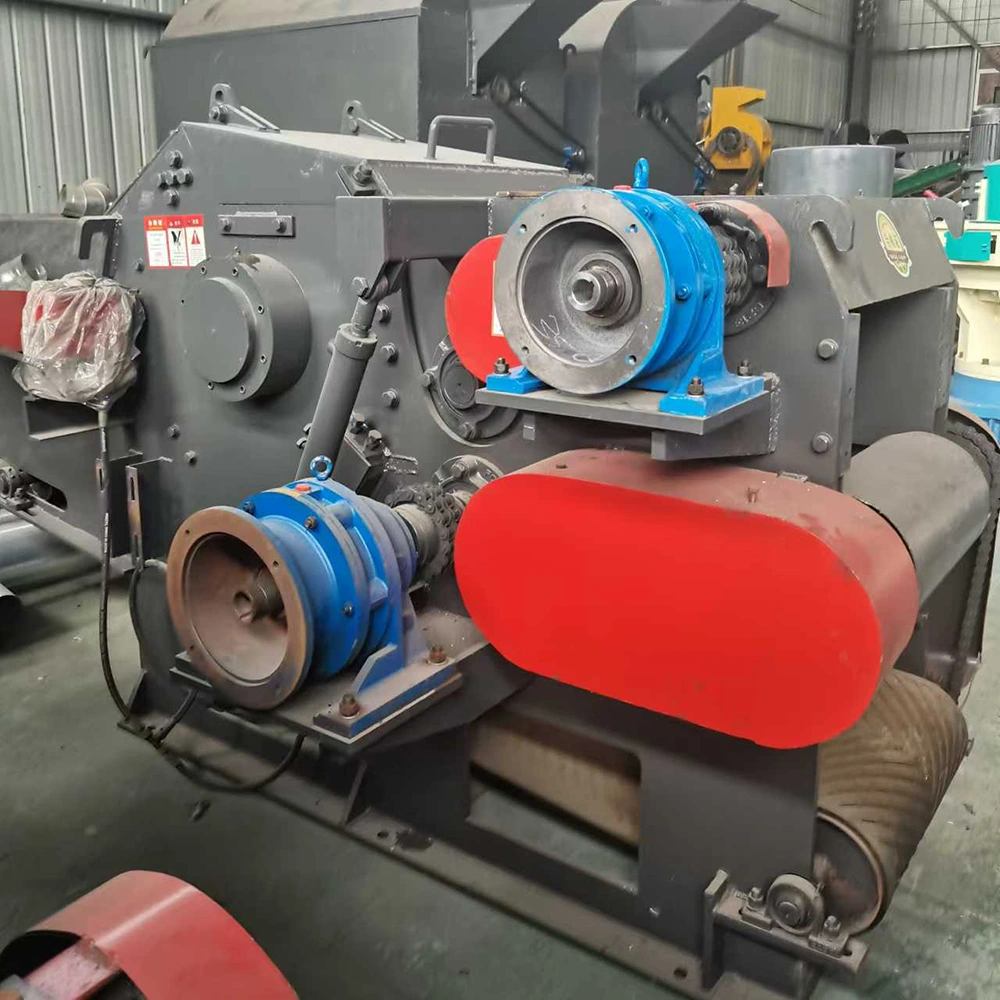
Tiers, Structures and the Upstream Stage You Own
EMP builds the Shred platform in three tiers on published figures. X-215 runs a 45 kW main motor at 4 to 5 tonnes per hour with a 400 by 180 mm feed inlet and 160 mm maximum feed diameter. X-216 runs 55 kW at 6 to 8 tonnes per hour with a 540 by 240 mm inlet and 200 mm maximum feed diameter. X-218 runs 110 kW at 8 to 12 tonnes per hour with a 680 by 310 mm inlet and 300 mm maximum feed diameter. Each tier cuts to a chip of about 35 mm, runs on 380 V supply, uses hydraulic feeding with chain-driven feed rollers, and gives a hinged cover for knife and knife gap access. Two limits belong in the same sentence as the specification. First, the published Shred parameter table lists no metal separation device, so nails, staples and stone in the intake have to be removed upstream by magnetic separation and destoning before the feed rollers, and the machine is not sold as a machine that eats metal or rock. Second, the chipper delivers the first-stage chip only; the board-core particle is produced by the downstream flaking stage, and the two run in series. With those boundaries respected, the plant stops buying chip quality by the truckload and starts owning its intake, its particle length window and the density, surface and bond strength that follow from them.
- Image provenance: both source paths resolve inside the resolved Shred designer gallery (/data/hot/vault/设计师图片库/Shred/) and neither file had been used in an earlier Shred post.
- Published figures only: 45/55/110 kW, 4-5/6-8/8-12 t/h, 400×180 / 540×240 / 680×310 mm feed inlets, 160/200/300 mm maximum feed diameter, about 35 mm chip, 380 V, hydraulic feeding, chip screen recirculation.
- Honest boundary carried in the copy: no metal separation device is listed in the Shred parameter table, nail and stone bearing material must be magnetically separated and destoned upstream, and the final board-core particle is made downstream on the flaking stage.
- Language check: no banned weak words (high quality, best solution, one-stop solution, advanced technology, reliable product, most efficient) and no claim that the chipper itself processes metal or stone.


