Molded Pallet Equipment Supply
The Buyer Whose Expansion Decision Is Stuck at the Equipment End
A wood pallet hydraulic press is not hard to want and it is hard to buy. Pallet plants that already run molded output, and traditional nailed-pallet plants trying to enter the molded category, both hit the same three gates on the equipment side: European turnkey lines sit above the plant's capex band, the supplier list is short, and an oversized press frame has to cross an ocean before it can make a single pallet. This page follows that buying problem onto the Y32 three-beam four-column platform at 1250 to 2500 ton, explains why a machine that knocks down into container-loadable pieces is a structural requirement rather than a finish detail, and sets out the staged route from a first trial line to a copied second line.
Why a Monolithic Press Frame Turns a Simple Expansion Into a Shipping Project
The usual answer in the category is a welded whole-frame press. It is a legitimate machine, but it fixes the port of departure and the port of arrival at the same time: the frame leaves as one oversized, overweight piece, which means flat-rack or break-bulk planning, special inland haulage at both ends, a crane on site on the day the truck arrives, and a schedule that moves whenever a vessel moves. For a plant that wants to add one line this season and a second one after the first one is proven, that structure hands the delivery timetable to a shipping calendar. The other half of the problem is commercial: the tier of supplier that only sells a complete plant as one indivisible package leaves the buyer with no way to stage, and no way to compare, because the price is never published as a scope. The decision gets made for the buyer by freight and financing rather than by the pallet the plant intends to sell.
Why the Y32 Three-Beam Four-Column Structure Is Chosen, Not Preferred
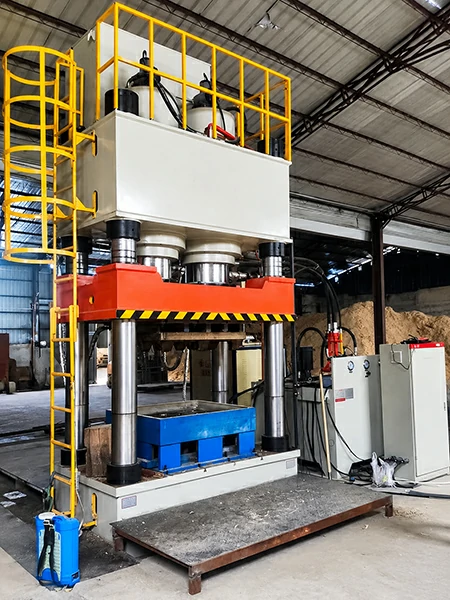
EMP builds the molded pallet press on a Y32 three-beam four-column structure: a top beam, a slide and a worktable, carried on four solid columns that double as the guide and the locked body of the machine. That is exactly why it can be broken into shippable pieces, loaded into standard containers, and re-assembled and aligned at the plant rather than arriving as one un-shippable mass. The columns guide the slide, so the frame geometry is re-established on site with the machine's own alignment references, and the top beam carries the hydraulic station on its back. The four tonnage tiers cover different capacity bands on one platform: the Y-1250, Y-1600, Y-2000 and Y-2500 hydraulic press at 12500, 16000, 20000 and 25000 kN, with motor power from 55 kW to 75 kW, slide stroke from 700 mm to 900 mm, daylight from 1200 mm to 1600 mm, and a worktable that reaches 2500 x 1700 mm on the largest tier. System working pressure is 25 MPa, working speed across the range is 5 to 10 mm per second, and each closing forms one finished molded pallet in a single heated press cycle, with the platens running the hot press window at 150 to 180 C and 15 to 20 MPa for a 180 to 240 second cycle. The boundary is stated the same way it is stated on the product page: this machine is not sold as a stand-alone unit. Crushing to about 5 mm particle size, drying to 8 to 12 percent moisture, and even MDI adhesive mixing all have to be in place upstream, because a press fed outside that window forms rejects, not pallets. Choosing this structure is therefore an engineering decision about delivery, not a preference about how the machine looks.
What the Photographs Show and What the Staged Route Delivers
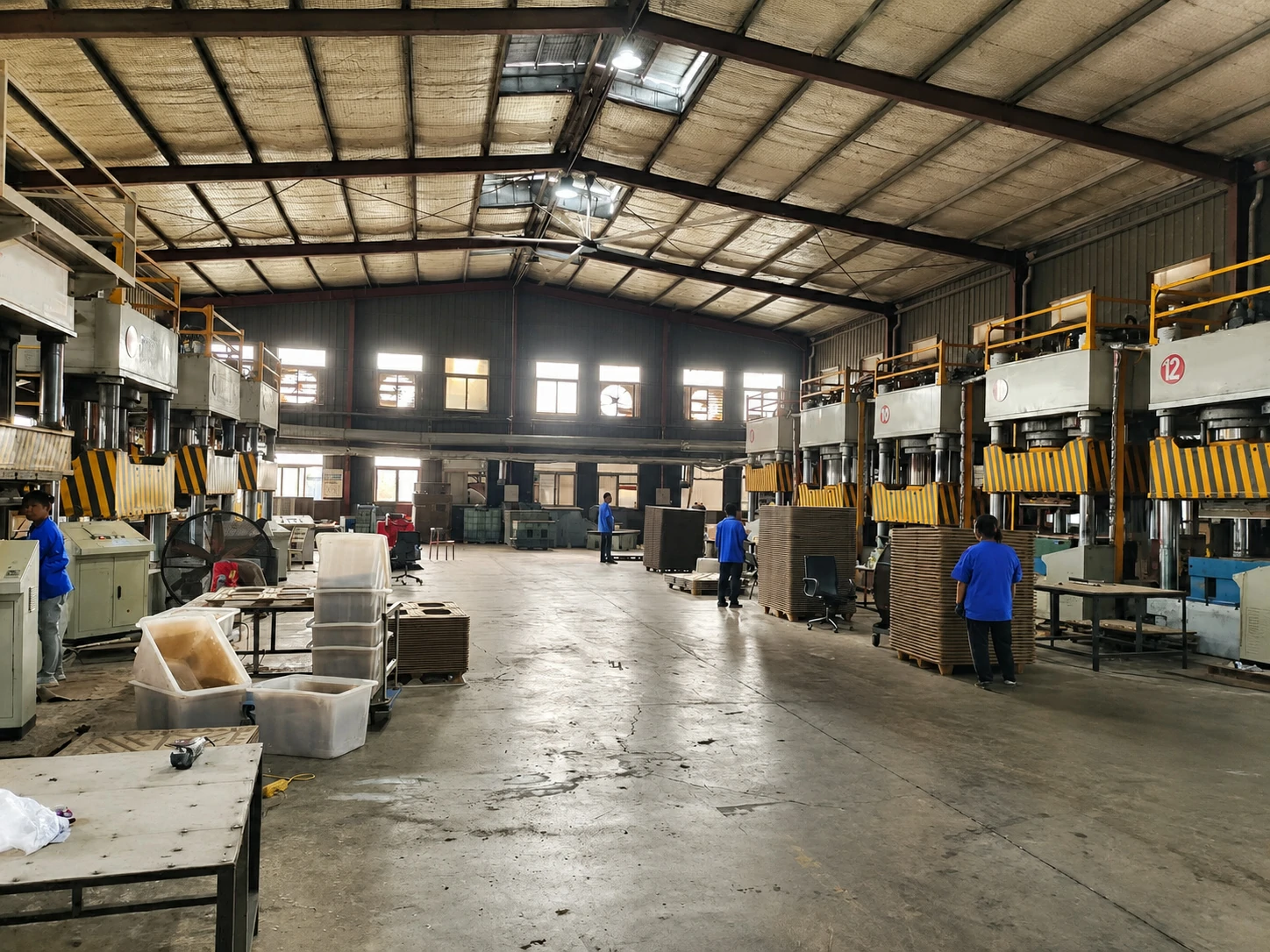
The two photographs on this page are the plain evidence for that argument. The first shows a single heavy four-column machine with its top-mounted hydraulic cylinder, red cross beam and four chrome guide pillars, wrapped by yellow safety railings with an access ladder and an independent hydraulic power unit and control cabinet standing beside it. The second shows a production floor where the same press station repeats in a row, each unit with its own safety guard and its own control cabinet, which is what a plant buying capacity line by line actually ends up with. What that delivers at the end of the route is a capacity plan the plant controls: the first line is bought, installed, commissioned and proven on one tonnage tier, and the next line copies the first one with the same structure, the same mold interface and the same settings, instead of a single irreversible capital event. The price band sits below the European turnkey tier, EMP runs its own molded pallet factory so the equipment has output behind it rather than a specification sheet alone, and turnkey installation and commissioning are part of the delivery, so ocean transport and site assembly both land inside one contract. Send the pallet size, the density and the target output per shift, and the tonnage tier and platen can be matched to the line before the first container is booked.
- Title, SEO title, slug, H1, first-screen summary and both image alt texts all carry the exact phrase wood pallet hydraulic press.
- Body follows customer and scene, then the old whole-frame and single-supplier problem, then the Y32 three-beam four-column fit, then structure and parameter evidence with photographs, then the staged capacity result.
- Plain text only in every section body: no HTML tags, attributes, Markdown or angle brackets; the renderer owns the paragraph markup and the CTA to /contact/.
- Only MldP facts from the resolved product brief and traffic profile are used: Y-1250 to Y-2500 ton tiers at 25 MPa and 55 to 75 kW, 2500 x 1700 mm maximum platen, the 150 to 180 C hot press window with 8 to 12 percent moisture and about 5 mm particle size stated as an upstream boundary, and the press is not sold as a stand-alone machine.


