Molded Pallet Production Line – Capacity Expansion Gate
The Expansion Decision That Stalls at the Equipment Gate
A wood pallet hydraulic press is the one stage a molded pallet plant cannot buy around, and it is also where expansion stalls: a European turnkey plant sits above the capex band of a regional pallet manufacturer, the supplier shortlist is short, and a welded one-piece frame turns one added line of capacity into an oversized cargo project. This page follows an operating molded pallet plant adding capacity, and a traditional nailed pallet plant entering the molded category, onto the Y32 three-beam four-column platform at 1250 to 2500 ton, where the top beam, slide and worktable carried on four solid columns can be separated into container-shippable pieces and re-assembled on site, and where the same tonnage tier can be repeated line by line once the first line proves the process. The upstream boundary is stated plainly: crushing to about 5 mm, drying to 8 to 12 percent moisture and even MDI adhesive mixing have to be in place before the press forms anything, and the press is not sold as a stand-alone machine.
What the Old Route Costs When Capacity Has to Grow
The old route takes two shapes and both cost more than the tonnage they add. The first is to buy the whole thing at once: one oversized turnkey pallet plant from a European brand, one approval, one lump of capex, a one-piece welded frame that cannot be separated for the crossing, and a commissioning window long enough that the plant carries fixed cost while nothing ships. The second is to stay where the plant already is, on traditional nailed wooden pallet lines, and keep buying capacity with labour, board sorting and heat-treated wooden pallet compliance, which never becomes fumigation-free and never becomes nestable. A third shape catches buyers who try to save money on the machine itself: a general four-column hydraulic press is not a pallet press, it has no pallet mold, no heated platen and no pallet cycle, so the saving is spent again on the second purchase. All three routes share one weakness. The plant cannot grow in steps, because the frame, the freight and the process have been bought as a single indivisible block.
Why the Y32 Three-Beam Four-Column Platform Is the Fit
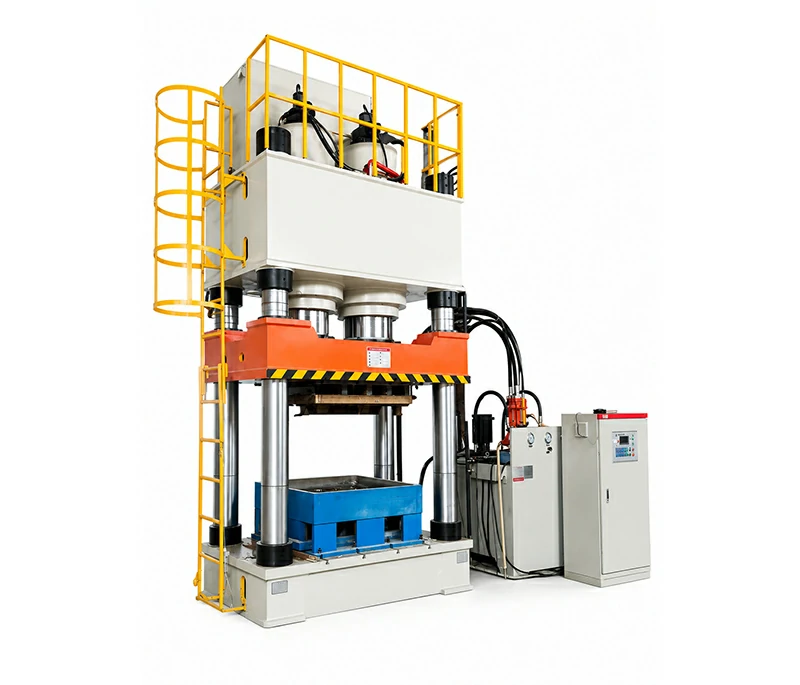
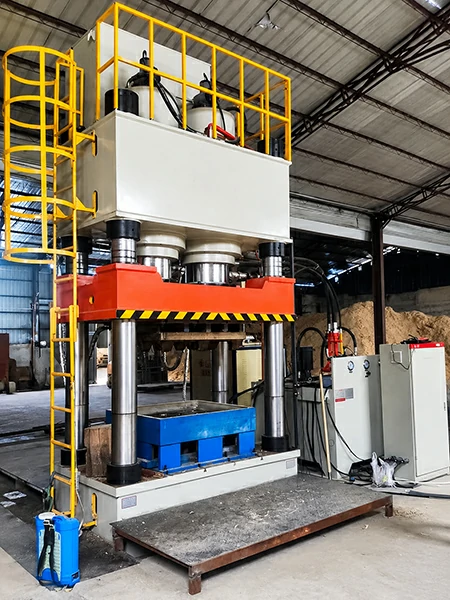
The Y32 three-beam four-column platform is where this buying problem gets a structural answer. Three beams means a top beam, a slide that travels and a worktable, and four columns means four solid round columns at the corners that act as the guideways and, locked with nuts, close the frame into one rigid body. The tiering covers the capacity question without a custom build: Y-1250, Y-1600, Y-2000 and Y-2500, meaning a 1250 ton hydraulic press up to a 2500 ton hydraulic press, with slide strokes from 700 to 900 mm, servo motors from 55 to 75 kW and effective platen sizes from 1700 x 1400 mm up to 2500 x 1700 mm. Hot press molding runs at 150 to 180 C and forms one finished molded pallet per cycle, at a molded pallet density of about 900 kg per cubic metre, and a die change moves the same machine onto nine-leg, grid base, Japanese or Sichuan pallet styles, with a large platen able to run a smaller pallet size below its own table. The structural reason EMP works on this frame rather than a welded whole is delivery. Top beam, slide, worktable, columns and cylinders can be separated into pieces that go into containers on a container shipping pallet plan, then re-assembled and aligned at the plant, which is how one line of added capacity stops being an oversized cargo project. The two images on this page show the same argument twice: the whole machine on a white background, where the top beam, the four solid columns, the slide and the worktable are visible as separate structural members, and the same frame installed on a factory floor with its guide pillars, hydraulic power unit, control cabinet and safety railings, at the point where installation and commissioning begin. The platform also carries an equipment and pallet double identity, because EMP runs its own molded pallet factory on the same machines, so a buyer can look at a working molded pallet production line rather than a photograph, and servo energy saving of 25 to 55 percent, noise under 80 dB and remote 4G diagnostics are published as claimed figures rather than third-party tested ones.
What the Plant Owns Once the First Line Runs
Once the first line runs, the plant owns a process rather than a machine. Output is a nestable pallet that stacks about four to one, so empty returns and warehouse pallet storage cost a fraction of a fixed-deck pallet, and the one-piece molded shape has no nails and no splinters, which is what food, pharmaceutical and electronics packaging lines ask for. Because the pallet is a hot pressed engineered wood product rather than solid wood packaging, it is exempt from ISPM-15, so the heat treatment, fumigation and IPPC marking spend becomes a one-time equipment investment, and the same pallet works as an export pallet, a shipping pallet, a container shipping pallet, a racking pallet and a forklift pallet on the customer list the plant already has. The expansion path is the part the supply side usually blocks: the plant proves one tier, then copies the same tier as orders grow, moving from a semi-automatic pallet production line to a fully automatic pallet production line on the same process platform instead of re-buying the plant. The limits are stated before the order, not after. Crushing to about 5 mm, drying at 150 to 180 C to 8 to 12 percent moisture and even MDI adhesive mixing have to be in place, because the press is not sold as a stand-alone machine. On the sizing side, the published screen points to annual demand above 30,000 pallets, a plant of about 600 square metres, 6 m of clear height for the mold and 200 kW of available power; below roughly 10,000 pallets a year, buying finished pallets stays cheaper than buying a line. Above that line, the capacity question stops being a supplier question.
- Title, SEO title, slug, H1, first-screen summary and both image alt texts all carry the phrase wood pallet hydraulic press.
- Title and slug checked against the live news category and set apart from the existing wood pallet hydraulic press posts; no duplicate title.
- Facts held to the product brief: Y32 three-beam four-column structure, 1250 to 2500 ton tiers, platen up to 2500 x 1700 mm, 150 to 180 C hot press molding, 8 to 12 percent moisture, about 5 mm particle size.
- Boundary stated: crushing, drying and MDI adhesive mixing precede the press, and the press is not sold as a stand-alone machine.


