Dryr Rotary Sawdust Dryer
Start With the Customer, Not the Machine: A 1 to 2 tph Line Whose Energy Bill Sits in the Drying Stage
Drying is the single largest energy line on a biomass pellet line, and on a 1 to 2 tph plant it is often quoted at around 70 percent of total pelletizing energy. That number is decided at one machine, not at the pellet mill: a rotary sawdust dryer that is asked to pull 35 to 60 percent wet wood down to the 10 to 15 percent band the press needs. The usual answer on site is to push furnace temperature up. This page sets out why residence time, a sealed drum and stable temperature feedback move kWh per tonne further than a hotter furnace does, what the DRYR H-1010 to H-1815 ladder covers at 0.8 to 2 t/h, and why a drum built out to 17 to 18 m is the lever that actually holds output moisture on high-moisture recycled wood.
The Old Answer on Site Is a Hotter Furnace, and It Stops Paying Back
When output moisture runs high, the quickest lever an operator has is more heat: raise the furnace setting and hope the drum keeps up. Three things go wrong. First, sawdust ignition temperature is commonly quoted at or below 280 degrees Celsius, so the margin between a working drum and a scorched or smouldering load shrinks exactly when the operator needs it. Second, a short drum gives the wet material less time in contact with hot gas, so wetter feed simply leaves wetter, and the mill downstream pays for it with roller slip, blinded die holes and re-feed tonnage. Third, open drum ends and an unsealed inlet chute pull cold air in and leak fines and odour out, so heat paid for at the burner is spent heating the yard. Sun drying is the other old answer, and a wet season removes it.
What DRYR Changes: Temperature Sensing, Uniform Vibration and a Sealed Drum Instead of More Flame
DRYR is a rotary sawdust dryer built around three controls rather than one furnace setting. Temperature sensing follows the drum so the working band is a measured number, not a guess from a hand-squeeze sample. Uniform vibration keeps material coming off the lifting plates as a consistent curtain, so the same residence time is applied to every particle instead of to a sliding pile. The sealed drum and inlet chute close the drying envelope, which means paid-for heat stays inside the drum and the cyclone dust collector at the discharge carries the exhaust rather than the machine bay. Hot air is raised in a refractory lined combustion chamber, and the multi-fuel sawdust dryer furnace runs on coal, oil, gas, or on-site biomass solids and pellets, so the plant is not locked to one fuel market. Self-insulation holds quoted thermal efficiency above 80 percent, and coal consumption is quoted at under 8 kg per tonne dried, on a stated basis.
Residence Time as the Design Variable: H-1010 to H-1815, a Drum Out to 17 to 18 m, and What the Line Gets Back
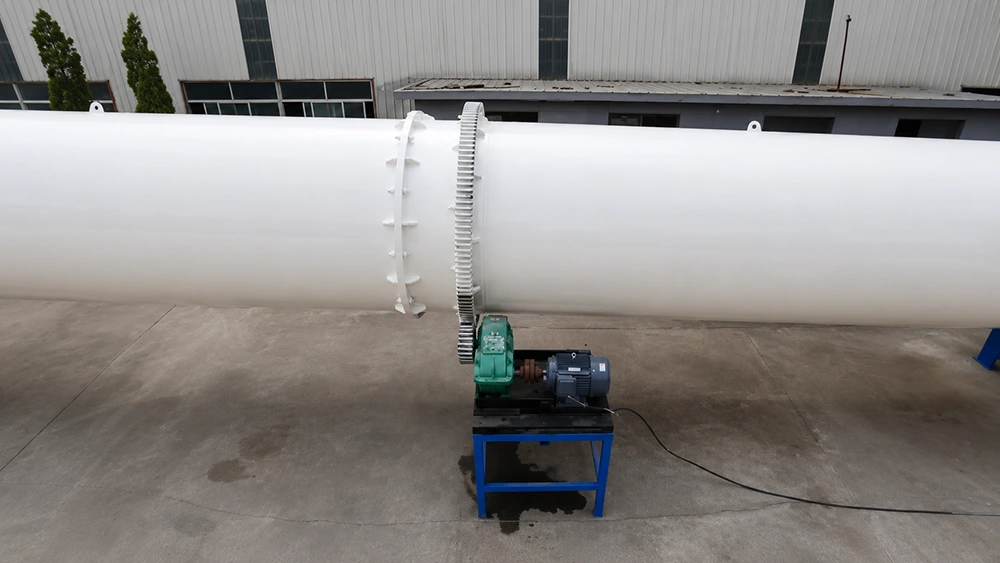
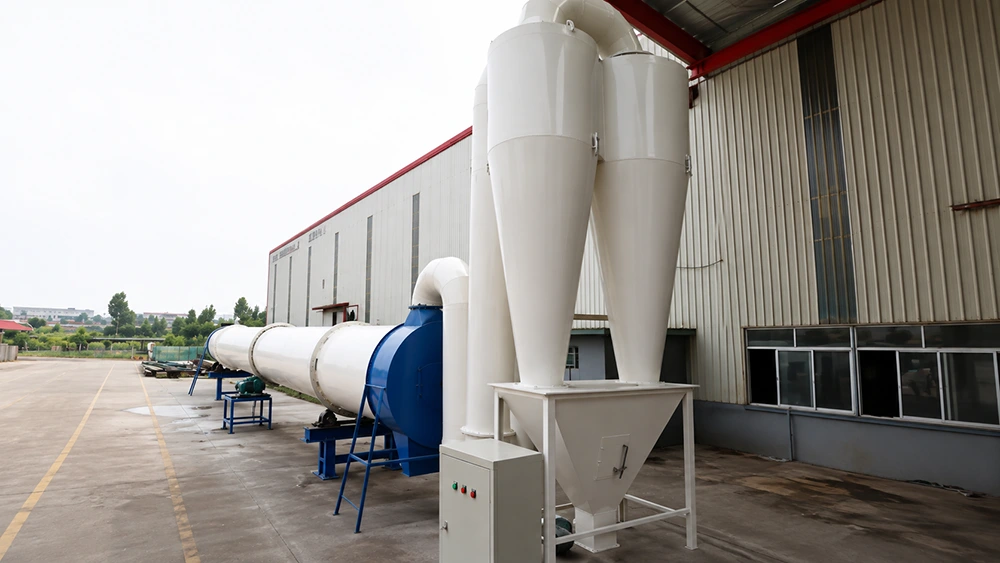
On an industrial sawdust dryer, water removal is a product of contact time and hot gas volume, so the honest lever on high-moisture recycled wood is drum length, not flame. The platform runs four tiers: H-1010 on a 1000 mm drum at 4 kW main and 7.5 kW induced draft fan for 0.8 to 1 t/h, H-1212 at 5.5 kW and 7.5 kW for 1 to 1.2 t/h, H-1512 at 7.5 kW and 11 kW for 1.2 to 1.5 t/h, and H-1815 on an 1800 mm drum at 11 kW and 15 kW for 1.5 to 2 t/h. Drum internal hot air is quoted at 200 to 500 degrees Celsius and output moisture below 10 percent. Where the feed is wetter than a standard drum can hold, the drum is built out to 17 to 18 m in bolted flange sections, assembled on site, and the extra length buys residence time. The photographs show the two halves of that claim: the external girth gear, pinion, gearbox and motor on the blue base frame that turn a long drum at controlled speed, and the twin cyclone separators with conical hoppers that keep the sealed system exhausting clean. The result a plant is buying is a discharge moisture that holds inside the pelletizing or molding band shift after shift, fewer mill stops from wet feed, and fuel spent on evaporation instead of on cold air. Limits are stated plainly: the quotes above carry no published test conditions, drum length is a project-confirmed build rather than a catalogue default, and final tonnage and moisture move with species, initial moisture, particle size, fuel and site conditions, so each project is sized on its own sampling.
- No HTML tags, attributes or Markdown appear in any section body; the renderer owns all paragraph markup.
- Energy-share, moisture, temperature, drum-length, efficiency and fuel figures are attributed to the quoted product or industry basis and are not presented as verified third-party test results.
- Both images come from the resolved Dryr designer gallery only, with honest alt text covering the girth gear drive and the twin cyclone separators.
- The body carries the emp-section root markers, one primary call to action to the contact page, and no H1 because the Neve template owns it.