Rotary sawdust dryer, pellet line pre-treatment
Where the Wet Tonnage Comes From Before the Pellet Mill Sees It
A biomass pellet plant or a boiler fuel line prices its mill, its die and its kWh per ton on one input it does not control: the moisture in the wood it is fed, which on recycled timber, yard waste and monsoon stock runs 35 to 60 percent against a mill that wants 10 to 15. The consequences are physical, not commercial. The pellet mill overloads, the roller slips instead of compacting, die holes blind over with wet mash, the press gets cleaned instead of run, pellet density drops and pellets crack at the cooler. This page follows the DRYR sawdust dryer for pellet production stage: continuous hot air drying with temperature sensing, uniform vibration and a sealed drum and inlet chute, an H-1010 to H-1815 ladder at 0.8 to 2 t/h, a drum quoted at 200 to 500 degrees Celsius internal hot air with output moisture below 10 percent, and a drum built out to 17 to 18 m in bolted-flange sections where residence time, not heat, is the constraint.
What Wet Feed Does Downstream: Overload, Roller Slip and the kWh Paid Twice
Feed 35 to 60 percent wood straight to a pellet mill and the failure shows up after the dryer, which is why it is usually blamed on the press. The die is compacting water, so the mill draws more power for the same tonnage, the roller slips on wet mash instead of gripping it, and die holes blind over until the die is pulled and cleaned. Operators answer with steam, extra pressure or a slower feed, and the shift goes into die cleaning and re-feed instead of output. Pellet density falls, and under-dense pellets crack at the cooler and come back as re-feed tonnage. Drying is already the largest single energy item in a pelletizing line, and water a dryer leaves in the material is paid for twice: once as furnace fuel, then again as electricity at a mill working against moisture. Sun drying, a manual drying floor and a small airflow dryer sized on nominal tonnage share one weakness, that none of them is metered, so the mill inherits variance instead of a feed specification.
Why a Rotary Drum Dryer Fits This Feed: Temperature Control, Uniform Vibration, a Sealed Drum
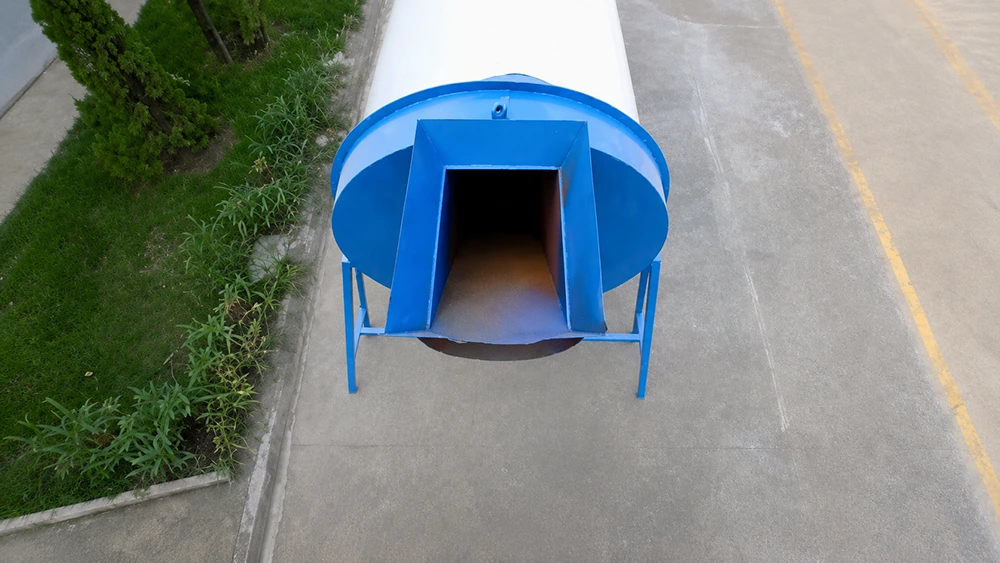
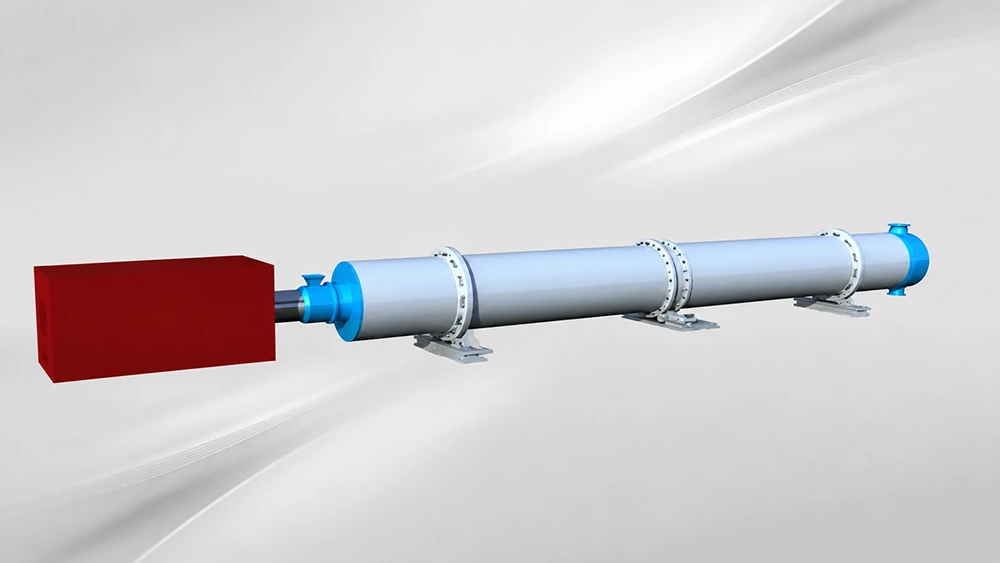
DRYR is a sawdust rotary drum dryer run as a continuous stage. A multi-fuel hot air furnace produces the gas, combined lifting plates lift and drop the material into a curtain that meets the gas stream, and temperature sensing, uniform vibration and a sealed drum with a sealed inlet chute stop the drying condition from drifting with operator attention. The platform runs H-1010, H-1212, H-1512 and H-1815 at 0.8 to 2 t/h on 1000, 1200, 1500 and 1800 mm drums, with 4, 5.5, 7.5 and 11 kW main motors and 7.5, 7.5, 11 and 15 kW induced draft fans, drum internal hot air quoted at 200 to 500 degrees Celsius and output moisture below 10 percent, taken lower where the process asks. The first image is the inlet end, where wet material first meets hot air; the second is a 3D rendering of the bolted-flange drum on its saddle supports, marked as a rendering because it is one. Where 12 m of drum does not give the residence time a raw material needs, the drum is built out to 17 to 18 m, shipped in bolted-flange sections and assembled on site, with a cyclone dust collector, optional baghouse and PLC control on the same frame.
What the Line Gets Back, and Where the Numbers Stop
The line gets back a feed moisture it can size a mill against. Mill overload and die cleaning stop being a shift event, kWh per ton at the press stops paying for water the dryer left in, and re-feed tonnage from cracked pellets comes down. The 17 to 18 m option buys residence time where heat alone will not do it, which is the difference between a dryer specified to the raw material and one bought on nominal tonnage. The same stage serves a sawdust dryer for molded wood pallet line, where MDI or UF glue bonding needs a stable moisture rather than a dry average. The limits are stated plainly: output moisture below 10 percent, under 8 kg of coal per tonne dried and thermal efficiency above 80 percent are product figures quoted without published test conditions, so tonnage and final moisture move with species, initial moisture, particle size, fuel and site conditions, and each project is sized on its own sampling. Where the raw material already sits inside the process window, the line runs without a dryer at all.
- Parameter set used: H-1010, H-1212, H-1512 and H-1815 at 0.8 to 2 t/h on 1000, 1200, 1500 and 1800 mm drums, main motors 4, 5.5, 7.5 and 11 kW, induced draft fans 7.5, 7.5, 11 and 15 kW.
- Drum internal hot air of 200 to 500 degrees Celsius and output moisture below 10 percent are quoted as product figures without published test conditions, and the page states that limit.
- No measured energy percentage is attached to DRYR; drying is described as the largest single energy item in a pelletizing line without claiming a site figure.
- Image note: the inlet end image is a site photograph, the bolted-flange drum image is a 3D rendering marked as such and is not used as a test result.