Skip to content
Home » October 20, 2026

October 20, 2026

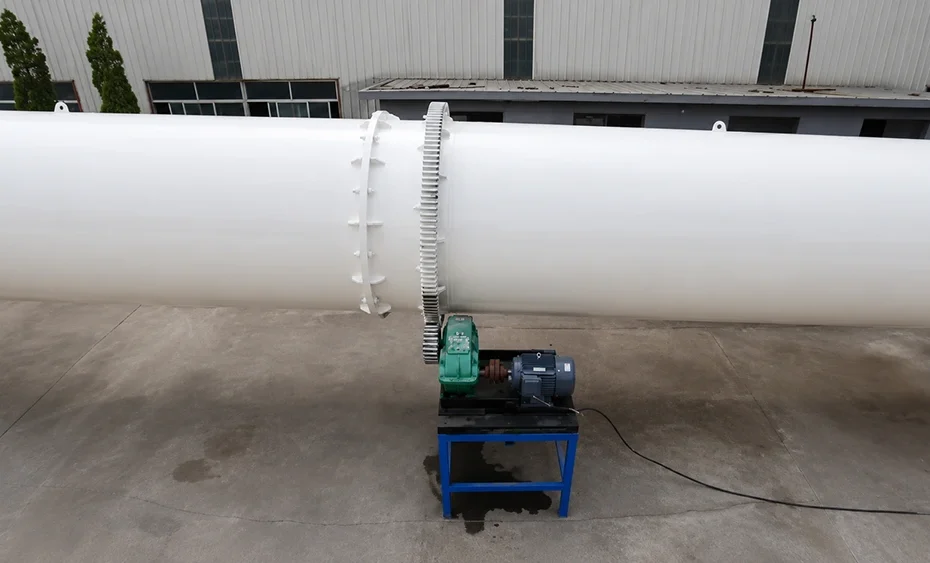
White horizontal rotary drum dryer with external girth gear, pinion drive, gearbox, and electric motor

Industrial Sawdust Dryer as an EPC Line Item: Standardized Drum Build, Assembled Structure and Optional PLC Control That Keep After-Sales Risk Off the Integrator

  •  

An EPC contractor signs one after-sales number for a whole pellet, briquette or molded pallet line, including the drying stage it did not design, and the complaints that reach an integrator are rarely about capacity: equipment wearing faster than the maintenance plan assumed, an electrical load and interlock map that does not match the panel drawings, and a layout that makes an operator walk around the machine to reach a grease point. This page follows the DRYR industrial sawdust dryer through that exposure, from the yard-welded drum whose roundness is set by a welder’s hand, through a factory-assembled shell with machined flange fit and girth gear concentricity, bolted flange sections that re-assemble to the works geometry, a compact structure that holds plot area and civil foundation down against a comparable machine of the same duty, and optional PLC control that puts feed rate, hot air furnace and induced draft fan on one signal chain. Four tiers run H-1010 to H-1815 on 1000, 1200, 1500 and 1800 mm drums at 0.8 to 2 t/h with 4, 5.5, 7.5 and 11 kW main motors and 7.5, 7.5, 11 and 15 kW induced draft fans, drum internal hot air quoted at 200 to 500 degrees Celsius, output moisture stated under 10 percent, self-insulation above 80 percent thermal efficiency with under 8 kg of coal per tonne dried, a refractory brick lined multi-fuel furnace and a sealed drum with combined lifting plates and temperature sensing. Limits are stated plainly: those figures carry no published test conditions, tonnage and final moisture move with species, initial moisture, particle size, fuel and climate, wear part life, foundation loads and the electrical schedule are confirmed per project, and the bolted flange view is a 3D rendering rather than field evidence.
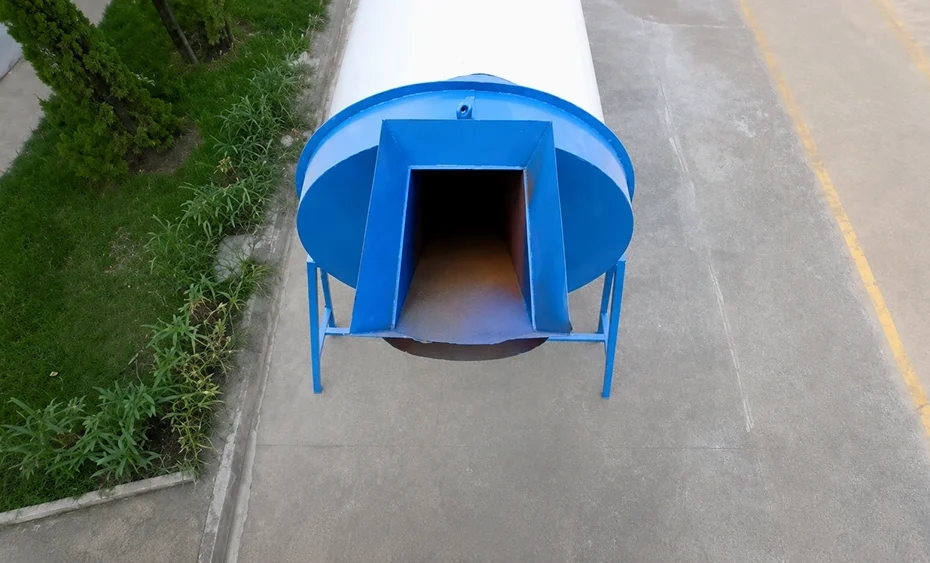
Industrial sawdust dryer front end with rectangular inlet chute, curved guard panels and steel support legs on an assembled drying module

Sawdust Dryer Spec-In for EPC Contractors: 0.8 to 2 t/h Modular Drying Modules That Scale a 1 to 20 t/h Line

  •  

An EPC contractor quoting molded pallet, pellet and charcoal lines anywhere from 1 t/h to 20 t/h cannot carry a bespoke drum from job to job, and the drying stage is the module that decides whether it can. This page follows the DRYR sawdust dryer as a standardized modular sawdust dryer for EPC projects: H-1010 to H-1815 covering 0.8 to 2 t/h on 1000, 1200, 1500 and 1800 mm drums with 4, 5.5, 7.5 and 11 kW main motors and 7.5, 7.5, 11 and 15 kW induced draft fans, an assembled structure that bolts into a line already built, drums extended to 17 to 18 m in bolted flange sections where residence time is the constraint, drum internal hot air quoted at 200 to 500 degrees Celsius, output moisture stated below 10 percent, a refractory lined multi-fuel hot air furnace, self-insulation quoted above 80 percent thermal efficiency with under 8 kg of coal per tonne dried, a cyclone dust collector with optional baghouse and PLC control, and about 50 percent less plot footprint and civil foundation investment against comparable models. It is positioned as an OEM or complementary drying module beside an integrator’s own machine rather than a replacement. Limits are stated plainly: those figures carry no published test conditions, so tonnage and final moisture move with species, initial moisture, particle size, fuel and climate, section count and foundation loads are confirmed per project, and the drum cutaway view is an engineering rendering rather than field evidence.
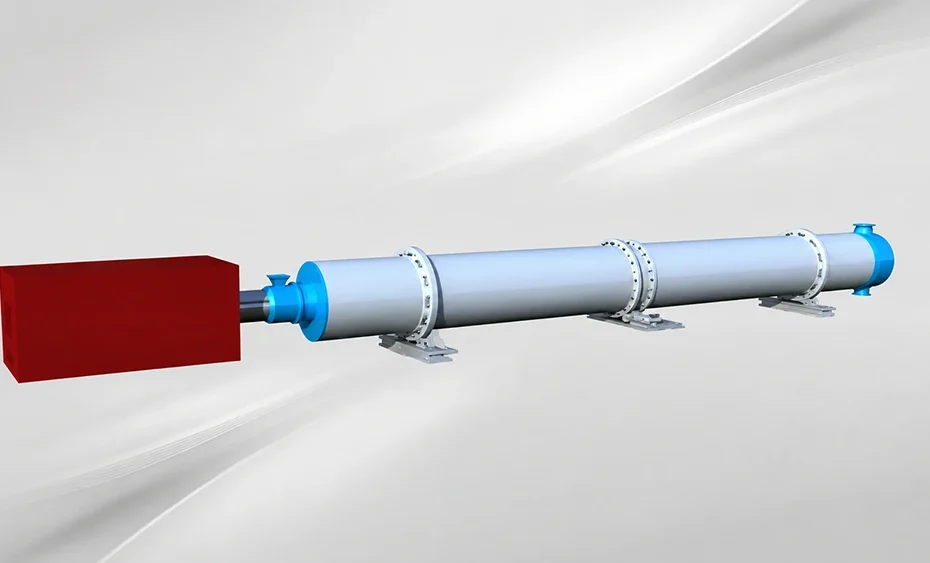
3D rendered horizontal tube dryer with drive motor, bolted flanges, end housings, and support saddles

Sawdust Dryer for EPC Overseas Projects: Split Shipment, On-Site Assembly and Half the Civil Foundation

  •  

An EPC integrator signs a molded pallet or pellet line in one country and commissions it in another, and the drying stage decides how many of its own crew days the site consumes. This page follows the DRYR sawdust dryer on an overseas deployment: an assembled structure with a drum built to 17 to 18 m in bolted flange sections, shipped split and re-assembled and commissioned on site, against an integral heavy drum over 220 tonnes with a segmented girth gear. It sets out the H-1010 to H-1815 ladder at 0.8 to 2 t/h on 1000, 1200, 1500 and 1800 mm drums with 4, 5.5, 7.5 and 11 kW main motors and 7.5, 7.5, 11 and 15 kW induced draft fans, drum internal hot air quoted at 200 to 500 degrees Celsius, output moisture stated below 10 percent, a multi-fuel furnace, self-insulation above 80 percent thermal efficiency with under 8 kg of coal per tonne dried, a cyclone dust collector with optional baghouse and PLC control, and about 50 percent less plot footprint and civil foundation investment against comparable models. Limits are stated plainly: those figures carry no published test conditions, so tonnage and final moisture move with species, initial moisture, particle size, fuel and climate, the bolted flange view is a 3D rendering, and section count, lifting plan and foundation loads are confirmed per project.

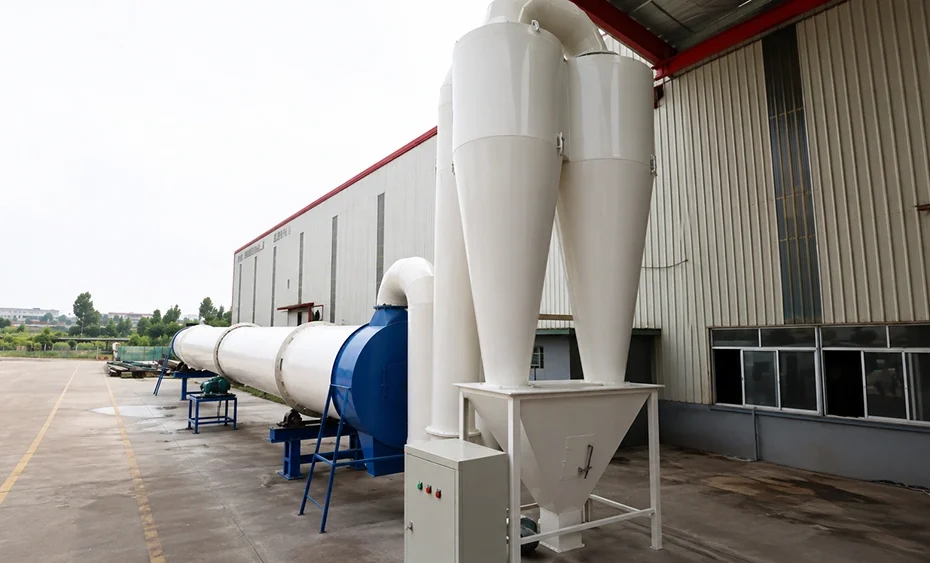
Industrial rotary drum dryer with twin cyclone separators and conical dust collection hopper

Rotary Sawdust Dryer for Southeast Asia Rainy-Season Feedstock: Sizing the Drum to 17–18 m and the Induced Draft Fan to 40–50 Percent Initial Moisture

  •  

Freshly felled residue in Vietnam and across Southeast Asia reaches the yard at 40 to 50 percent initial moisture, and the wet season makes both the moisture and the supply irregular. This page follows one sizing decision on the DRYR rotary sawdust dryer, from that intake problem through sun drying, a small airflow dryer and a short standard drum with a hotter furnace, to a drum scaled out to 17 to 18 metres and an induced draft fan raised a tier after the material is sampled at the customer’s own storage location. Tiers run H-1010 to H-1815 at 0.8 to 2 t/h on 1000, 1200, 1500 and 1800 mm drums with 4, 5.5, 7.5 and 11 kW main motors and 7.5, 7.5, 11 and 15 kW induced draft fans, drum internal hot air quoted at 200 to 500 degrees Celsius, output moisture stated below 10 percent, combined lifting plates with temperature sensing, a sealed drum, self-insulation above 80 percent thermal efficiency with under 8 kg of coal per tonne dried, a multi-fuel hot air furnace, a cyclone dust collector with optional baghouse and PLC control. Limits are stated plainly: those figures carry no published test conditions, so tonnage and final moisture move with species, initial moisture, particle size, fuel and climate, and the cutaway drum view is an engineering rendering rather than field evidence.
Industrial rotary drum dryer with twin cyclone separators and conical dust collection hopper

Industrial Sawdust Dryer Dust Control Scope: Discharge-End Cyclone, Optional Baghouse Filter and Where Spark Detection Stays With the Client’s Fire System

  •  

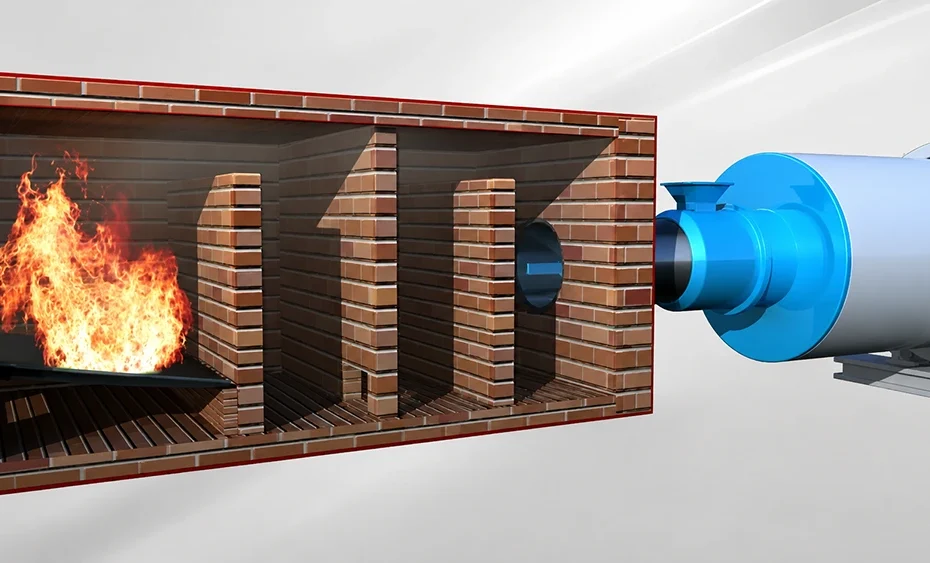
Dust on a pellet or molded pallet line is generated at three stages, and the dust answer is usually split between the machine supplier and the plant fire and environmental package. This page follows the DRYR sawdust dryer through that seam: exhaust routed to a conical cyclone dust collector at the discharge end with a conical collection hopper, expandable to a baghouse filter, a sealed drum and inlet chute with seal condition monitored, and a PLC control cabinet tying feed rate, hot air furnace and induced draft fan together, across H-1010 to H-1815 at 0.8 to 2 t/h on 1000, 1200, 1500 and 1800 mm drums with 4, 5.5, 7.5 and 11 kW main motors and 7.5, 7.5, 11 and 15 kW induced draft fans, drum internal hot air quoted at 200 to 500 degrees Celsius, output moisture stated below 10 percent, self-insulation above 80 percent thermal efficiency and under 8 kg of coal per tonne dried. The boundary is stated plainly: our published data does not claim built-in spark detection or fire suppression, so where an EPC project mandates it that duty is interfaced with the client’s existing fire system or added separately, and the published figures carry no published test conditions.

3D cutaway rendering of a brick-lined industrial drying furnace with burner assembly and internal baffles

Sawdust Dryer Thermal Efficiency and the Fuel Bill: Self-Insulation Above 80 Percent, Under 8 kg of Coal per Tonne, and a Multi-Fuel Furnace Running on the Plant’s Own Biomass

  •  

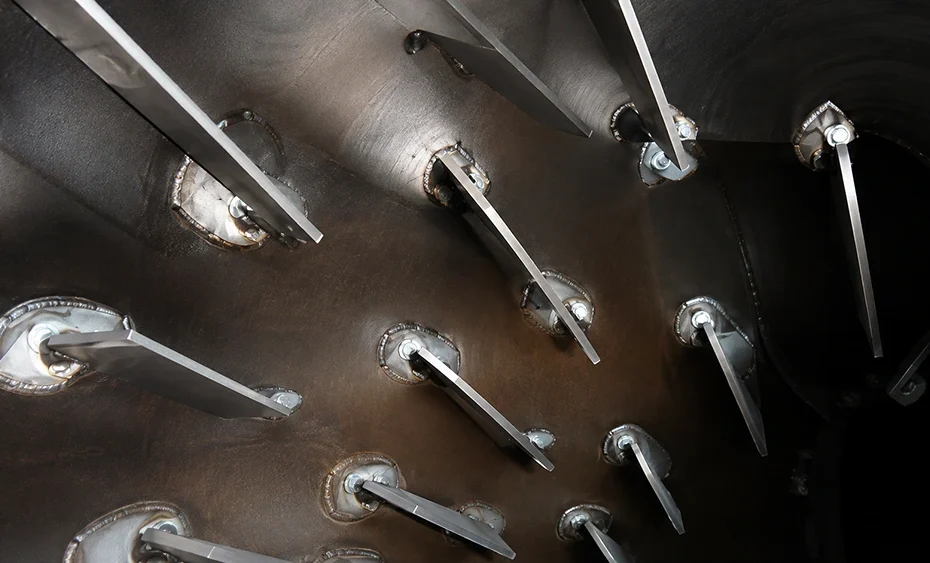
Drying is roughly 70 percent of the energy a pellet line spends, so the sawdust dryer, not the pellet mill, carries the plant’s fuel exposure. This page follows one tropical EPC procurement decision from the monthly fuel bill to the drum: a self-insulation shell quoted above 80 percent thermal efficiency and under 8 kg of coal per tonne of material dried, a refractory brick lined combustion chamber that accepts coal, oil, natural gas and dry solid, granular or powder biomass fuel, combined lifting plates with temperature sensing and a sealed drum, and the H-1010 to H-1815 ladder at 0.8 to 2 t/h on 1000, 1200, 1500 and 1800 mm drums with 4, 5.5, 7.5 and 11 kW main motors and 7.5, 7.5, 11 and 15 kW induced draft fans, drum internal hot air quoted at 200 to 500 degrees Celsius, output moisture stated below 10 percent, and a cyclone dust collector with optional baghouse. Limits are stated plainly: those figures carry no published test conditions, fuel burn and final moisture move with species, initial moisture, particle size, fuel and climate, and the furnace cutaway view is an engineering rendering rather than field evidence.
Combined lifting plates inside a rotary sawdust dryer chamber, staggered paddle bars on welded mounting plates for uniform hot air drying

Sawdust Dryer Moisture Control for Swinging Raw Material: Temperature Sensing, Combined Lifting Plates and Output Under 10 Percent

  •  

Raw material arriving at a different moisture every load is the reason pellet quality varies, and the pellet mill is usually blamed for it. This page follows the DRYR rotary sawdust dryer through that intake problem: temperature sensing monitoring on the drum, combined lifting plates that lift the wet feed into an even curtain for full heat exchange, uniform vibration and a sealed drum and inlet chute, with PLC control tying feed, furnace and induced draft fan to one signal. Output moisture is stated below 10 percent and taken lower to under 7 percent where a molding or pellet process asks, on drum internal hot air quoted at 200 to 500 degrees Celsius. Four tiers cover 0.8 to 2 t/h on 1000, 1200, 1500 and 1800 mm drums with 4, 5.5, 7.5 and 11 kW main motors and 7.5, 7.5, 11 and 15 kW induced draft fans, plus a cyclone dust collector with optional baghouse, self-insulation above 80 percent thermal efficiency and under 8 kg of coal per tonne dried. Limits are stated plainly: those figures carry no published test conditions, so tonnage and final moisture move with species, initial moisture, particle size, fuel and climate.

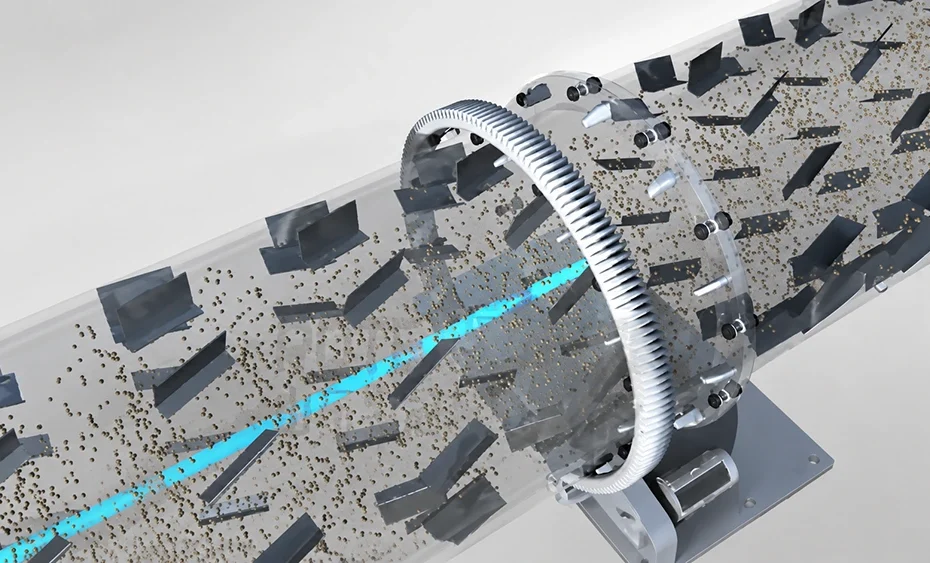
Rotary sawdust dryer drum cutaway rendering with staggered lifting plates, girth ring gear, rollers and drive support base

Sawdust Dryer in an EPC Pellet Line: Matching the 0.8 to 2 t/h Rotary Drum Drying Module to the Mill, Not After the Line Is Built

  •  

An EPC pellet line is one tonnage from pulverizer to press, and the drying stage is the one usually sized last. DRYR sizes the module against the mill: H-1010 to H-1815 at 0.8 to 2 t/h on 1000, 1200, 1500 and 1800 mm drums with 4, 5.5, 7.5 and 11 kW main motors and 7.5, 7.5, 11 and 15 kW induced draft fans, drum internal hot air quoted at 200 to 500 degrees Celsius, output moisture stated below 10 percent, and drums built to 17 to 18 m in bolted flange sections where residence time on 40 to 50 percent intake is the real constraint. Limits are stated plainly: those figures carry no published test conditions, and the two cutaway images are engineering renderings, not field evidence.

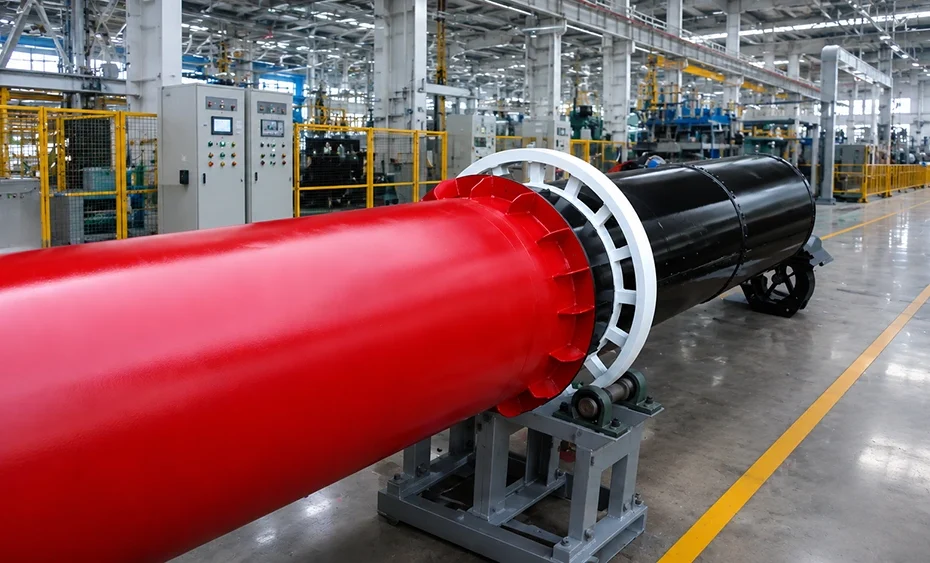
Red and black cylindrical drum assembly on steel roller supports in an industrial production hall

Rotary Sawdust Dryer for Remote and Inland Markets: Split Shipment, 17 to 18 m Drum Sections and On-Site Assembly and Commissioning

  •  

A rotary drum built out to 17 to 18 m does not ship as one welded shell, and an inland plant far from the port pays for that twice: once on freight and once on commissioning. This page follows the DRYR sawdust dryer on a remote delivery route, shipped as bolted flange sections and re-assembled on site, across H-1010 to H-1815 at 0.8 to 2 t/h on 1000, 1200, 1500 and 1800 mm drums with 4, 5.5, 7.5 and 11 kW main motors and 7.5, 7.5, 11 and 15 kW induced draft fans, drum internal hot air quoted at 200 to 500 degrees Celsius, output moisture stated below 10 percent, a multi-fuel refractory lined hot air furnace, self-insulation quoted above 80 percent thermal efficiency, combined lifting plates with temperature sensing and a sealed drum, a cyclone dust collector with optional baghouse, and about 50 percent less plot footprint and civil foundation investment against comparable models. Limits are stated plainly: figures carry no published test conditions, so tonnage and final moisture move with species, initial moisture, particle size, fuel and climate, and section count, lifting plan and foundation loads are confirmed per project.

Red and black cylindrical drum assembly on steel roller supports in an industrial production hall

Hand-Welded Yard Drum vs Machined Rotary Sawdust Dryer Drum: Out-of-Round Shells, Girth Gear Wear and the Moisture Record a Certification Buyer Asks For at 0.8 to 2 t/h

  •  

An export-oriented molded pallet or pellet plant usually inherits its drying stage: a rotary drum welded up on site, a moisture check done by squeezing a fistful of sawdust, and a batch record kept in one operator’s memory. This page follows one procurement decision on the DRYR rotary sawdust dryer, from what an out-of-round field-welded shell does to girth gear teeth, support rollers and bearings, through the factory-machined assembled structure, bolted flange sections, combined lifting plates and PLC control that replace the guesswork, to the figures a buyer can file: H-1010 to H-1815 at 0.8 to 2 t/h on 1000, 1200, 1500 and 1800 mm drums with 4, 5.5, 7.5 and 11 kW main motors and 7.5, 7.5, 11 and 15 kW induced draft fans, drum internal hot air quoted at 200 to 500 degrees Celsius, output moisture stated under 10 percent, self-insulation above 80 percent thermal efficiency with under 8 kg of coal per tonne dried, a cyclone dust collector with optional baghouse, and drums built to 17 to 18 m in bolted sections. Limits are stated plainly: the assembled drum and bolted flange view is a 3D rendering, not a site photograph, and those published figures carry no published test conditions.

Get a Pallet Machine Price Quote & ROI Plan
Request Quote WhatsApp
🇬🇧 EN 🇪🇸 ES 🇫🇷 FR 🇷🇺 RU 🇮🇹 IT 🇩🇪 DE 🇳🇱 NL
×

Get a Precision Quote

Leave your requirements below. Our engineers will reply within 12 hours with customized technical details and pricing.