Sawdust dryer fuel strategy
A Yard That Takes Tonnage Twelve Months and Decides What Leaves the Gate
A wood recycling yard that dries its own tonnage instead of shipping it wet turns the dryer into the largest fuel consumer on the property, and the fuel question becomes the machine question. This page follows a multi-fuel sawdust dryer on that site: a refractory brick-lined combustion chamber that takes coal, oil, natural gas or the yard's own sawdust, wood chips, crushed offcuts, pellets and powder; a self-insulation shell quoted above 80 percent thermal efficiency and under 8 kg of coal per tonne dried; and an H-1010 to H-1815 ladder covering 0.8 to 2 t/h on 1000, 1200, 1500 and 1800 mm drums with a 4, 5.5, 7.5 and 11 kW main motor and a 7.5, 7.5, 11 and 15 kW induced draft fan. Hot air inside the drum is quoted at 200 to 500 degrees Celsius with output moisture below 10 percent, held by combined lifting plates, temperature sensing and a sealed drum, with a cyclone separator or optional baghouse on the exhaust and bolted-flange sections where the drum runs out to 17 to 18 m. The limits are stated plainly: those figures are quoted without published test conditions, so fuel burn, tonnage and final moisture move with species, initial moisture, particle size, fuel choice and site climate, and each project is sized on its own sampling.
Why a Coal-Only Furnace and an Uninsulated Drum Stop Fitting a Recycling Yard
The default answer on many yards is still open-yard sun drying backed by a furnace built around one fuel, usually coal or imported diesel. Sun drying holds the yard hostage to the wet season and to shed area: a drum sized on a dry month cannot keep pace when ambient humidity sits high for weeks, so the wet tonnage stacks up and the boiler or the press downstream waits. A single-fuel furnace adds a second exposure, because the drying cost then follows the price of one commodity the yard does not produce, and changing fuel usually means rebuilding the furnace. There is a quieter third loss as well, and it is the uninsulated shell: heat that should be evaporating water leaves through the drum skin, the burner compensates with more fuel per tonne dried, and that penalty repeats every shift for the life of the machine. A fuel-flexible, insulated drum answers all three by removing the single-fuel lock-in and the shell loss rather than by promising one fixed number.
Where the Heat Comes From: A Lined Chamber That Burns What the Yard Cannot Sell
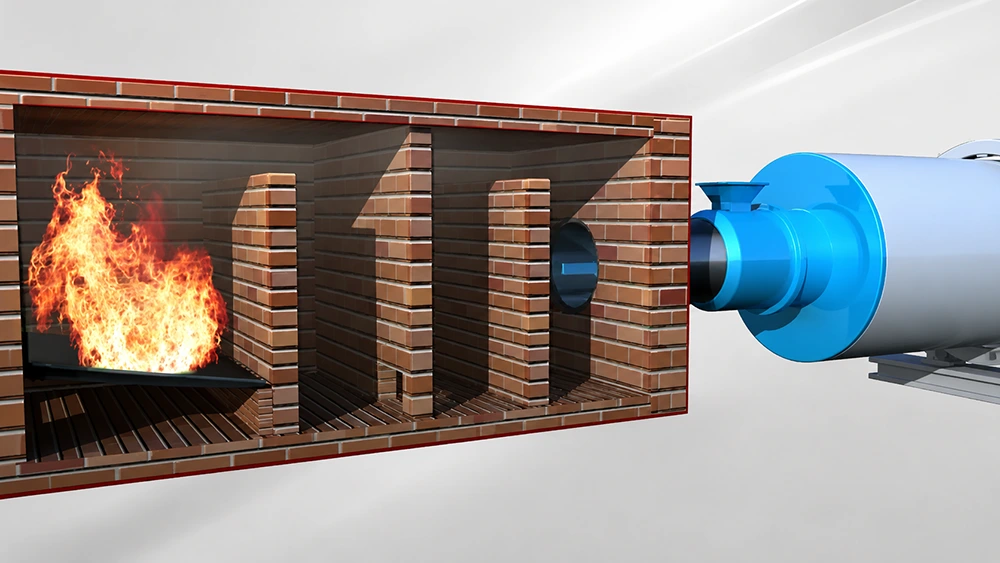
On DRYR the heat source is a refractory brick-lined combustion chamber with internal baffle passes and a burner assembly, so coal, oil, natural gas and solid biomass can be burned in the same chamber: sawdust, wood chips, crushed offcuts, pellets and powder. For a recycler the practical reading is direct, because the fraction of intake that is too wet, too contaminated or too low value to sell becomes the heat for the tonnage that is worth selling, and the fossil fuel line on the cost sheet shrinks to a top-up. The rendered cutaway above shows the brick lining, the baffle passes and the burner interface; it is an engineering visualisation rather than site photography, and it is the clearest evidence of where heat is generated and how the gas path is routed before it reaches the drum. Around that chamber the shell is built as a self-insulation design, quoted at above 80 percent thermal efficiency and under 8 kg of coal per tonne dried. Both figures are quoted without published test conditions, so fuel burn still moves with species, initial moisture, particle size, chosen fuel and climate.
Drum Ladder, Dust Control and the Cost the Yard Actually Controls
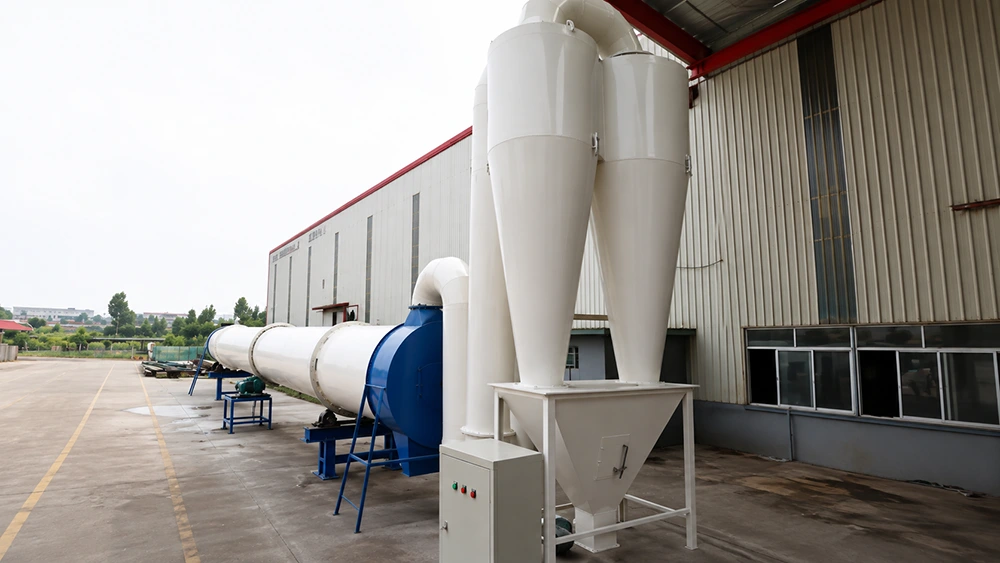
The drum runs in four tiers: H-1010 at 1000 mm diameter with a 4 kW main motor and 7.5 kW induced draft fan over 0.8 to 1 t/h; H-1212 at 1200 mm with 5.5 kW and 7.5 kW over 1 to 1.2 t/h; H-1512 at 1500 mm with 7.5 kW and 11 kW over 1.2 to 1.5 t/h; and H-1815 at 1800 mm with 11 kW and 15 kW over 1.5 to 2 t/h. Across the range, hot air inside the drum is quoted at 200 to 500 degrees Celsius with output moisture below 10 percent. Combined lifting plates lift and drop the material into a curtain across the gas stream, while temperature sensing, even vibration and a sealed drum hold the envelope closed. Exhaust leaves through a cyclone separator or an optional baghouse, with PLC control and screw conveyor feed available, and where residence time needs a longer body the drum runs out to 17 to 18 m in bolted-flange sections assembled on site. The photograph of the twin cyclone separators, conical discharge hoppers and control cabinet shows that closed loop on a built unit. What the yard is left with is a drying cost tied to its own residue stream and to whichever fuel it prices best that season, instead of a cost fixed by one commodity market, with tonnage and final moisture confirmed against its own material.
- Thermal efficiency above 80 percent and coal consumption under 8 kg per tonne are quoted without published test conditions
- Fuel compatibility needs project confirmation on species, moisture, sizing and local emissions rules
- Image 1 is a 3D cutaway rendering used as engineering visualisation, not site photography
- Output moisture below 10 percent and 0.8 to 2 t/h move with intake conditions and are verified by sampling