Dryr Sawdust Dryer · Dust and Fire Control
The plant this page is written for: fibre in, dust out, and a target moisture the next stage will not negotiate
Wood fibre and wood dust are the same material in two states, and a drying line that lets the second state escape is running a fire load it does not measure. This page follows a plant that crushes, dries and screens wood residue for pellets, board or molded pallets, and it looks at one specific pressure: dust leaving the drum and the inlet chute, the ignition risk that comes with it, and the emission and workplace rules that make an open drying stage hard to defend in Europe, North America and other regulated markets. The answer here is not a bigger extraction fan bolted on after the fact. It is a rotary sawdust dryer whose drum and inlet chute are sealed, whose seal condition is monitored, and whose dust-laden exhaust is handed to a cyclone dust collector with a baghouse filter where the site asks for it, so the material that makes the plant money is captured at the drum instead of settling across the yard.
Why the cheap answer stops working: open drum ends, hand sweeping and a furnace turned up to compensate
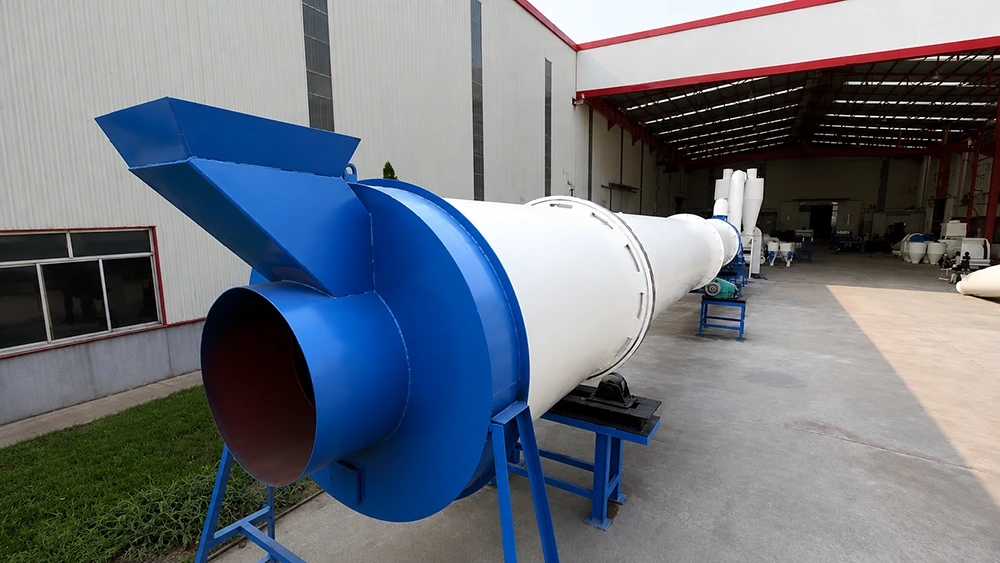
The first version of this line is usually assembled from what is available. Drying is done in the open air or under a shed with manual turning, which is free until the rainy season, when it stops being free and starts being a schedule problem. When a drum is added, it is often a low-cost unit with open ends and an unsealed inlet chute, fed by a hot air furnace that is pushed harder whenever the output moisture reads high. Three things then happen together. Fine dry fibre is pulled out of the drum ends and the chute by the same air stream that is supposed to be drying the material, so the yard, the roof structure and the tops of nearby equipment collect a combustible layer that nobody owns. The open ends also pull cold air in, which means more fuel to hold the same temperature band, and more of the drum working as a dust source rather than a dryer. And because the dust that escapes is dry and fine, it is the fraction with the lowest ignition temperature: sawdust ignition figures sit at or below roughly 280 degrees Celsius, which is inside the range a drum is designed to run at. On a site under real emission and workplace safety rules, that combination is not a housekeeping issue, it is a compliance and insurance issue, and it is the reason a dryer gets replaced rather than repaired.
What the DRYR sawdust dryer changes: sealed drum and inlet chute, seal monitoring, and cyclone or baghouse dust control
The DRYR design answers the dust question at the point where dust is created rather than at the fence line. The drum and the inlet chute are sealed, so the drying air path and the material path stay inside the machine instead of venting through open ends, and seal condition is monitored as part of the operating routine, so a worn seal is a maintenance item on a checklist rather than an invisible emission source. Exhaust air that has picked up fine fibre and moisture is routed to a cyclone dust collector, with a baghouse filter specified where the site or the local rule needs a finer cut, and the collected fraction is a product stream to be handled rather than a deposit to be swept. PLC control ties the feed, the furnace and the induced draft fan together, so the drum holds its temperature band instead of being driven by operator reaction, and continuous automated operation keeps one crew on one control point. On the fire side, the practical effect is that the volume of dry fine material sitting in open air around the drum drops sharply, and the two ignition sources that matter on a drying line, an open hot drum end and an accumulated dust layer, are both removed from the layout.
The evidence in the structure, and the result the plant is buying
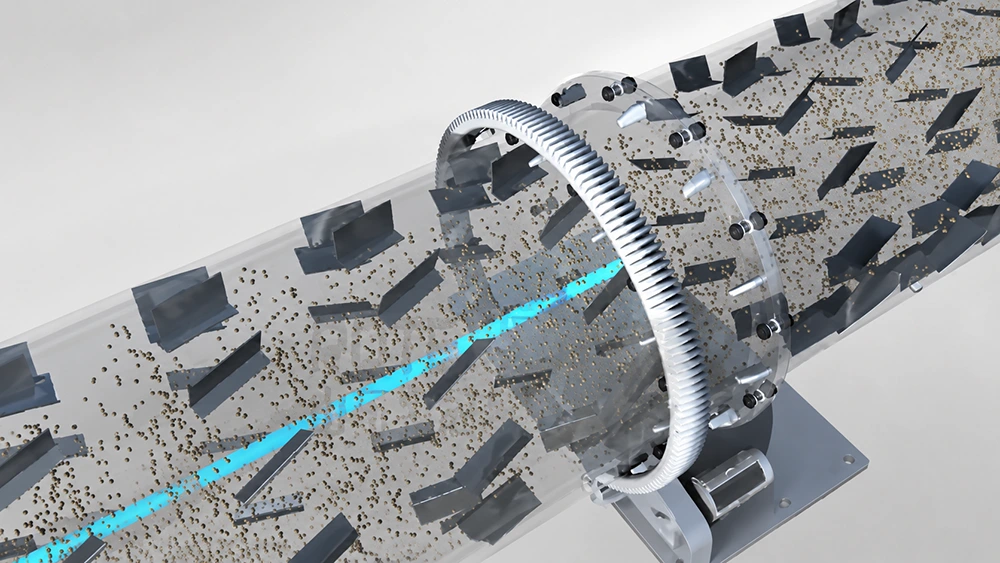
The published DRYR configuration runs the H-1010, H-1212, H-1512 and H-1815 tiers on 1000, 1200, 1500 and 1800 mm drum diameters, covering 0.8 to 2 t/h with 4, 5.5, 7.5 and 11 kW main motors and 7.5, 7.5, 11 and 15 kW induced draft fans, drum internal hot air in the 200 to 500 degrees Celsius band, output moisture stated below 10 percent, and drums built out to 17 to 18 m in bolted flange sections where residence time rather than furnace temperature is the constraint. The gallery images on this page show the two structures the dust argument rests on: the exhaust side, where the drum discharges through ducting into twin cyclone separators above conical collection hoppers with the blower and control cabinet alongside, and the drum interior, where staggered lifting plates carry material up and drop it through the hot air stream instead of letting it lie in the bottom of the shell. The result the plant is buying is a continuous sawdust drying stage that meets the pelletizing or molding moisture standard, keeps its fibre inside the machine, and gives a regulated market one defensible answer on dust, instead of a yard covered in it. Limits are stated plainly: published figures are quoted without published test conditions, so tonnage and final moisture move with species, initial moisture, particle size, fuel and site conditions, and cyclone or baghouse selection is confirmed per project.
- Title, SEO title, slug and H1 are written for this dust and fire control angle and do not repeat any previously published Dryr post.
- Both source images come from the resolved Dryr designer gallery at /data/hot/vault/设计师图片库/Dryr and are not carried over from earlier Dryr articles.
- All parameter figures used are the published DRYR set: H-1010 to H-1815 at 0.8 to 2 t/h, 1000 to 1800 mm drums, 200 to 500 degrees Celsius drum air, output moisture below 10 percent.
- Every section body is plain text with no HTML tags or angle brackets; the fixed renderer owns the body DOM and the contact call to action.