Multi-plant take-out economics
Scale Up on Price: Where a Replicating Pallet Group Sets Its Take-Out Budget
A presswood pallet group that plans to grow by competing on price cannot buy its way there one European automation package at a time. Its expansion model is a main base, three or four regional plants and an overseas unit, and every new plant copies the same hot press line, so the buying rule at the press exit is not which automation brand is most advanced but how low the take-out cost per unit of capacity can be held. AutoG is the automatic pallet take-out robot from EMP that pairs one vacuum suction arm with two 1250 to 1600 ton hydraulic presses on a molded wood pallet line, so a new plant copies one robotic take-out cell per press pair instead of one automation package per press, and press exit headcount moves from one operator per press to one cell per press pair.
The Old Answer Gets More Expensive Every Time the Line Is Copied
Manual take-out scales in the wrong direction. On a 1250 to 1600 ton hydraulic press the take-out post is one operator per press, so a two-press line carries two take-out operators per shift, and a group that copies that line three more times multiplies the post as many times as it multiplies the presses. The post itself is also the hardest one to fill and the riskiest one to keep: the freshly pressed pallet leaves the mold at about 80 degrees Celsius, the MDI binder off-gas reaches the same station on the same press open signal, and any mis-fire during the open die transfer is a crush or shear exposure for the person reaching in. Waiting for the pallet to cool instead is not free either, because the press is idling while it waits on a cycle of roughly four to five minutes. The alternative answer, buying a European turnkey automation package for each press, fixes the labour question but prices the fix per press, and that is exactly the cost shape a price-led replication strategy cannot absorb. This is the point where a press tending robot stops being a convenience item and becomes a line costing decision.
Why AutoG Fits: One Arm Across Two Presses Instead of One Cell per Press
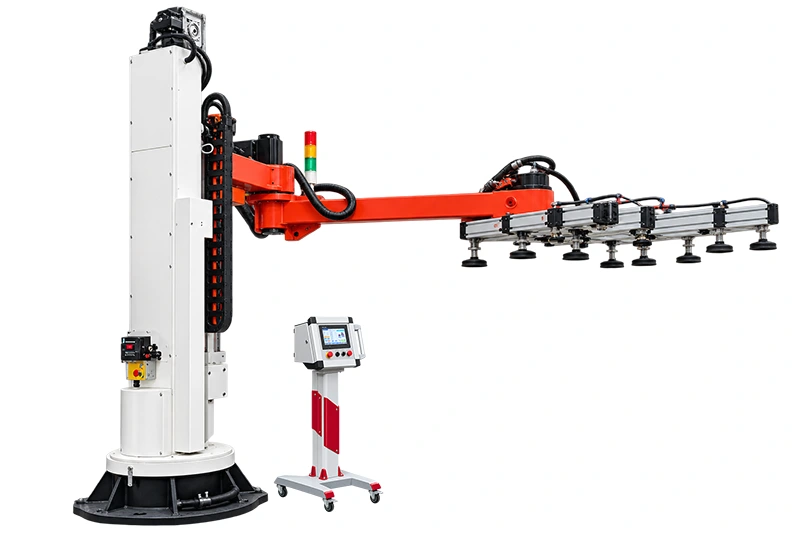
AutoG is the press exit take-out and stacking device on a presswood pallet line, and its configuration is the reason it belongs in a price-led expansion. A single arm serves two presses: it waits while press A is closing and pressing, takes the pallet when A opens, transfers to press B, takes that pallet, and works back and forth on the press open and close signals through the line PLC. The end effector is a vacuum suction gripper that attaches to the molded pallet surface, which is what lets the unit handle the freshly pressed unit at about 80 degrees Celsius instead of waiting for it to cool, and it stacks the pallet where it leaves the gripper, so the manual second lift disappears with the manual first lift. Two press stations therefore run on one robotic offloading cell, which is the lowest take-out cost per unit of capacity we offer, and adding the next press does not automatically add the next automation package. The boundary is stated plainly: AutoG is the take-out device at the press exit on a molded wood pallet line, not the hydraulic press itself, not the crush, dry or glue stages, not a general case palletizer, and not a line that runs on its own.
What the Structure Photos Evidence, What Stays Project-Confirmed, and the Result
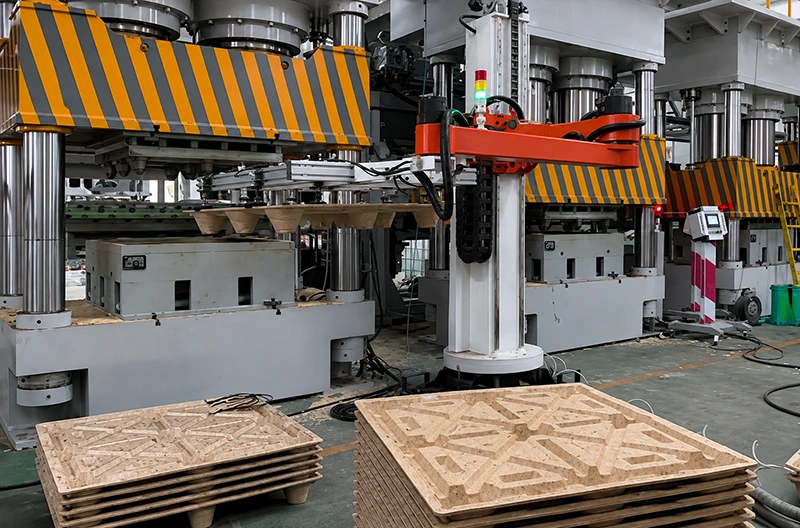
The white background photo shows the structure a new plant copies: a floor mounted base with a vertical column, a long horizontal arm, a multi-cup vacuum gripper beam at the end, cable chain routing and an independent mobile touch control pedestal. The press line photo shows the environment the cell works in, a multi-column hot press with a transfer arm and stacked pressed panels at the exit side, which is the press exit layout a semi-auto to full-auto line upgrade has to fit into. Images evidence visible structure and site relationship only. Several figures stay project-confirmed rather than published specifications: rated load, working radius, repeat accuracy, suction and vacuum configuration, footprint, power and air demand, robot body source and control interface are settled with the technical team per plant, and we publish no ROI, payback period or hourly output. The 80 degrees Celsius handling figure comes from the product description, while the four to five minute cycle, the two-operator comparison and continuous running are taken from our own narration and are quoted as narration rather than as a certified duty rating. The result at plant level is the one that matters to this strategy: press exit manning moves from one operator per press to one robotic cell per press pair, so the second, third and fourth plant copy a low-cost take-out cell instead of an automation package priced per press, and the unit capacity take-out cost stays where a price-led scaling plan needs it.
- Body copy is plain text only, with no HTML tags, attributes, Markdown or angle brackets; the fixed renderer owns the DOM and the post template owns the H1.
- One arm two presses, vacuum suction take-out and about 80 degrees Celsius handling are stated as the product fit, with press-exit device boundary and non-functions stated explicitly.
- Rated load, working radius, repeat accuracy, suction and vacuum configuration, footprint, power, air demand, robot body source and control interface stay project-confirmed, and no ROI, payback or hourly output is claimed.
- Narration-sourced figures are labelled as narration, image evidence is limited to visible structure and site relationship, and the page closes on the /contact/ enquiry route.