Press exit safeguarding on a presswood pallet production line
Where the take-out post sits on a molded wood pallet line
A presswood pallet plant that adds a press usually adds a take-out post with it, and that post is the one job on the line that cannot be safeguarded by holding people away from it: someone has to reach into the open die zone for a pallet that leaves the mold at about 80 degrees Celsius. AutoG is the automatic pallet take-out robot from EMP, installed at the press exit of a molded wood pallet line, where one vacuum suction arm alternates across two 1250 to 1600 ton hydraulic presses on their open signals, takes the freshly pressed pallet without a cooling wait and stacks it where it leaves the gripper. This page follows one safeguarding decision from a single press to a press pair and from one plant to the next copy of the same line. The boundaries are stated plainly: rated load, working radius, repeat accuracy, suction and vacuum configuration, footprint, power and air demand and robot body source stay project confirmed, no ROI, payback or hourly output is claimed, and the unit is the press exit take-out device on a presswood line, not the press itself, not the crush, dry or glue stage and not a general case palletizer.
Why a guard, a light curtain or a second pair of hands does not close the gap
Safeguarding is where the manual take-out version stops being a staffing question. A fixed guard around the press opening cannot protect a person who has to reach through that opening every cycle. A light curtain that stops the press slide whenever the beam is crossed stops the cycle rather than the exposure. An interlock that allows the transfer only inside the open window is a signal, not a separation, because the operator is standing inside the window that signal permits. The other version of the same problem is manning: two presses mean two take-out operators per shift, plus night shift premium, absence cover and the retraining cycle that follows turnover, and every additional plant inherits the same post and the same roster. Neither version improves with training, and both leave the plant choosing between a slower cycle and a manual reach into the press die zone at around 80 degrees Celsius, with MDI binder off gas arriving on the same press open signal.
One vacuum suction arm across two presses: why this duty fits a robot and not a person
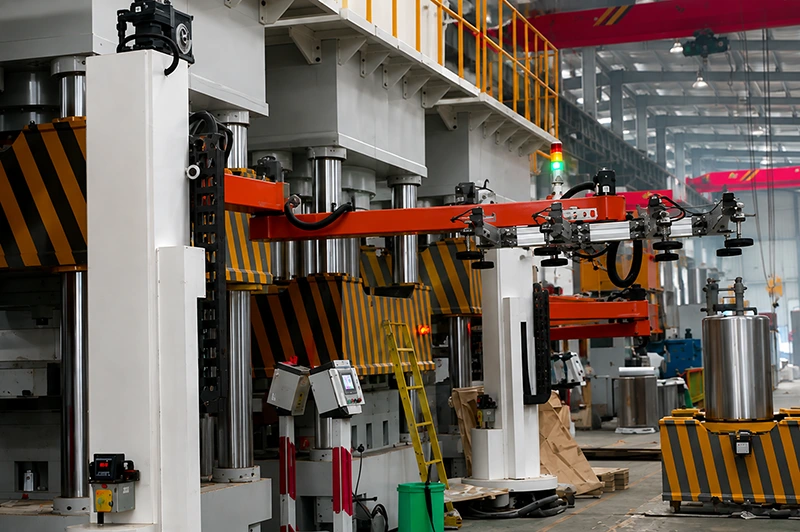
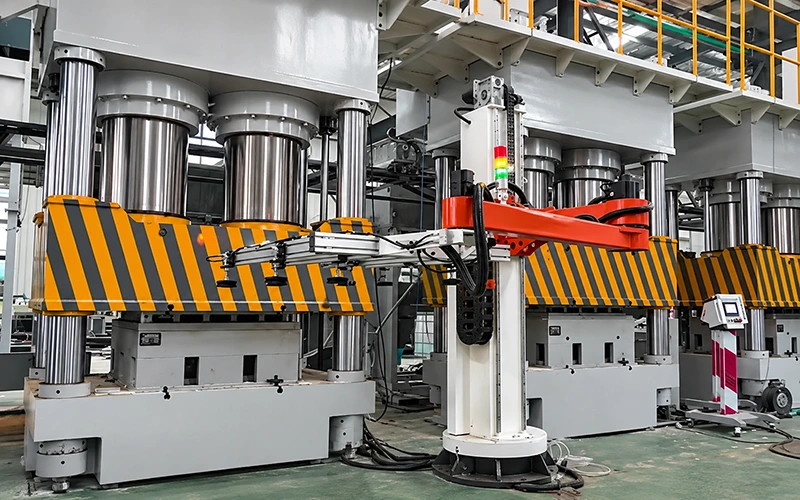
AutoG is a six-axis articulated robot arm with a vacuum suction pallet transfer end effector, mounted at the press exit, taking the pallet from the open mold by suction on the pallet surface and stacking it where the gripper releases it. On a two press main base one arm alternates: press A is pressing and the arm waits, press A opens and the arm takes out, the arm crosses to press B, press B opens and the arm takes out. Because the transfer is performed from outside the press open to close window, the press exit is physically unoccupied from the open signal to the close signal. On heat, the machine handles the 80 degree pallet without a cooling wait, which is the part a person cannot do safely and the part that otherwise costs cycle time on a 4 to 5 minute molded pallet cycle. The sequence is carried on the press open and close signals through the line PLC, on the same control logic as the presses and the flattening machine, so the take-out stage is not a separate third-party integration. On running hours, EMP states that the unit runs continuously once powered, and that statement is quoted here as a supplier statement rather than a published work schedule or a takt figure. The two photos on this page are the visible evidence: the transfer arm and its multi suction gripper array with light tower at the press station, and the press station with its striped safety guards and the robotic transfer arm in the open position.
What the plant is left with, and what stays project confirmed
The result is a press exit where nobody stands at 80 degrees Celsius, and two press stations running on one robotic offloading cell, so take-out headcount is set per press pair rather than per press and is not multiplied again each time the line is copied into another plant. In upgrade terms it is the increment that takes a semi-automatic line to a fully automatic pallet production line at the discharge end, without changing the press. What stays open is stated as open. Against a 1250 to 1600 ton press, rated load, working radius, repeat accuracy, suction count and vacuum generation, footprint, power and air demand and the robot body source are confirmed per project on the customer's own press, mold and layout. Throughput, ROI and payback are not claimed here, and the running hours statement above is a supplier statement. The scope boundary is the press exit take-out device on a molded wood pallet line: AutoG is not the press, not the crush, dry, glue or flattening stage, and not a stand-alone production line. Plants planning a press pair, a third press or a second line can bring their press tonnage, mold size and shift pattern to the contact page and have the take-out cell scoped against them.
- Both image source_path values are taken from the resolved AutoG designer gallery, and every image url was returned by the media batch import for those same source files.
- No ROI, payback, hourly output, takt or headcount guarantee is claimed; the 24 hour continuous running line is quoted as a supplier statement, not as a published work schedule.
- Robot rated load, working radius, repeat accuracy, suction and vacuum configuration, footprint, power and air demand and robot body source are stated as project confirmed rather than published specifications.
- AutoG is declared as the press exit take-out device on a presswood pallet line, not the press itself, not the crush, dry, glue or flattening stage and not a stand-alone line; section bodies are plain text with no HTML tags or angle brackets.