 | Are your carbon black or resin bags slipping during forklift turns? In the chemical sector, “dynamic load” isn’t just a spec sheet number—it’s the difference between a safe transfer and a spilled ton of raw material on your warehouse floor. Discover why standard wood pallets are failing your heavy bagged goods and how high-density molded solutions stabilize your 2.5-ton loads. |
The Truth About Dynamic Load in Chemical Logistics
When we talk about the dynamic load of pressed wood pallets, we aren’t talking about a static lab test. We are talking about the moment your forklift operator hits the brakes while carrying two stacked pallets of PVC resin.
Standard GMA wooden pallets often flex under the concentrated weight of heavy industrial bags (like 25kg valve bags or 1-ton FIBCs). This flexing causes the load to shift, leading to the dreaded “leaning tower” effect in your shipping containers.

Extreme load testing demonstrates the structural integrity required for heavy industrial applications.
Ampallet’s molded design is created under 1,600 tons of pressure. This process fuses the wood fibers into a single, solid piece with a high stiffness modulus. The result? A verified 2.5-ton dynamic load capacity that doesn’t warp or bow, keeping your chemical drums and bagged additives stable during transit.
Eliminating the “Nail Pop” Risk for Bagged Goods
In the raw materials industry, a single protruding nail head is a disaster. If you are shipping carbon black (N220) or fine powder chemicals, a punctured bag means contamination, rejected shipments, and hours of cleanup.
Traditional wooden pallets loosen over time. Vibration during transport causes nails to back out, turning the pallet deck into a hazard for soft packaging.

Yellow PVC resin bags stacked safely on a smooth, nail-free surface.
Our molded wood pallets are inherently nail-free. The smooth, rounded edges and flat surface are engineered specifically to protect soft packaging. By switching to a one-piece molded design, you eliminate the primary cause of packaging rupture in the supply chain.
Maximizing Warehouse Density with Stacking
Space is money, especially in climate-controlled chemical storage zones. When your pallets aren’t in use, how much space are they wasting?
Because standard wood pallets cannot nest, they clutter your loading docks. Ampallet’s design offers a 4:1 nesting ratio.

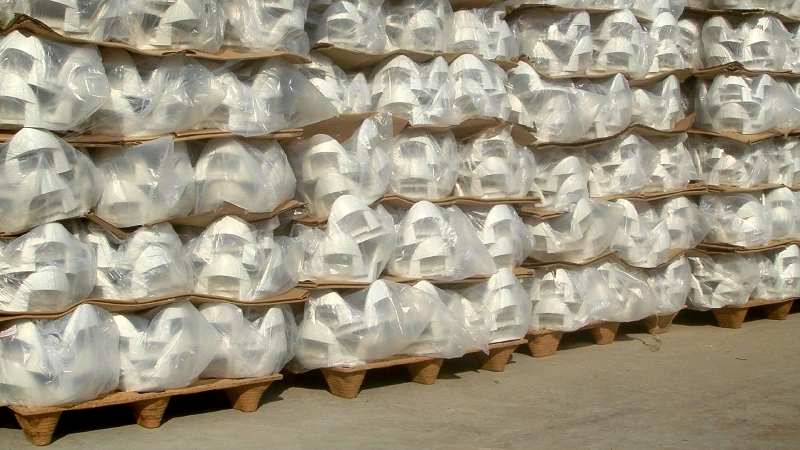
Visual proof: 50 nested Ampallets take up less space than 20 traditional wooden pallets.
This means you can store 2,500 pallets in the same footprint that used to hold 1,000. Furthermore, when shipping loaded goods, the consistent dimensions (tolerance ±2mm) ensure that your export pallets integrate perfectly with automated palletizers and shrink-wrapping lines, preventing machine jams caused by irregular wood sizes.
Performance Comparison: Chemical Logistics
| Feature | Ampallet Presswood | Traditional Wood (GMA) | Plastic Pallet |
|---|---|---|---|
| Dynamic Load | Up to 2.5 Tons (Rigid) | 1.5 – 2 Tons (Flexible) | 1 – 2 Tons |
| Surface Safety | Smooth, No Nails | High Risk of Nail Pops | Smooth (Slip Risk) |
| Moisture Resistance | High (MDI Resin) | Low (Absorbs Water) | Excellent |
| Export Compliance | ISPM 15 Exempt (Ready) | Requires Heat Treatment | Exempt |
Frequently Asked Questions
1. Can these pallets handle the weight of 208L (55-gallon) chemical drums?
Yes. Our heavy-duty molded pallets are rated for a dynamic load of 2.5 tons. The high-density compression ensures the pallet deck does not bow under the concentrated rim load of steel or plastic drums, preventing instability during forklift transport.
2. Are these pallets safe for high-humidity environments like Southeast Asia?
Absolutely. Unlike standard particle board that swells, Ampallet uses MDI (medical-grade) adhesive which creates a waterproof bond. They maintain structural integrity even in the humid conditions common in Vietnam or Indonesia logistics hubs.
3. Do I need a fumigation certificate for export to Europe?
No. Presswood pallets are classified as “processed wood” under ISPM 15 regulations. They are 100% exempt from fumigation and heat treatment requirements, saving you administrative costs and preventing customs delays.
4. Will the pallet damage my super sacks (FIBCs)?
No. The one-piece molded design eliminates all nails and staples. The rounded corners and smooth deck surface are specifically designed to prevent snagging or puncturing woven polypropylene bags.
5. How does the price compare to plastic pallets?
Ampallet offers a similar load capacity to heavy-duty plastic pallets but at roughly 1/3 of the cost. This makes them the ideal “one-way” export solution where return logistics for expensive plastic pallets is not feasible.