One-way export shipping: when a molded presswood pallet beats a sawn timber pallet
What the recycling loop does to pallet choice
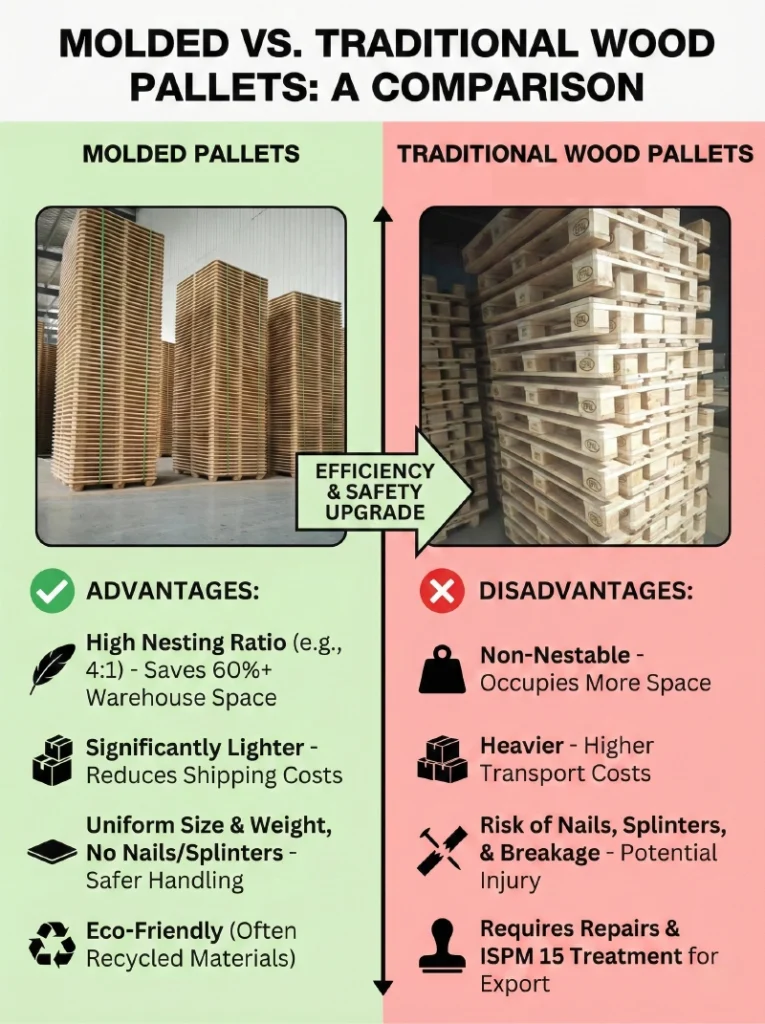
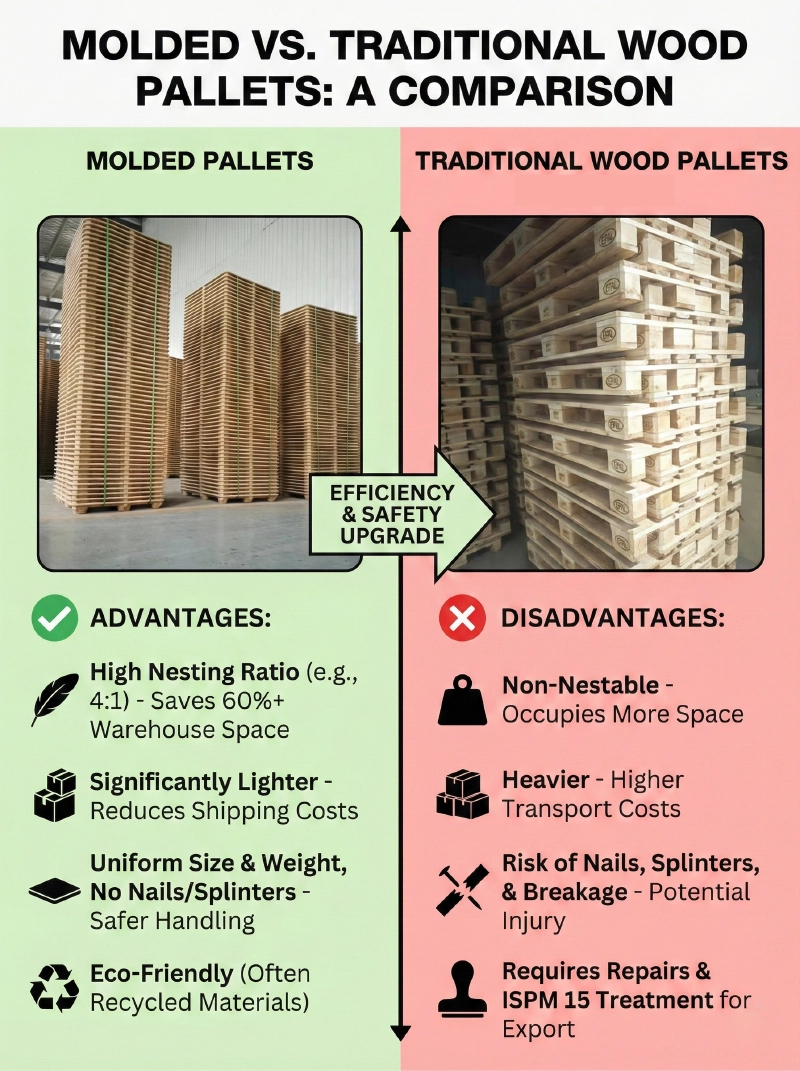
For a one-way export lane, the pallet is not a reusable asset; it travels with the goods and is left at destination or scrapped. That makes three numbers dominate the cost model: empty-pallet space in the container, paperwork and dwell time at the port of export, and damage rate on the load. Sawn timber pallets score unevenly across these three. Empty, they do not nest, so a 40 HQ will hold roughly the same number of loaded units whether the pallet itself takes up half a cubic metre of air or a tenth. Moisture and weight vary from pallet to pallet because sawn timber is cut, not pressed, which is why the IPPC ISPM 15 standard treats raw wood packaging as a regulated article that needs heat treatment or methyl bromide fumigation and a visible mark. If the mark is missing or the certificate has expired, containers can be held, re-treated, or sent back at the exporter's cost. A molded presswood pallet is pressed from wood fibre with heat and pressure, so it sits in the ISPM 15 processed-wood category and does not require a fumigation or heat-treatment certificate; the importer's port should still be confirmed before each new lane. Because the fibre and the binder are compressed together in one moulded part, tare weight stays consistent shipment to shipment, and the deck has no nails, screws, or staples to puncture cartons or 208 L drums.
For shipments that will not come back, the empty pallet volume, the export paperwork, and the nail-and-splinter damage rate usually decide the choice. A molded presswood pallet pressed in one piece from wood fibre removes the heat-treatment or fumigation certificate, lets empty units nest into roughly a quarter of the height, and ships a smooth, nail-free deck. The unit price is only one line on the cost sheet; landed cost per shipped unit, including empty return freight and damage claims, is the comparison that actually changes the purchasing decision.
What actually changes on the floor
Three physical differences show up the day the pallet arrives on the loading dock. First, empty nesting. Ampallet nine-leg and similar nestable pressed-wood footprints interlock so that roughly 20 pallets that would stack to about 2.7 m in sawn timber stack closer to 0.75 m; one customer program logged a drop from two stacks of empty timber pallets 5.4 m high to a single nested stack about 2.1 m high, which freed finished-goods floor space from about 150 m² to about 40 m² and cut delivery frequency by roughly 75%. Second, deck condition. The molded deck is smooth and rounded, with no nail heads or screw tips to catch a stretch wrapper, puncture a corrugated carton, or dimple the chime of a 208 L drum; damage-rate numbers in the 18% range are reported when nail-pop incidents stop. Third, forklift handling. A four-way entry pocket with about 90 to 96 mm of clearance is a standard molded-wood feature; pockets guide the forks so loading speed improves by roughly 15% and the risk of a fork tip punching the deck instead of sliding into the pocket goes away.
What the numbers look like
For a 1200 × 800 mm export unit at about 13 kg, molded presswood commonly quotes a static load around 6,000 kg and a dynamic load around 2,000 kg, which covers most palletized export cargo. For a 1140 × 1140 mm chemical-drum unit at about 17 kg, dynamic load sits at roughly 2,500 kg and static load at roughly 7,000 kg; when the load is two layers of 208 L drums, a 15 mm particleboard strip is bolted across the bottom so the nine feet no longer press point-loads onto the drum chimes. Heavy-duty molded pallets go further on dynamic load, while standard plastic export pallets usually price roughly three times higher per unit and only pay back when the same pallet returns through a closed loop for years. None of these numbers should be treated as a universal rating: every published figure is tied to a specific size, mould, and test condition, so procurement should match the spec sheet to the actual shipment before committing.
Where the comparison stops being fair
A one-way export pallet is not asked to be a long-life asset. A molded presswood pallet is a one-piece pressed part, so a severe impact usually means the whole unit is scrapped; a sawn timber pallet can sometimes be re-nailed from spare boards. For ten-plus-year indoor pool rotation, or for outdoor use on rough ground where the load is dragged rather than lifted, a heavy-duty plastic pallet or a metal pallet is the correct tool. Equally, a UF-bonded pressed-wood pallet from a low-cost source is a different product: it can release formaldehyde well above furniture-grade limits and tends to swell and de-laminate in humid sea freight, which is the opposite of what an MDI-bonded pressed-wood unit is designed to do. The right baseline for an export-shipping decision is therefore MDI-bonded molded presswood against ISPM 15-marked sawn timber, not the cheapest pressed-wood variant against the most expensive plastic pool pallet.
Buyer checks before switching a lane
Five checks clear most of the risk on a new export lane: (1) Confirm the destination country's import rules with the consignee or freight forwarder, since ISPM 15 processed-wood exemption is widely accepted but not universal. (2) Match the pallet spec sheet to the load: size, dynamic load, static load, and whether a double-face or 15 mm particleboard strip is needed for stacked drums or bagged minerals. (3) Confirm dimensional tolerance, typically about ±2 mm, against any automated stacking, AGV, or wrapping equipment on the dock. (4) Ask for the binder type and the test method behind load and moisture-swelling figures, so MDI-bonded molded wood is not confused with UF-bonded pressed wood. (5) Run a sample shipment: count empty pallets per container, weigh ten random units, photograph the deck on arrival, and compare landed cost per shipped unit against the incumbent pallet for at least one full cycle.
How Ampallet fits this lane
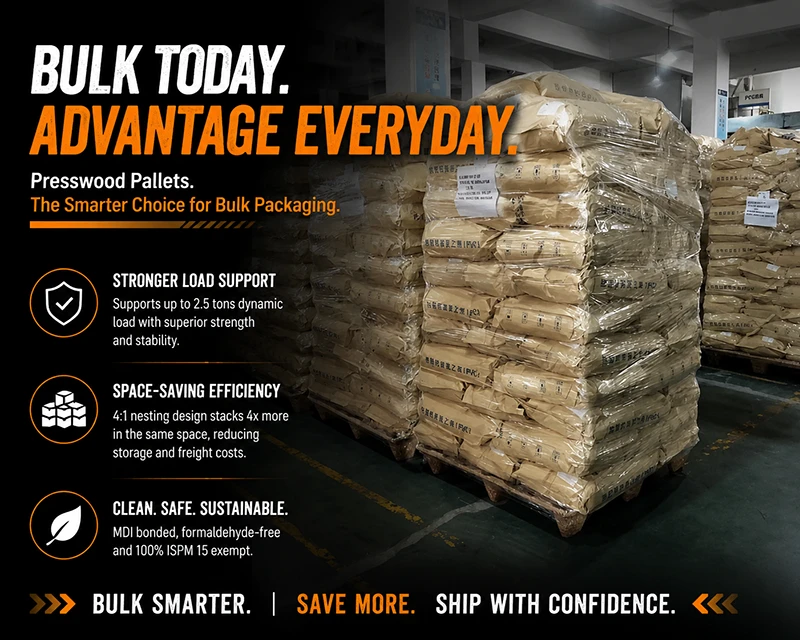
Ampallet is a one-piece molded presswood pallet bonded with MDI adhesive and pressed in roughly 220 °C, 1400 psi cycles, which puts it on the processed-wood side of ISPM 15 and on the zero-formaldehyde side of CARB-NAF food and medical export specs. The nine-leg inverted-cone footprint nests about 4:1 so empty units take roughly a quarter of the warehouse height of sawn timber, four-way forklift entry with about 90 to 96 mm of pocket clearance keeps handling fast, and a 1200 × 800 mm unit at roughly 13 kg or a 1140 × 1140 mm unit at roughly 17 kg covers most export cargo up to a 2.5 t dynamic load. Ampalletline, the full molded-pallet production line, is a separate offer for buyers who want to press their own pallets in-country, and the Ampallet team can scope spec sheets, sample shipments, and lane-by-lane landed-cost comparisons on request.
- Every quantitative figure is attached to the spec or scenario in which it was recorded, never generalised to the whole product line.
- Ampalletline production-line equipment is referenced as a separate offer and never mixed into the finished-pallet cost or compliance story.
- The ISPM 15 processed-wood exemption is described as widely accepted, with destination-country confirmation required per lane.
- Load, tolerance, and nesting figures keep their source caveats and are not promoted to universal ratings.