Presswood Pallet Capacity Expansion
Presswood Pallet Capacity Expansion Hits a Linear Labor Wall
On a presswood pallet production line, every new 1250 to 1600 ton hydraulic press used to mean two more take-out operators per shift and another crew of night-shift labor the plant had to recruit, train, and retain. AutoG is the automatic pallet take-out robot from EMP that pairs one six-axis arm with two presses, so capacity doubles without doubling the take-out headcount on the floor.
Why Adding a Press Used to Mean Adding Two More Operators
Traditional manual take-out on a presswood pallet production line runs one operator per press, two presses per shift, and three shifts to keep 24 hour continuous output running. Doubling press capacity adds another full take-out crew, another training cycle, another payroll tax stack, another night-shift recruitment drive, and another exposure window inside the press danger zone of the 1250 to 1600 ton hydraulic press. The capex on the new press can be amortised over years, but the take-out labor cost climbs in lockstep with every press added to the line. Long before the press reaches its rated 4 to 5 minute press takt, the expansion case turns uneconomical and the recruitment calendar starts to dictate the production calendar on the floor.
AutoG Automatic Pallet Take-Out Robot Decouples Capacity From Take-Out Headcount
AutoG is the automatic pallet take-out robot that sits at the press exit of a fully automatic pallet production line and breaks that linear scaling rule. One six-axis articulated robot arm with a vacuum suction end effector is sized to serve two 1250 to 1600 ton hydraulic presses in alternating mode: take-out, transfer, and automatic stacking on press A, then repeat on press B while the first press runs another 4 to 5 minute press cycle. The take-out station headcount plateaus at one cell operator per dual-press set, and adding a second robot cell covers the next two presses without doubling the take-out labor pool that the plant has to recruit, train, and insure across three shifts.
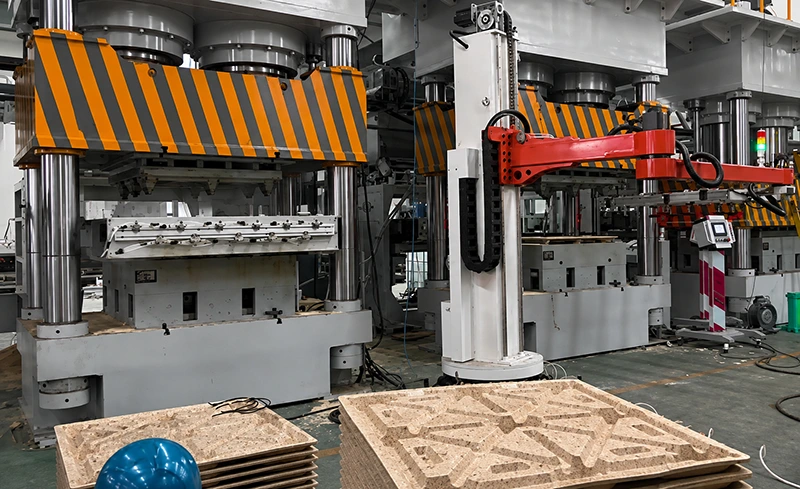
From Two Operators Per Press to One Robot Cell Per Two Presses
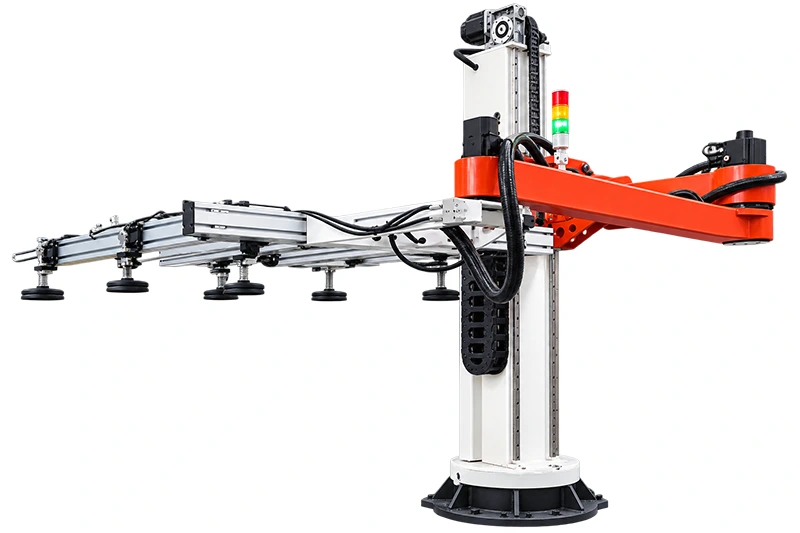
The standalone AutoG unit shows the structure that makes the dual-press cell layout work: a column-mounted vacuum handling arm, multi-suction-pad head, cable management chain, and stack light, all sized to reach both press exits from a single floor footprint. In the line integration view, the gantry loading robot works beside the four-column hydraulic press, takes the pallet at around 80 degrees Celsius on the press open to close signal through the line PLC, and stacks it directly without a secondary manual lift. The headline result is the take-out labor math: capacity doubles, take-out headcount does not, and the expansion business case stops being held hostage to the night-shift recruitment calendar on the presswood pallet production line.
- Section 1 sets the presswood pallet production line capacity expansion scene, names the 1250 to 1600 ton press, and locates the 80 degrees Celsius take-out bottleneck at the press-open station.
- Section 2 names the old headcount stack and how it scales linearly with every added press on the 4 to 5 minute press cycle and the 24 hour shift pattern.
- Section 3 names AutoG as the automatic pallet take-out robot and explains the one arm two presses concept that breaks the linear scaling rule on a fully automatic pallet production line.
- Section 4 cites the six-axis articulated robot arm, vacuum suction end effector, 80 degrees Celsius take-out, 24 hour operation, and pairs the structure and line integration images with the final capacity versus headcount result.