PRESSWOOD PALLET PRODUCTION | AUTOMATIC OFFLOADING
When consistency pressure reaches the press discharge point
Automatic press unloading robot for molded wood pallet lines: AutoG coordinates hot-press unloading, repeatable transfer, and stacking so manufacturers can protect dimensional consistency while supporting AI defect inspection and higher yield expectations.
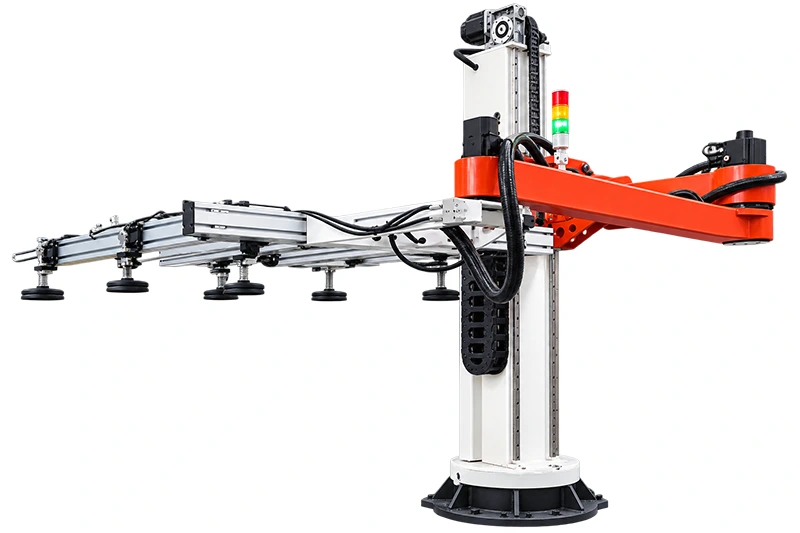
Why manual take-out creates process variation
The conventional arrangement places an operator beside each press to remove the pallet, carry it away, and stack it. With 1250–1600 ton molded pallet presses, this puts people close to a hazardous operating area. The pallet is also approximately 80°C after demolding, while MDI adhesive processing can create concerns about exposure to gases at the hot-press station. Manual drops, uneven gripping, and changing placement angles add avoidable pose variation. Waiting for cooling can add press-side delay; moving and stacking by hand makes stable continuous operation difficult.
A dedicated fit for hot-press pallet unloading
AutoG is a dedicated automatic take-out robot for the discharge side of an EMP molded wood pallet production line. It is not the hydraulic press itself or a general-purpose packaging robot. After the press opens, the six-axis articulated robot arm enters the mold area, uses a vacuum suction gripper to take the finished pallet, transfers it to the stacking position, and repeats the sequence. One AutoG can alternate between two molded pallet hydraulic presses, waiting during pressing and taking over when either press completes its cycle.
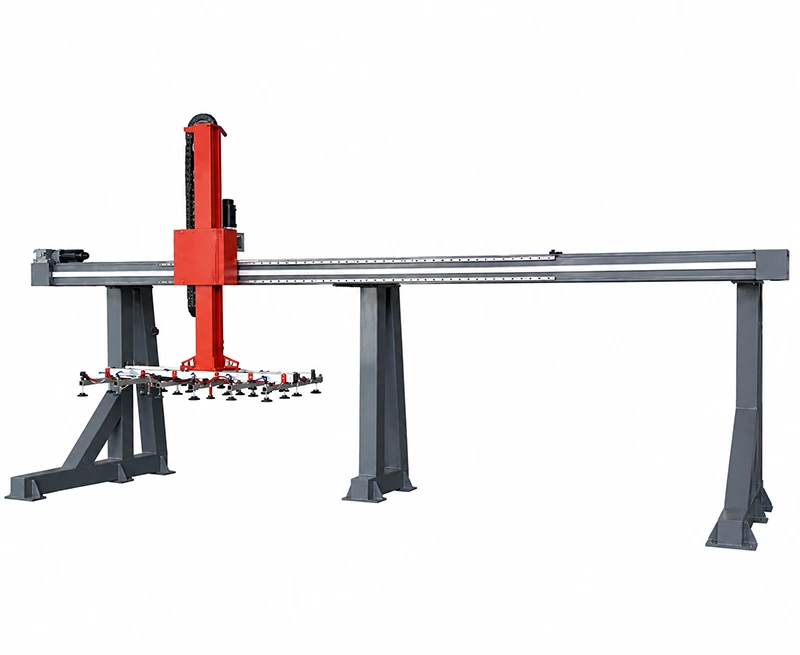
From controlled transfer to better process stability
The AutoG structure provides the evidence for this workflow: an articulated handling arm, vacuum suction end effector, cable management, and factory-integrated transfer layouts. The indexed AutoG images show the gripper and gantry movement used for industrial handling, while the factory configuration shows robotic transfer beside a press and stacked panels. Confirmed references include approximately 80°C pallet handling, six-axis motion, and press-side transfer to stacking. The result is a more controlled handoff for downstream AI defect inspection and consistency programs, while final load, reach, repeatability, vacuum, and interface values remain items for the project technical proposal.
- Use only confirmed AutoG facts and the supplied customer pain point about dimensional consistency, yield, AI inspection, manual drops, and pose variation.
- Follow the required logic: customer and scene, old-method problem, product fit, structure and evidence, then the operational result.
- Do not claim unconfirmed load, reach, repeatability, suction count, vacuum specification, power, air supply, PLC model, installation dimensions, certification, output rate, or ROI.
- Use the exact primary phrase Automatic press unloading robot naturally in the title, SEO title, slug, H1, summary, and image alt fields generated by the route.


