HYDRAULIC PRESS TAKE-OUT ROBOT | AUTOG
The press-side bottleneck: manual take-out breaks the line rhythm
Hydraulic press take-out robot AutoG removes a practical bottleneck in molded wood pallet manufacturing: the press finishes a 4–5 minute cycle, but manual unloading still waits for heat or exposes operators to a pallet at about 80°C. By coordinating with press open-and-close signals through the line control logic, AutoG transfers the molded pallet from the press to the stacking position without making the press wait for a manual take-out action.
Why AutoG fits a two-press pallet production cell
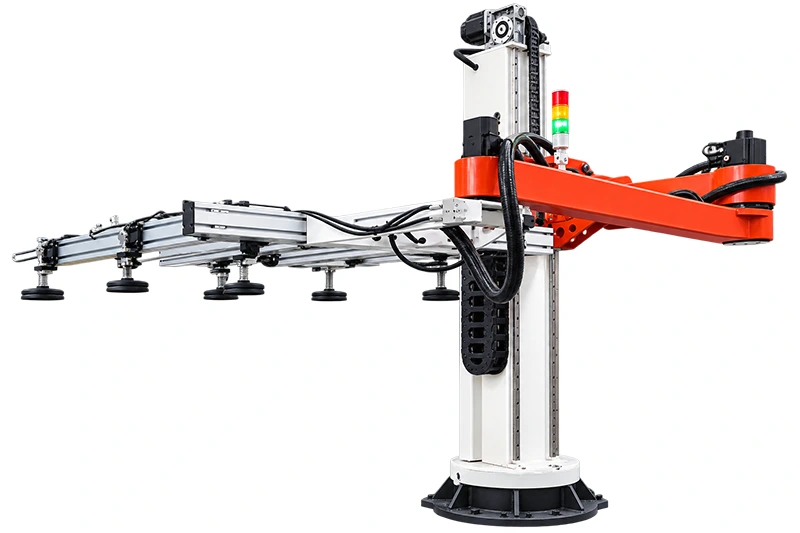
AutoG is designed for this specific boundary between a molded wood pallet hydraulic press and the stacking position. It is an automatic take-out robot for the outfeed and pallet transfer step, not the press itself and not a general warehouse robot. A single arm can serve two molded pallet hydraulic presses in an alternating sequence: it waits during pressing, responds after the press opens, removes the finished pallet, transfers it to the stacking position, and then moves to the other press when its cycle is ready. This one-arm-two-press arrangement makes the robot a practical component for a semi-auto to full-auto line upgrade.
Structure and evidence: vacuum handling for hot pallet transfer
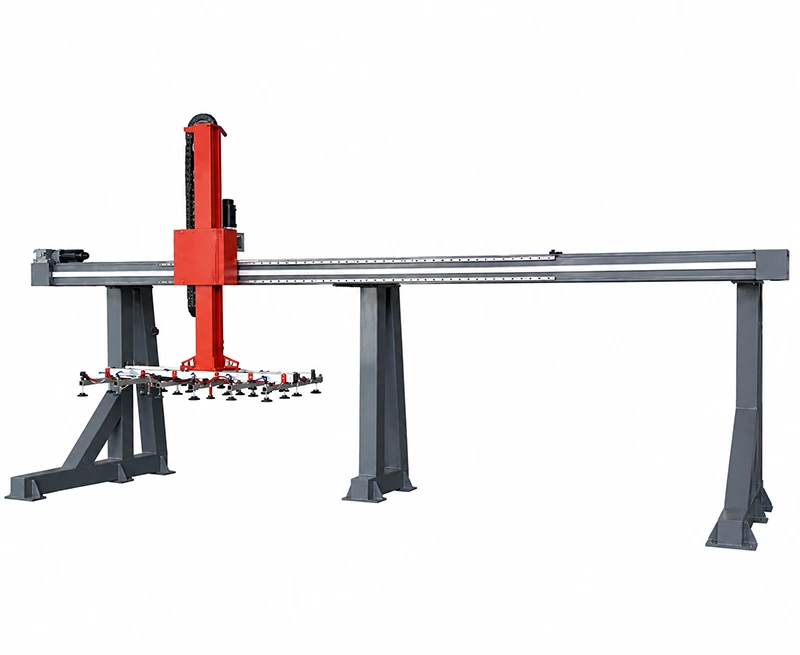
The visible machine structure supports the intended handling path. The AutoG gallery image shows a long articulated arm on a column base, a multi-suction vacuum end effector, cable management, and a stack light. These elements correspond to the required pick-and-transfer motion at the press outfeed. AutoG uses six-axis articulated movement for up, down, left, right, forward, backward, and orientation changes needed during take-out and stacking. Its confirmed handling capability includes direct transfer of pallets at about 80°C, so the process does not need to add a cooling wait as a prerequisite for automatic unloading. The second image is a product rendering that illustrates a gantry-style vacuum handling layout with a linear travel structure, lift carriage, cable carrier, and multi-cup gripper; it is a configuration illustration, not a claim for a universal AutoG dimensional specification.
The result: synchronized unloading and a clearer automation upgrade path
With press open-and-close signals coordinated through PLC logic, the take-out sequence can be aligned with the actual press state instead of relying on an operator's timing. The expected result is a shorter press waiting interval, a cleaner handoff from pressing to automatic stacking, and better use of the press-side station. AutoG also reduces the need for people to perform repetitive take-out and secondary stacking beside a large press, while keeping the product boundary clear: final performance depends on the confirmed press layout, pallet design, gripper configuration, cycle timing, and integration conditions. For factories targeting a fully automatic pallet production line, these are the points to verify during technical quotation.
- The article is fully English and follows the customer scenario, legacy problem, product fit, evidence, and result sequence.
- Use only confirmed AutoG facts: 80°C handling, six-axis articulated arm, vacuum suction gripper, one arm serving two presses, and 4–5 minute press-side cycle context.
- Do not claim unconfirmed payload, reach, precision, PLC model, power, air supply, installation dimensions, throughput, ROI, or certification.
- Both images are from the resolved AutoG designer gallery and their ALT text contains the exact keyword Hydraulic press take-out robot.


