AUTOG | MOLDED WOOD PALLET PRODUCTION AUTOMATION
The press-side unloading problem
Press tending robot automation moves operators away from the hot, gas-exposed unloading zone after molded wood pallets leave the hydraulic press. AutoG uses vacuum suction transfer and automatic stacking to connect presswood pallet production with a safer offloading workflow.
Why AutoG fits the production stage
The conventional arrangement also creates a staffing and cycle-matching issue. With two molded pallet hydraulic presses, factories may assign approximately two people to take pallets out manually. Waiting for the product to cool can add delay, while removing it immediately increases the need to control operator exposure and press access. AutoG is adapted to this exact boundary: it is an automatic pallet take-out robot installed at the press discharge side, not a replacement for the hydraulic press and not a general warehouse robot.
Structure, operating fit, and image evidence
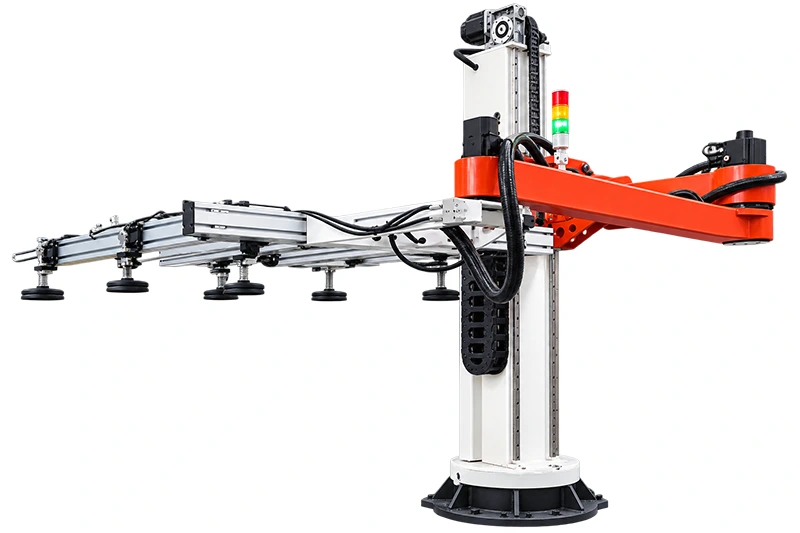
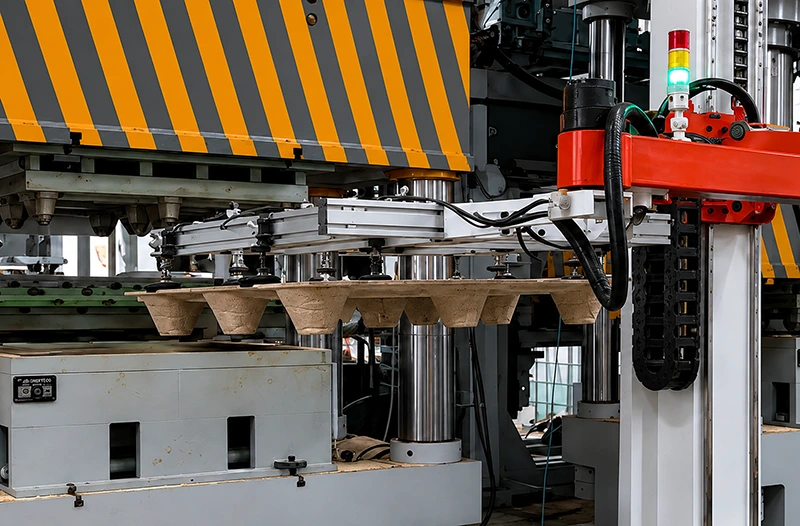
AutoG combines a six-axis articulated robot arm with a vacuum suction gripper for pallet pickup, transfer, and stacking. The documented configuration allows one arm to tend two molded pallet hydraulic presses, alternating between press A and press B while the current press is in its pressing stage. The product description confirms safe handling of pallets at about 80°C. In the AutoG gallery, the first image shows the long articulated arm, suction head, cable chain, and stack light. The second image shows a molded-fiber transfer station with linear movement components, cable routing, and multi-cavity trays. These images support the visible equipment layout; final load, reach, suction, control, and installation values must be confirmed for the project.
From manual exposure to automated offloading
After the press opens, AutoG enters the mold area, grips the finished pallet by vacuum, transfers it out of the hot press zone, and places it at the stacking position. The result is a more controlled presswood pallet production line: operators no longer need to stand in the high-temperature gas-exposed unloading area for routine take-out, and the same robot can coordinate the discharge work of two presses. For a semi-auto to full-auto line upgrade, the next engineering step is to confirm pallet geometry, gripper design, press spacing, safety interlocks, cycle timing, and the interface with the line PLC. Contact EMP to review the press tending robot layout for your 1250–1600 ton press application.
- The article uses only resolved AutoG product facts and does not invent robot load, reach, precision, vacuum, power, or PLC specifications.
- The article follows customer and scene, legacy method problem, product fit, structure and evidence, then operational result logic.
- The article uses Press tending robot in the title metadata path, H1 and opening summary as required by the route.
- The article presents the two selected AutoG gallery images as evidence of visible structure and workcell context, not as proof of undisclosed specifications.


