Robotic offloading system for molded wood pallet production
The press discharge problem: hot pallets and human exposure
Robotic offloading system automation removes people from the press discharge zone when a 1250–1600 ton molded wood pallet press opens with an approximately 80°C pallet. AutoG uses a six-axis articulated robot arm and vacuum gripper to take out, transfer, and stack hot pallets, helping manufacturers replace manual hydraulic press pallet take-out with a controlled press-to-stacking workflow.
Why the old manual solution limits safety and continuity
Manual take-out creates two connected problems. First, every press cycle brings a person back to the hazardous area of a high-force machine; an unexpected equipment movement can turn access into a serious crushing or severing risk. Second, the operator must handle a hot pallet and then perform secondary transfer and stacking. MDI adhesive used in molded pallet production can also generate gases during hot pressing, creating an additional reason to reduce routine presence at the press-side station. With two presses, the traditional comparison is roughly two take-out workers, while manual handling makes 24-hour production and stable staffing more difficult.
Why AutoG fits press tending and dual-press offloading
AutoG is designed as an automatic pallet take-out robot for the press-side section of an EMP molded wood pallet line. Its job is specific: wait while pressing is in progress, enter after the press cycle is complete, grip the pallet with a vacuum suction end effector, transfer it away from the press, and place it at the stacking position. The six-axis articulated robot arm provides the up, down, left, right, forward, and backward movement plus orientation adjustment needed for press tending and palletizing. One AutoG can be configured to serve two molded pallet hydraulic presses in an alternating cycle, subject to the final layout and control sequence.
Structure and evidence for a controlled pallet transfer path
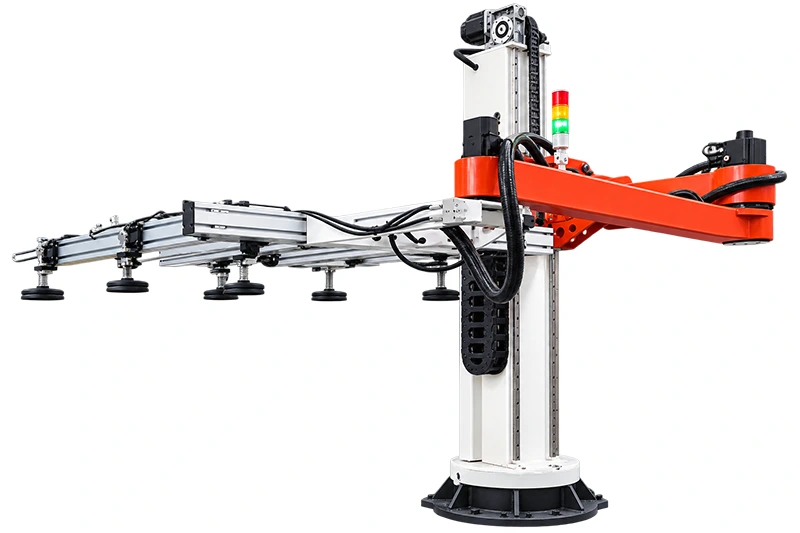
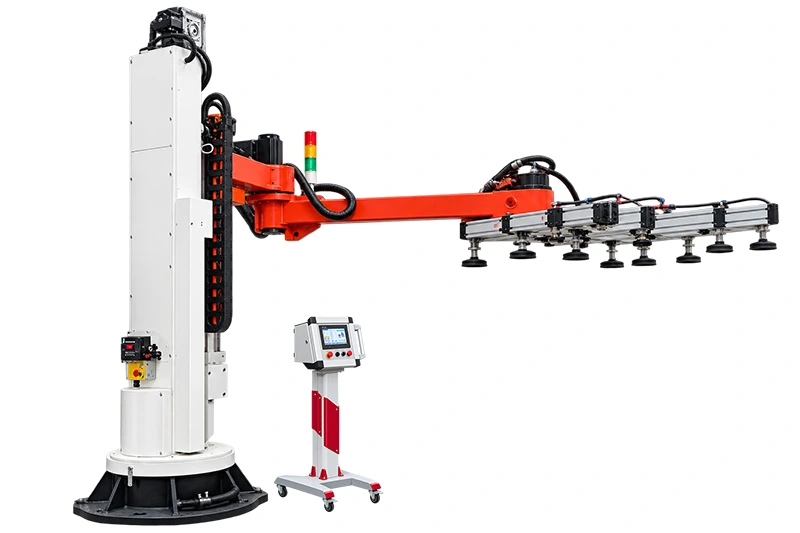
The product evidence supports a practical structure rather than a generic robot claim. The AutoG gallery shows a column-mounted industrial handling arm, articulated boom, cable management chain, stack light, and a multi-suction-pad vacuum head. A second view shows the floor-mounted arm together with a mobile control pedestal and multi-cup handling beam. These visible elements match the intended vacuum suction pallet transfer workflow: capture the pallet, adjust its orientation, move it clear of the press, and place it for automatic stacking. The application brief confirms automatic take-out, pallet transfer, automatic stacking, six-axis movement, two-press tending, and safe handling of approximately 80°C pallets. Payload, reach, vacuum hardware, installation dimensions, utilities, and PLC details should be confirmed in the project specification.
- 1250–1600 ton press compatibility must be confirmed against the final line layout and control sequence.
- 80°C pallet handling is a stated equipment capability; cooling time and thermal process limits require project confirmation.
- Robot payload, reach, vacuum specification, installation dimensions, utilities, and PLC interface are not fixed public specifications.
- Safety guarding, interlocks, risk assessment, and commissioning remain part of the complete press-line engineering scope.


