In logistics and warehouse management, pallets are a critical component affecting storage efficiency, transportation costs, and inventory control. However, many companies overlook a key factor in pallet selection: space utilization. An inefficient pallet design can waste valuable warehouse space, leading to unnecessary storage costs.
Today, we will compare the pressed pallet to traditional wooden pallets in terms of space utilization. We’ll analyze how a pressed pallet can help you save space and improve storage efficiency, with specific figures to show how every bit of savings translates into corporate profit.
The Limitations of Traditional Wooden Pallets
Traditional wooden pallets are not designed to maximize storage space. Their bulky, rigid structure and uneven surfaces make stacking unstable and inefficient. To ensure safety, a certain gap must be maintained between wooden pallets, which further increases storage costs and wastes valuable warehouse real estate.
- Wasted Space: The rough surfaces and imprecise design of wooden pallets create large gaps, leading to low stacking density.
- Inefficient Transport: Their heavy weight limits the amount of goods that can be transported in each shipment, reducing overall efficiency.
Optimizing Space with the Pressed Pallet
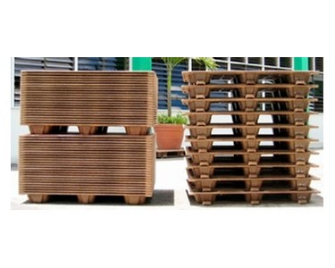
In contrast, the pressed pallet is engineered for stacking optimization and space-saving. Created using high-temperature and high-pressure compression molding, it features a smooth surface and uniform structure, ensuring stability and reducing gaps for more compact stacking.
- Precision Design: The smooth, solid surface allows for higher stacking density and stability.
- Lightweight Strength: It is lighter than wood yet capable of carrying heavy loads, enabling more goods to be transported and stored.
- High Stacking Capacity: Its design allows for vertical stacking, maximizing warehouse storage density.
For example, in a 1,000-cubic-meter warehouse, switching to a pressed pallet can increase stacking efficiency by 50%, adding 500 cubic meters of usable storage space. If each pallet holds goods valued at $500, this space saving translates to an additional storage value of $250,000.
Improving Warehouse Efficiency and Reducing Costs
An optimized pallet design doesn’t just save space; it improves overall warehouse efficiency. Staff can store and retrieve goods faster, reducing manual operation time and equipment usage. This leads to lower labor costs, reduced equipment operating expenses, and faster capital turnover.
If a warehouse has an annual operating cost of $50,000, improving storage efficiency by just 20% through a better pallet design could reduce labor and equipment costs by $10,000 annually.
Comparison Summary: Pressed Pallet vs. Traditional Wood
| Feature | Traditional Wooden Pallet | Pressed Pallet |
| Weight | Heavy, difficult to handle | Lightweight and strong, easy to stack |
| Stacking Efficiency | Low, wastes space | High, stable stacking with reduced gaps |
| Durability | Prone to breaking, frequent replacement | High durability and long service life |
| Space Utilization | Low, with unnecessary gaps | High, maximizes space utilization |
| Shipping Costs | Higher due to weight | Lower, reducing shipping weight |
| Warehousing Costs | High, due to wasted space | Low, saving storage space and cost |
Choosing a pressed pallet is a strategic move to optimize space, reduce costs, and improve capital turnover. If you are facing challenges with high storage costs and low space utilization, it is the clear choice for improving your operational efficiency.