Scope 3 packaging carbon
The Old Pallet on a Carbon Ledger: Heat-Treated Solid Wood and the Virgin-Polymer Alternative
A materials science group that publishes a cut of roughly 15 percent on Scope 1 and 2 by 2030, a 2050 net-zero commitment that includes Scope 3, and a circular solutions programme counted in millions of tonnes does not buy packaging on unit price alone any more. The pallet under a drum, an IBC or a jumbo bag has become a line in the supplier carbon file: it is re-bought by the thousand, it is rarely returned, and every unit carries the emissions of whatever substrate it was made from. This is the gap a presswood pallet closes, not by being described as green, but by being a molded wood pallet made from wood processing residue and recovered wood fibre, pressed in one piece with an MDI binder, so the packaging line in a Scope 3 file has a specific material to point at instead of a plastic pallet invoice.
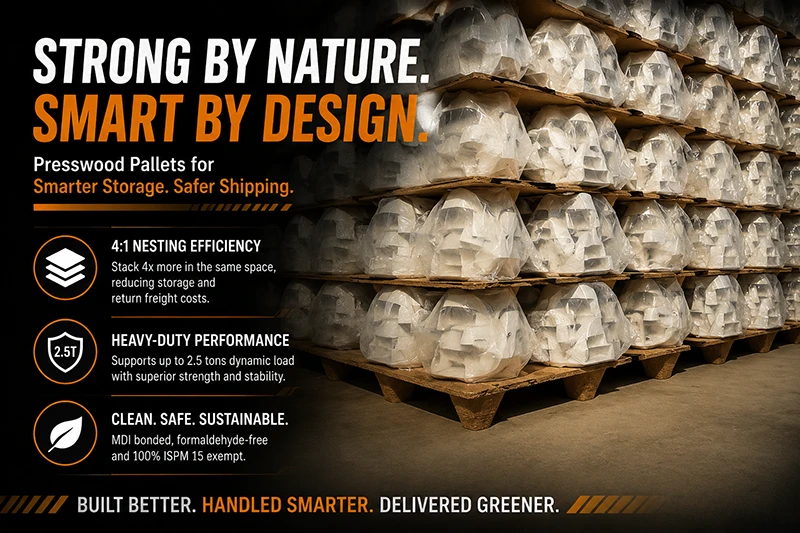
The Feedstock Answer: Wood Residue, Recovered Wood Fibre and a Named MDI Binder
Ampallet is a presswood pallet, and the material argument starts before the press. The fibre is wood chips, sawdust and offcuts from wood processing, with recovered wood fibre in the blend, not a virgin polymer granule and not a sawn board. That residue is steam dried from about 148 degrees Celsius down to about 138 degrees Celsius for around 30 minutes, blended with an MDI adhesive, and molded at about 220 degrees Celsius on a 1600 ton servo hydraulic press, where the pallet body reaches about 105 degrees Celsius internally and holds above 56 degrees Celsius for at least 30 minutes, with finished moisture at 9 percent or below. For a circular solutions programme that is being counted in millions of tonnes, the sequence matters more than the slogan: the feedstock is a residue stream, the binder is named on the material sheet, and the pallet is one molded body rather than boards, nails and separate feet. MDI cures by moisture instead of being moisture sensitive, with thickness swelling under 2 percent after 24 hours of water immersion in the tested position, and the product holds a CARB-NAF no added formaldehyde position, so the moisture and preservative story does not have to be bought back with a later treatment.
What the Structure Has to Carry: Deck Flatness, Nine Conical Feet and Load per Model
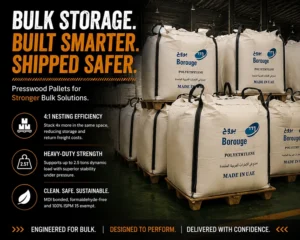
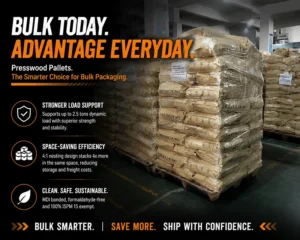
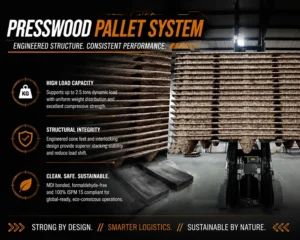
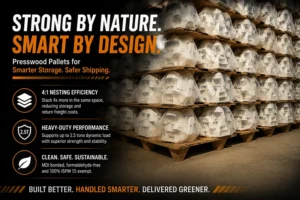
A carbon claim that cannot carry the load is not a packaging answer, so the structure is stated per size rather than as one extreme. The 1140 x 1140 x 135 mm nine-leg drum unit runs about 17 kg with 2500 kg dynamic and 7000 kg static load and 96 mm fork entry; the 1200 x 800 x 125 mm nine-leg unit runs about 13 to 14 kg with 2000 kg dynamic and 6000 kg static load and 92 mm fork entry; the 800 x 600 x 125 mm six-leg unit runs about 6 kg with 1000 kg dynamic and 3500 kg static load and 95 mm fork entry. All three are four-way entry with guide slots, molded round corners at R25 or R35, a corner height difference of 3 mm or less and a deck plane held near plus or minus 2 mm, which is what keeps an automatic line, an AGV or a palletizer on a stable read. The images on this page are the evidence a procurement team can inspect rather than a rendering to be trusted: the ribbed, fastener-free molded fibre deck of a single presswood pallet, and stacked one-piece units with their support feet visible, the geometry that gives about a 4 to 1 nesting ratio and roughly 0.75 metres of stack height for 20 empty units instead of about 2.7 metres. A 40HQ container carries 1650 of the 1200 x 800 units, 1452 of the 1200 x 1000 units, 1320 of the 1140 x 1140 units and 3744 of the 800 x 600 units, so one shipment moves fewer empty return legs and leaves less buffer floor to rent.
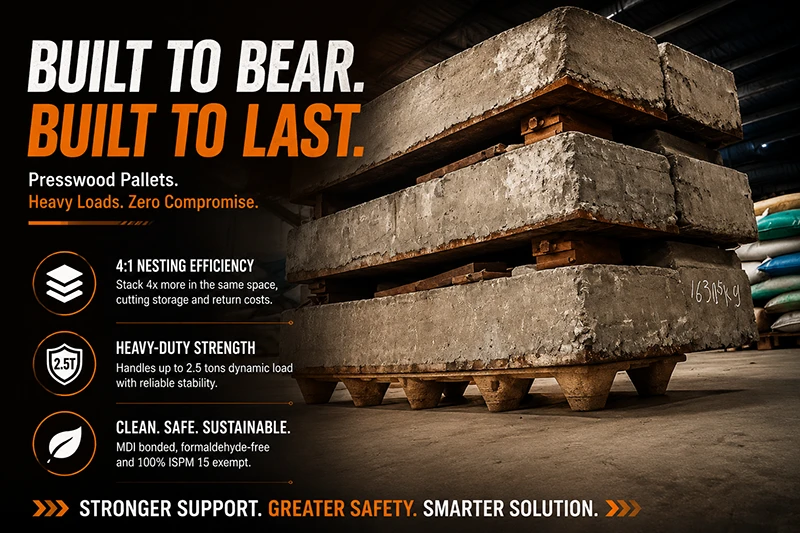
What the Buyer Files, and What This Pallet Does Not Claim
For the buyer, the result is a packaging line that holds up in three places: the feedstock is a residue stream rather than a virgin polymer, the body is one piece with no nail, no repair bench and no re-treatment after repair, and the empty unit nests four to one so the return leg and the buffer floor stop carrying air. Where end of life is wired into a circular solutions programme, a worn one-piece unit can be crushed back to fibre and re-molded on a molded pallet line instead of being re-boarded, which is a real loop rather than a recyclable label on a polymer body. The limits are stated as plainly as the numbers. This page does not claim a third party EPD, an FSC chain of custody or an ISO 14001 certificate, because no such document is held for this product. A project level figure of about 5.967 kg CO2e per pallet has been quoted for this line and is re-run per specification, plant and lane instead of being reused as a constant. Recycled content is confirmed per plant and per batch. The nestable single face unit is not a long term racking pallet. A one-piece body is replaced rather than locally repaired. Load is confirmed against the specification sheet for the actual drum count, stacking height and handling equipment. And a fumigation-free reading stays a destination rule and a forwarder question, never a blanket promise.
- Scope 3 packaging carbon problem bound to a named feedstock and substrate comparison
- old scheme problem stated for heat treated solid wood and virgin polymer plastic pallets
- load, fork entry and weight given per model instead of one advertised extreme
- limits stated: no EPD, FSC or ISO 14001 claim, carbon figure re-run per lane, nestable unit not a racking pallet