WOOD WASTE TO PALLET CONVERSION FOR TIMBER PRICE VOLATILITY AND ESG PRESSURE
When Timber Price Volatility Meets ESG Due Diligence
When virgin timber prices rise, then supply tightens, pallet operators carry a cost they cannot reliably pass through. At the same time, customers and investors ask for evidence on zero-deforestation sourcing, FSC or PEFC expectations, recycled content, and carbon reduction. AutoML uses a presswood pallet machine and a molded pallet production line to convert sawdust, wood waste, straw, bamboo powder, and other plant fibers into one-piece, nail-free pallets, creating a more controllable material route without hiding the cost of MDI adhesive or mold-release control.
Why AutoML Fits a Waste-Fiber Cost and Compliance Strategy
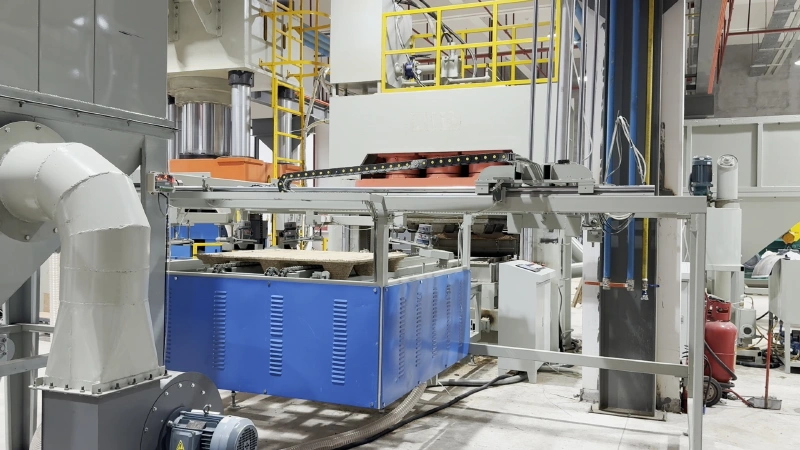
AutoML is a project-based presswood pallet production system, not just a standalone press. It connects crushing, drying, glue mixing, dosing or spreading, hot pressing, demolding, and stacking. Sawdust, wood chips, shavings, straw, bamboo powder, bagasse, and other lignocellulosic residues can be evaluated against local supply and trial data. This is Wood Waste to Pallet Conversion: recovered feedstock becomes a production input instead of an undervalued disposal stream. Retired pallets can be crushed and re-fed where contamination controls and process trials allow, giving ESG reporting a physical circular route. For food, pharma, or export-grade applications, selected MDI adhesive offers no formaldehyde, water resistance, and high strength. The trade-off is real: MDI costs more and can stick to molds, so an automatic release-agent spray system is required and must run normally. If it stops, mold damage is an operating cost, not a footnote. AutoML can be configured as a semi-automatic or fully automatic line around labor, utilities, plant layout, and output.
What the Line and Factory Evidence Show
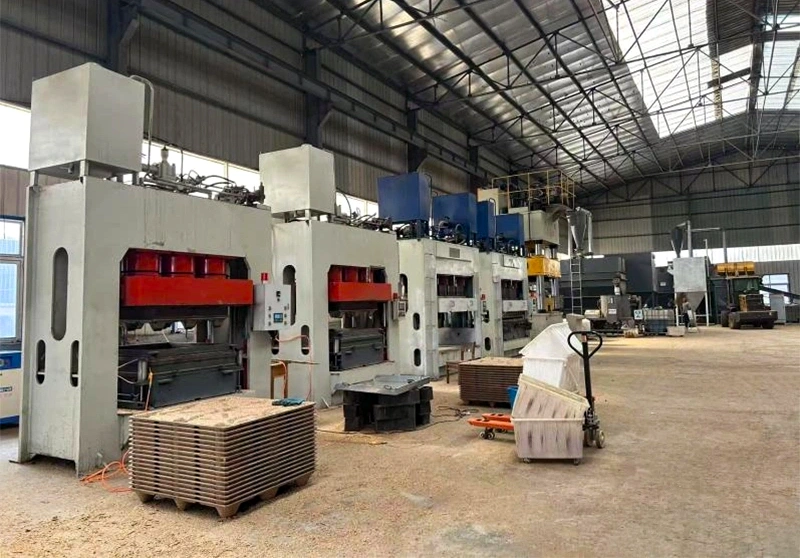
The factory evidence follows the material logic. The press-row image shows multiple heavy hydraulic hot presses, while the finished-pallet image shows the molded output after forming and handling. A common 1600T class reference uses 150 to 180 degrees Celsius, 15 to 20 MPa, and roughly 180 to 240 seconds per cycle, with product density around 0.8 to 1.2 grams per cubic centimeter. Feedstock particle size often begins around length 5 to 30 millimeters and thickness 2 to 5 millimeters. Moisture is not a universal fixed number: it must be matched to the MDI or UF and PF glue system and confirmed in trials. Common mold references include 1000 by 1000, 1100 by 1000, 1200 by 1000, 1219 by 1016, and custom sizes. The same equipment logic supports Nestable Pallet Manufacturing, an Industrial Pallet Press Machine setup, and an Automated Pallet Manufacturing Line. Final load rating, cycle time, utility demand, and output belong in the project technical agreement.
The Result: A Predictable Circular Pallet Cost Story
The result is a more predictable pallet-cost and compliance conversation, not a guaranteed fixed price. Local waste supply, energy, adhesive, utilization, maintenance, and financing still govern ROI. The practical gain is to replace part of virgin-timber exposure with controlled plant-fiber inputs, turn waste into an asset, and create a circular feed route for eligible retired pallets. One-piece, nail-free molded pallets can support export packaging and may provide an ISPM-15 Exempt Pallet Equipment or Fumigation-free Pallet Machine route when the applicable rules, buyer specifications, and product tests are satisfied. For an operator evaluating a High ROI Pallet Production Setup or Eco-friendly Pallet Production, start with a raw-material audit, moisture and glue trials, the MDI release-agent sequence, mold and load specifications, and a line-level payback model before selecting semi-automatic or fully automatic automation. A project review can then test the feedstock, pressing cycle, pallet performance, and evidence required for the customer’s ESG report.
- Virgin timber exposure can be reduced, but local fiber supply, preprocessing, energy, adhesive, utilization, and maintenance still determine actual pallet cost.
- Recovered sawdust, straw, bamboo powder, and eligible end-of-life pallets create a documented Wood Waste to Pallet Conversion route.
- MDI can support no-formaldehyde, water-resistant, high-strength output for selected food, pharma, and export applications after validation.
- MDI costs more and can stick to tooling, so the automatic release-agent spray system must operate normally to protect the mold.