Sawmill residue to sellable chips
The residue problem a sawmill actually carries
FAO's Appendix VI, Table 1 puts the sawmill residue balance in plain terms: rough conversion to finished lumber keeps only about 40–52% of the original log volume, while slabs, edgings and trimmings account for roughly 34%, sawdust for around 12%, and bark for another 12%—so about 46% of the incoming log leaves the saw as a side stream that has to go somewhere. FAO also notes that those slabs, edgings and sawdust can feed particleboard lines or combustion, which is why chipping is the gateway between yard waste and downstream value. For a mill sawing 100,000 m³ of rubberwood a year, the cumulative volume of slabs, edgings and trimmings is large enough that open-pile storage carries real fire, handling and environmental-accounting cost. The figure of 46% is an FAO industry benchmark, not a customer-specific number, and the chips Shred produces are one step in that chain—drying, pelleting, board pressing or boiler combustion each sit downstream as separate processes.
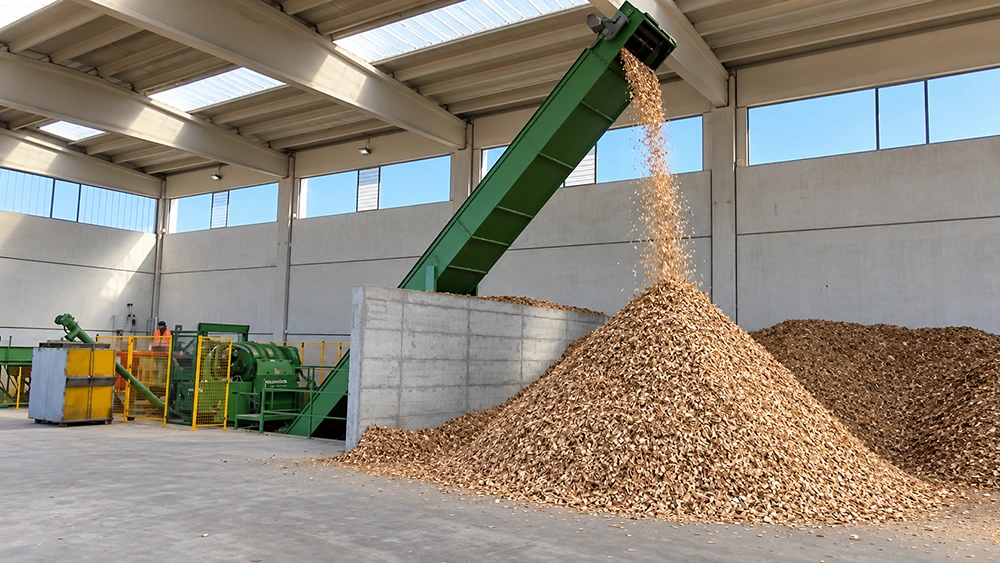
Sawmills recover only part of every log. The rest—slabs, edgings, offcuts, sawdust and bark—sits on the yard as a disposal cost, a fire load and a compliance question. A stationary drum wood chip making machine turns that stream into uniform 30–35 mm chips that particleboard plants, pellet mills, MDF lines and in-house boilers can absorb, so the same residue that costs money to remove becomes a sellable or in-house fuel input.
Why a drum wood chipper fits irregular sawmill residue
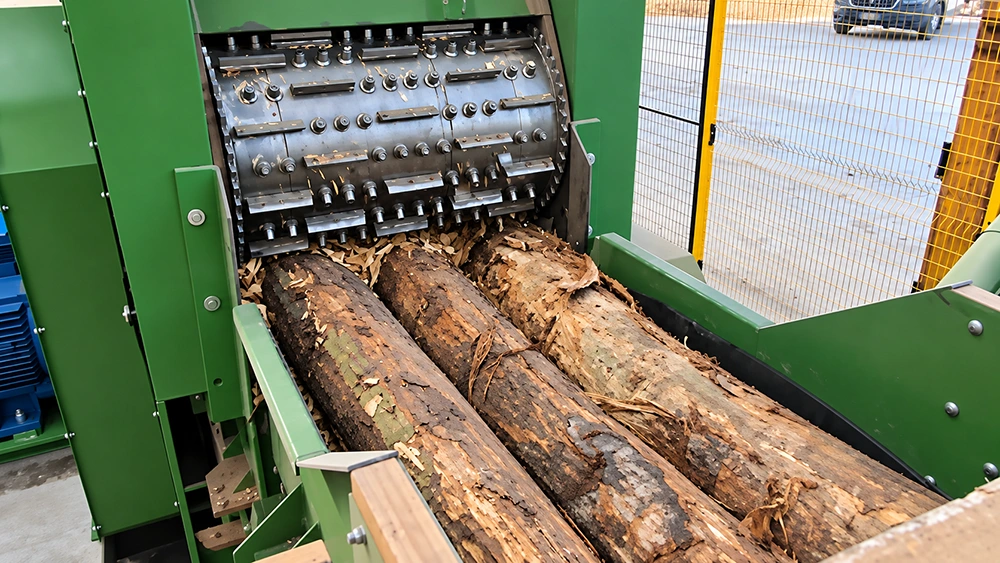
Slabs, edgings and trimmings arrive curved, wet, mixed in thickness and often carry grit. Shred's geometry is built for that feed: the feed inlet is set perpendicular to the knife roller axis, two hydraulic-driven feed rollers pull the material in, and the upper feed roller floats on a hydraulic cylinder so the nip pressure stays even when slab thickness changes. A chipping screen underneath the knife roller returns oversize pieces to the cutting zone until they pass, so the discharge is a controlled 30–35 mm chip rather than a mix of splinters and chunks. The same FAO source that defines the residue balance recommends drum-style reduction for slabs and edgings, because the perpendicular feed and the screen loop tolerate irregular geometry in a way that a disc rotor does not. Disc chippers remain the reference for clean, uniform pulp logs; they are not the reference for what comes off a sawmill green chain.
Where X-215 sits in a sawmill residue flow
X-215 is the 45 kW entry point: a 600 mm knife roller, 400 × 180 mm feed opening, 160 mm maximum log diameter, and 4–5 t/h nameplate capacity on the official product page. The nameplate number is given as published and is not paired with a stated moisture, density or species baseline, so it should be read as a sizing signal rather than a guaranteed throughput on any specific rubberwood, pine or eucalyptus mix. For a mid-volume mill where slab and edging tonnage is modest, X-215 is the lowest CAPEX point at which a stationary wood chip making machine becomes worth installing instead of paying a third party to haul residue away, and the same chips can feed an in-house boiler or a local pellet or particleboard buyer. X-216 (55 kW, 6–8 t/h, 540 × 240 mm inlet, 200 mm max log) and X-218 (110 kW, 8–12 t/h, 680 × 310 mm inlet, 300 mm max log) scale the same geometry upward for higher residue flows and larger cross-sections. Across the three models the official feed-inlet area scales roughly 1 : 1.8 : 2.9 from X-215 to X-218, and the main motor scales 45 → 55 → 110 kW, so selection starts with the largest piece that has to enter the machine, not with the t/h number.
What the equipment actually contains
The body is welded from high-strength steel plate. Two gear-motor stations drive the upper and lower feed roller modules through chain-and-sprocket synchronization, with the chain runs shielded by metal guards. The knife roller carries alloy-steel fly knives fixed by dedicated bolts and clamp blocks; the official parameter table lists 2 fly knives per model. A V-belt drive from the main motor to a large pulley on the knife roller shaft gives a natural overload-slip behavior rather than a rigid coupling. The hydraulic pack powers the floating upper feed roller during running and, during maintenance, opens the upper housing and lifts the upper feed module so the operator can change fly knives and adjust the fly-knife / bed-knife gap, which is the working parameter that decides chip quality. The electrical package is a soft-start cabinet at 380 V with a frequency inverter for feed speed and a wireless remote for start and stop; there is no HMI or programmable panel because the operating sequence is one-directional, which suits low-skill operators but reads as lower automation to buyers expecting a touchscreen. A dust collector is listed on the official product page to support cleaner operation.
Evidence and what is not yet on paper
The capacity figures, knife-roller diameters, feed-opening dimensions, knife counts, motor powers and 30–35 mm chip length above are taken from the published X-215 / X-216 / X-218 parameter table on the official product page. Total power on that page (49.4 / 61 / 118 kW for X-215 / X-216 / X-218) reconciles to main motor plus two feed motors only; it does not visibly include the separately listed lower pressure roller power of 4 / 4 / 5.5 kW, and any hydraulic-pump motor is not shown in the table, so the published total should be treated as a partial figure until engineering reconciles it. Overall machine weight, overall dimensions L×W×H, conveyor belt length and power, hydraulic pump motor power, noise level, screen aperture, blade material grade and HRC, steel plate thickness, packing volume and a moisture / density / species capacity baseline are not disclosed on the official page; these are the items a buyer needs for freight quotes, plant layout, transformer sizing and ROI work, and they should be requested before purchase rather than inferred from competitor data. The page also lists Shred as suitable for construction formwork and demolition wood; the official parameter table does not list a metal-removal device on this model, and EMP's separate Wood Crusher is the model that carries an automatic iron-removal unit, so nail-bearing feedstock should be confirmed with engineering before being routed to Shred.
From yard waste to a chip revenue line
The economics follow directly from the FAO balance: roughly 46% of incoming log volume leaves as residue, and the same FAO appendix lists slabs, edgings and sawdust as particleboard or fuel feed. A stationary drum wood chip making machine placed at the end of the green chain converts that stream into a defined 30–35 mm chip on a continuous basis, with the screen loop holding size consistency and the hydraulic feed holding the rate steady across wet or curved material. For a mill already selling into particleboard, pellet or boiler markets, that means the disposal line on the cost sheet can be replaced by a chip line on the revenue sheet, with X-215 sized for modest tonnage and X-216 / X-218 available as residue volume grows. For a mill sawing 100,000 m³ of rubberwood a year, the residue stream is large enough that even a conservative share directed through a chipper changes the unit economics of the whole log. The role of Shred in that chain is the first step—chip size, chip uniformity and stable feed—not the full conversion to pellets, boards or energy, which remain separate downstream processes.
Buyer checks before specifying a model
1. Largest piece that must enter the machine: this is set by feed opening and maximum log diameter (160 / 200 / 300 mm for X-215 / X-216 / X-218), and it is a hard physical limit. 2. Residue moisture and species: nameplate t/h is published without a stated moisture, density or species baseline, so the figure should be read as a sizing signal, not a guaranteed throughput on any specific wood. 3. Total power for the electrical room: reconcile the published 49.4 / 61 / 118 kW with the lower pressure roller power of 4 / 4 / 5.5 kW and any hydraulic-pump motor before sizing the transformer and cable. 4. Downstream chip destination: particleboard, MDF, pellet or in-house boiler each have their own chip-size and moisture expectations downstream of the chipper. 5. Nail-bearing feedstock: route construction formwork and demolition wood through EMP's Wood Crusher with its automatic iron-removal unit, or confirm a metal-removal solution with engineering before sending that stream to Shred. 6. Conveyor and dust-collection interfaces: conveyor lengths and power are not on the official parameter table and should be requested when laying out the green-chain extension. 7. CE and EU Machinery Regulation 2023/1230: the legacy Machinery Directive 2006/42/EC is due to be replaced on 2027-01-20, so EU-bound orders should confirm the current compliance basis in writing. 8. Service footprint: on-site commissioning, spare-parts lead time and knife-replacement procedure are the practical items that decide daily uptime once the machine is installed.
How this maps to a sawmill residue line
Sawmill green chain → Shred drum wood chip making machine (X-215 / X-216 / X-218, 30–35 mm chips) → conveyor and dust collection → in-house boiler, or sale to particleboard / MDF / pellet plant. Shred's role is the chipping step; drying, pelleting, board pressing and combustion sit downstream as their own processes.
- canonical_product_resolved:Shred
- images_resolved_to_canonical_product_gallery
- content_within_product_published_parameters_only
- capacity_baseline_gap_disclosed
- total_power_discrepancy_disclosed
- nail_bearing_feedstock_routing_disclosed
- ce_and_2023_1230_window_disclosed
- no_absolute_efficiency_claim
- no_invented_throughput_or_roi_numbers
- shred_vs_wood_crusher_boundary_disclosed
- customer_attribution_preserved_for_46_percent_benchmark