Molded Pallet Line · Raw Material Cost Basis
The Plant This Is Written For: A Price List That Follows the Lumber Market
A pallet plant that buys sawn lumber carries the lumber market inside every quote: board prices move, the price list moves with them, and planning a quarter ahead turns into a bet on a commodity the plant does not trade. This page follows that problem onto a wood pallet hydraulic press, where the raw material basis changes from purchased lumber to recovered wood waste, sawdust and recycled wood, crushed to about 5 mm or finer, dried to 8 to 12 percent moisture and mixed with MDI adhesive before one heated cycle forms a finished molded pallet. The boundary is stated plainly: the press is not sold as a stand-alone machine, and the crush, dry and glue stages have to be in place before it forms anything.
Why the Old Basis Fails: Sawn Lumber Is a Traded Commodity
A traditional nailed wooden pallet, a heat-treated wooden pallet and a plywood pallet all begin as purchased lumber or panel, which means the cost of the unit is fixed by a commodity market the plant does not control and cannot contract around for long. Add the treatment step that solid wood packaging carries on export lanes, plus the labour at the nailing benches, and the plant is managing three cost lines that move for reasons outside its own floor. That is why the fix is not a cheaper board or a sharper quote: it is a different input. A wood pallet hydraulic press changes what the plant buys, not what it charges.
What the Press Runs On Instead: Recovered Wood, Not Purchased Lumber
A molded pallet production line runs on recovered wood: sawdust, wood waste, recycled wood, wood chip, wood shavings and agricultural residue. The material is crushed to a particle size of about 5 mm or finer, dried at 150 to 180 degrees Celsius to a moisture content of 8 to 12 percent, and mixed with MDI adhesive in a glue mixer. Only then does the press close. That sequence is why the press is not sold as a stand-alone machine: crush, dry and glue are part of the product, and the raw material basis of the plant shifts from buying lumber to collecting waste wood, which is a local stream rather than a traded one. Recovery volume has grown in step with that shift, with US recovered pallet counts rising from roughly 42 million to 83 million units between 2020 and 2022.
Structure, Tonnage and What Leaves the Gate
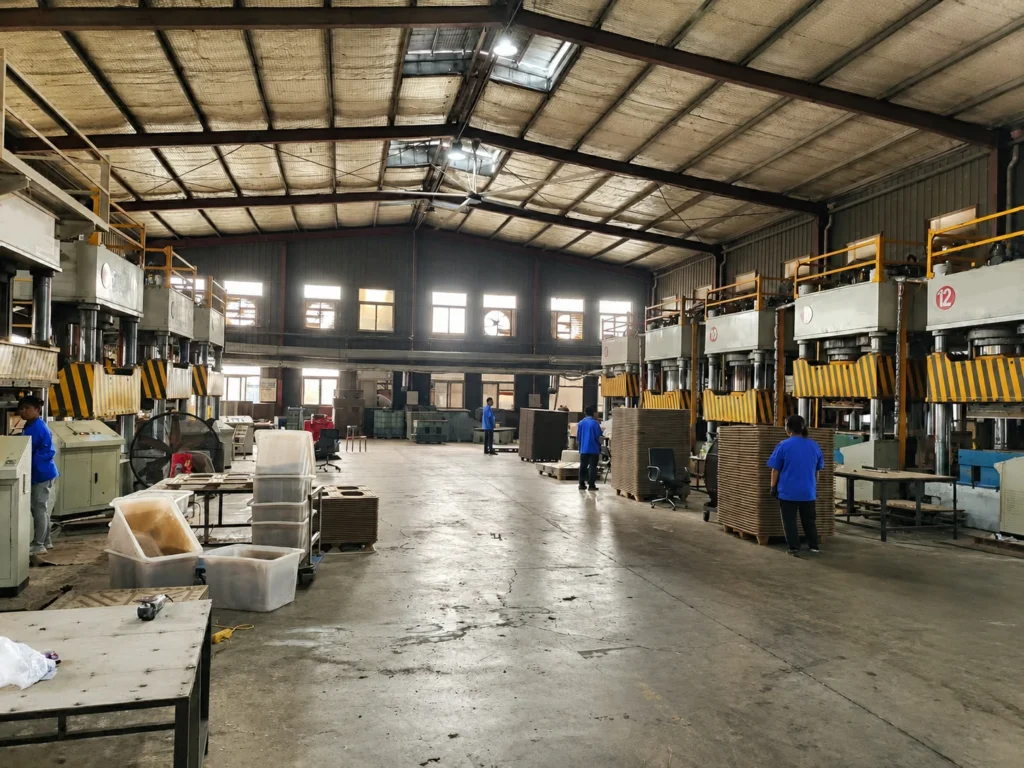
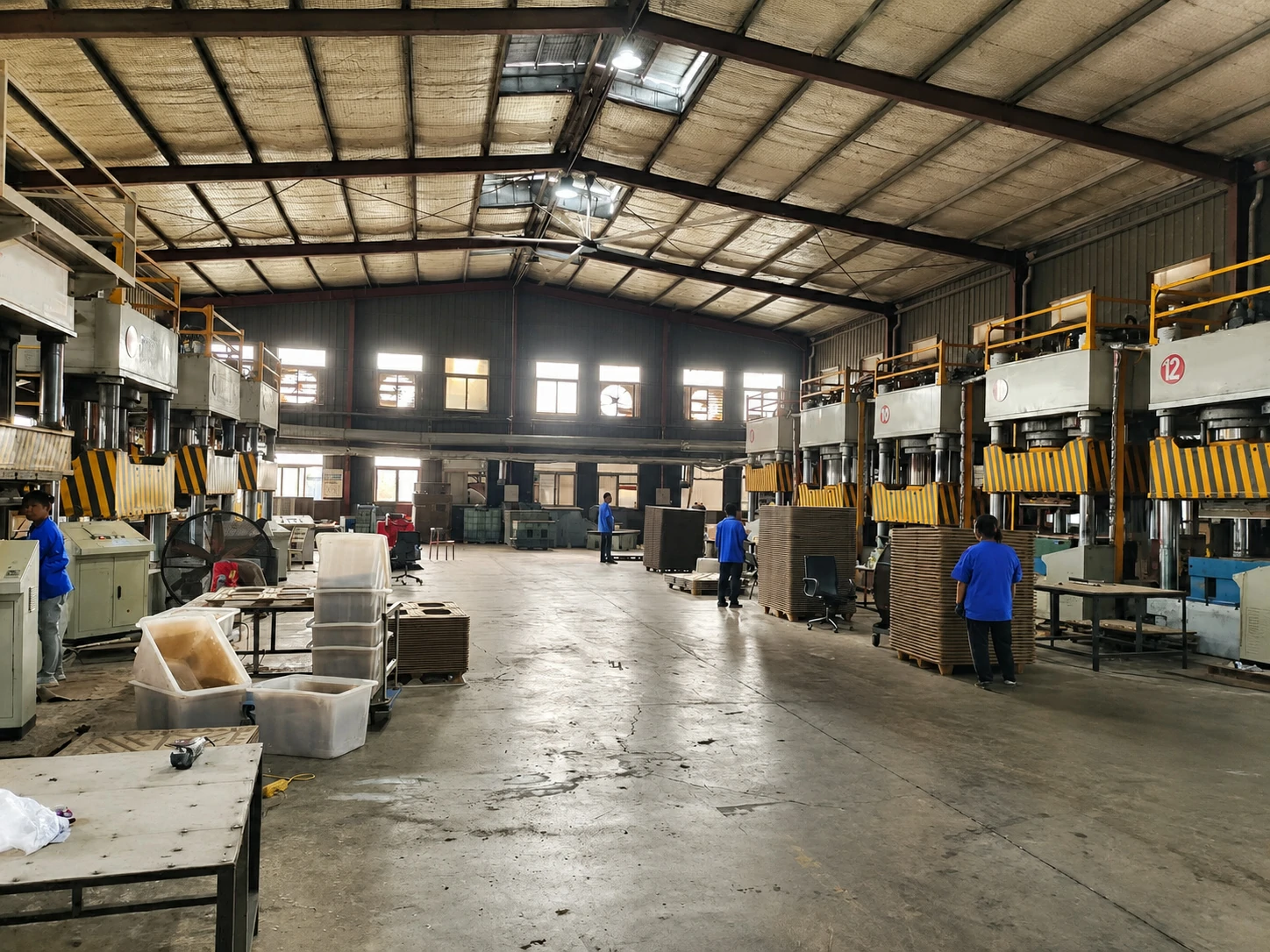
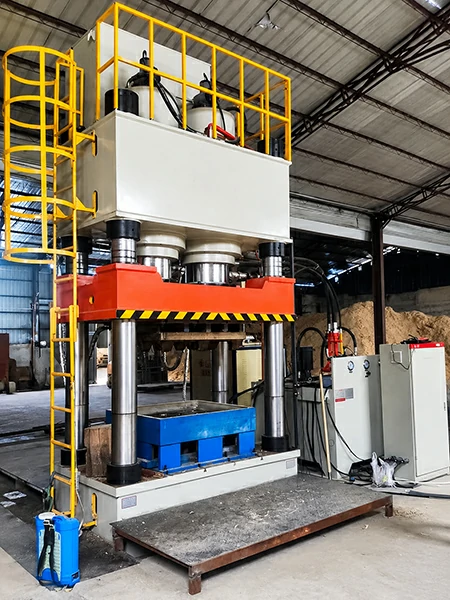
The machine is a Y32 three-beam four-column hydraulic press, with a top beam, a slide and a worktable carried on four solid columns, built for hot press molding rather than general pressing. Published tonnage runs from 1250 to 2500 ton, with a platen up to 2500 x 1700 mm, slide stroke from 700 to 900 mm, opening height from 1200 to 1600 mm, motor power from 55 to 75 kW and a system working pressure of 25 MPa. The molding cycle sits at 180 to 240 seconds, and one-press forming delivers one finished pallet per cycle, which is where the throughput of the line is set. The photographs on this page are the plant level evidence: a row of press stations with safety guards and independent control cabinets, and a single machine showing its four-column frame, chrome guide pillars, hydraulic power unit and control cabinet. What leaves the gate is a one-piece molded pallet with no nails and no splinters, a uniform load surface, a nestable design that stacks about four to one, and a fumigation-free pallet that sits outside the ISPM-15 treatment route for export lanes. The boundary belongs before the quote: a line like this needs roughly 30,000 pallets a year of demand, 600 square metres of floor, 6 metres of clear height and about 200 kW of available power, and the press is delivered as part of the line rather than on its own.
- Keyword wood pallet hydraulic press appears in the title, slug, intro and both image alt strings
- Both image source_path values resolve inside the resolved canonical product designer gallery for MldP
- Every section body is plain text with no HTML tags, attributes, Markdown or angle brackets
- Only MldP blog brief facts are used; the crush, dry and glue boundary and the not-sold-stand-alone limit are stated


