Chemical, jumbo bag and drum handling
Where a Nailed Wood Pallet Meets a Jumbo Bag and a Coated Drum
A chemical site handling FIBC jumbo bags and coated drums keeps finding the same fault under the load: a solid wood pallet is an assembly of boards and nails, and every re-boarded unit puts metal and splintered timber back into a lane where a person still touches the deck by hand. This page follows that fault from the bag surface and the drum base ring to a nail-free presswood pallet molded in one piece from wood fibre and an MDI binder, where deck, ribs and support feet are pressed as one body with no nail shank to back out and no sawn edge to lift a splinter.
Why the Solid Wood Pallet Keeps Producing Nails and Splinters
The defect is not a bad batch, it is the construction. A nailed wood pallet is an assembly: stringers, deck boards, blocks and a few dozen fasteners holding them together, and every repair adds holes to the same board. Heat treatment solves a phytosanitary problem, not a mechanical one, so a heat treated wood pallet still leaves the treatment chamber with the same nails in the same place. Moisture does the rest. A pallet that moves between a humid yard and a dry warehouse swells and shrinks across the board, the nail shank loses its grip in the hole it opened, and the head rises. Sawn board edges hold a raw fibre end that dries, splits and lifts. Incoming inspection can catch a nail head that is visible on the day it is checked, but it cannot catch the fastener that will back out on the fourth trip, and it cannot inspect the underside of a loaded deck at all. Re-boarding keeps the pallet in service and keeps the exposure in service with it, which is why sites that have already banned loose nails from their own maintenance still find them under their own bags.
One-Piece Molding Takes the Metal and the Splinter Edge Out of the Pallet
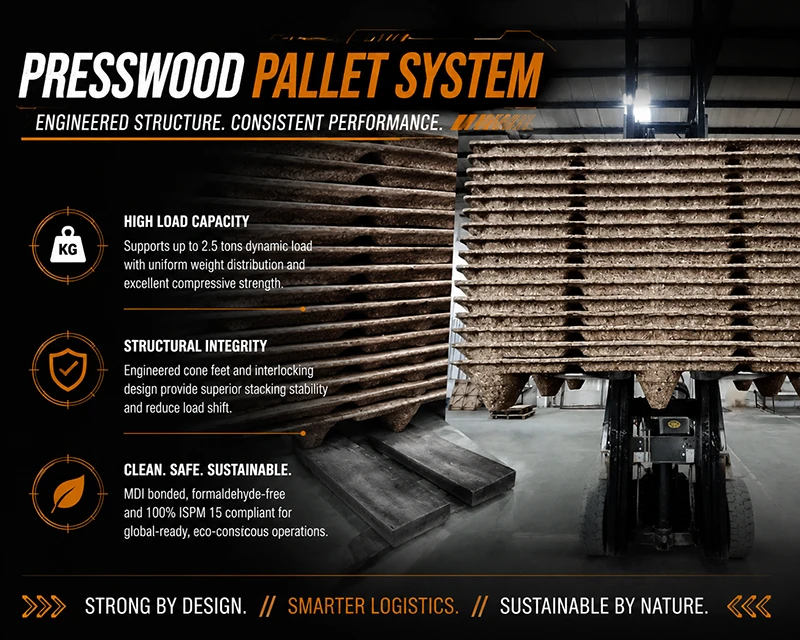
Ampallet is a pressed wood pallet, and the difference that matters on this job is that there is no assembly in it. Recovered wood fibre is blended with an MDI polyisocyanate binder and pressed in a steel mold on a 1600 ton hydraulic press at about 150 to 180 degrees Celsius, so the deck face, the reinforcing ribs and the nine conical support feet come out of the tool as one body at roughly 9 percent finished moisture, with no nail, no staple, no separate foot and no board joint. There is nothing in the pallet that can back out, because no fastener was ever driven into it. The edge is formed by the mold rather than sawn, with chamfered and round corners at R25 or R35 depending on the specification, so the trim that meets an FIBC bag is a closed, pressed face instead of a raw fibre end that lifts a splinter under a glove. Moisture curing MDI also means the deck does not delaminate the way a urea formaldehyde bonded board does when it takes water in a humid warehouse or a sea freight container, and the binder carries a no added formaldehyde position that keeps a food, pharma or personal care lane out of a separate material argument. As processed wood the pallet also sits outside the solid wood heat treatment cycle, which is a destination and forwarder question rather than a pallet specification question.
What the Lane Actually Gets: Loads, Fork Entry and the Safety Result
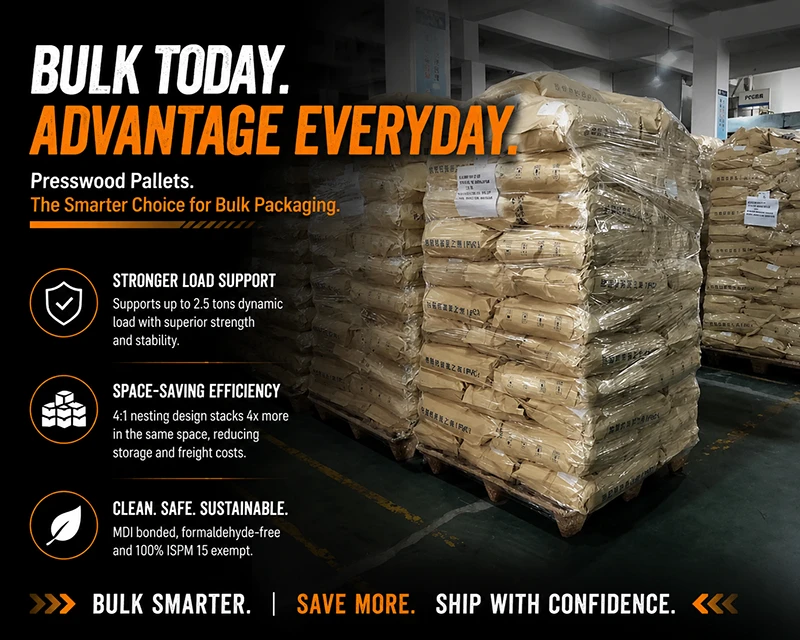
The specification is set per mold, so the numbers below are references confirmed against the order rather than a universal rating. The chemical drum unit at 1140 x 1140 x 135 mm runs about 17 kg with 2500 kg dynamic and 7000 kg static load, four-way entry and a fork entry of 96 plus or minus 3 mm with guide slots that square the forks up on the first approach. The 1200 x 800 x 125 mm nine-leg unit runs about 14 kg at 2000 kg dynamic and 6000 kg static, and the 800 x 600 x 125 mm six-leg unit runs about 6 kg at 1000 kg dynamic and 3500 kg static. Deck flatness is held near plus or minus 2 mm by the tooling, the inverted cone feet nest at roughly 4 to 1 when the pallets are empty, and the two photographs on this page show the same two facts from the field side: bags sitting on a deck with no fastener head under them, and a deck edge that is a molded face rather than a board end. The result is not a new load rating, it is the removal of one mechanical hazard from the lane. Nothing under the bag can puncture the weave, nothing under the drum can scrape the base ring coating, and nothing on the deck can cut a hand that touches it. The limits are stated plainly: the nestable single-face geometry is not a long-term racking pallet, a one-piece body cannot be re-boarded on site so a damaged unit is replaced rather than repaired, dynamic and static load follow the confirmed specification, and removing a nail and splinter exposure is not the same as a claim of zero incidents, because the EHS programme around the pallet stays the customer's own.
- Section bodies are plain text with no tag, attribute or markdown character
- The five-part chain runs from jumbo bag and drum damage to old pallet construction to one-piece molding to parameters to limits
- Load, size and fork entry figures are given as model references confirmed per specification
- Limits cover racking, field repair, per-spec load and the absence of any zero-incident claim



