CHEMICAL SITE PALLET POOL
A chemical site buys pallets by the thousand and stores the empty ones by the hectare
A chemical group running a couple of hundred sites across continents moves drums, jumbo bags and IBCs on pallets, and pays for the empty ones twice: once to buy them, and again on every square metre of covered floor they hold while waiting for a load. Non-nestable solid wood and plastic pallets return nothing to the building, because an empty unit takes the same floor as a loaded one. Ampallet is a nestable presswood pallet molded in one piece from wood fibre and MDI adhesive, with inverted cone feet that let empty units settle into each other at roughly a 4 to 1 nesting ratio, so the same pallet count occupies about a quarter of the floor, released for production, racking or rent that stops being paid. Load, nesting and compliance figures are confirmed per site rather than assumed.
Neither the solid wood pallet nor the plastic pallet gives that floor back
The incumbents are honest about this: a solid wood pallet, whether a GMA block or a Euro footprint, is a rigid body with fixed feet and no nesting geometry, so an empty unit occupies the same footprint as a loaded one and the yard stacks them like plates of timber. A stack of empty solid wood pallets runs to around 2.7 metres for the same count that a nested unit settles into roughly 0.75 metres. Heavy-duty plastic pallets behave the same way in most specifications, at a far higher unit cost, which is a poor match for one-way export lanes and an even worse one for a buffer that exists to be idle. Both categories also carry follow-on duties: nails and broken boards at the repair bench, ISPM 15 heat treatment, marking and certificate custody on every cross-border leg, and a forklift hour for every move because the load cannot be consolidated into a shorter stack.
Why a nestable presswood pallet fits a multi-site drum and bag flow
Ampallet is molded in one piece from processed wood fibre and MDI adhesive, with an inverted cone foot geometry instead of a fixed block, so the feet of one unit drop into the deck recesses of the one below. About four empty units then occupy the height of one: the same quantity a site already owns sits on roughly a quarter of the floor, and the pallet yard shrinks instead of growing with the buffer. The unit is light for its class, about 13 to 14 kg on a 1200 x 800 footprint, so a nested stack is still a single-forklift lift instead of a two-person job. The material position matters across borders too: as processed wood the pallet supports a fumigation-free reading, which removes the heat treatment chamber, the stamp and the certificate trail from a site-to-site transfer. Four-way entry and guide slots keep it compatible with the drum handling a chemical plant already runs, and the MDI binder holds a no-added-formaldehyde position rather than the urea formaldehyde one a low-cost pressed pallet carries.
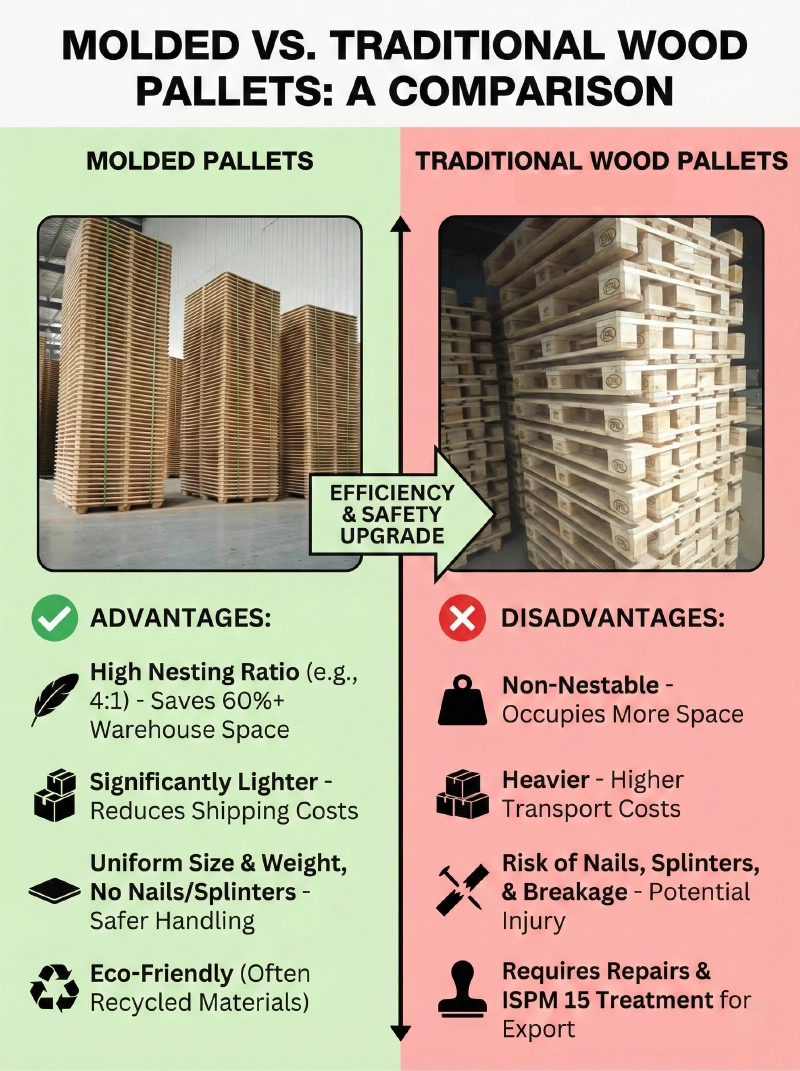
The structure, load and fork geometry behind that quarter, and what the site gets back
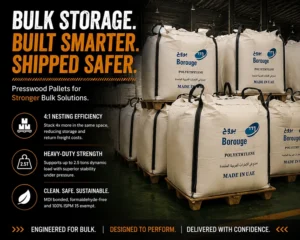
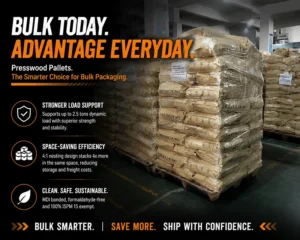
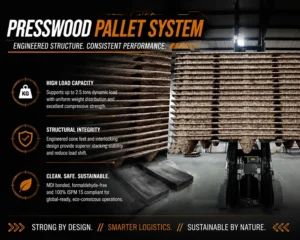
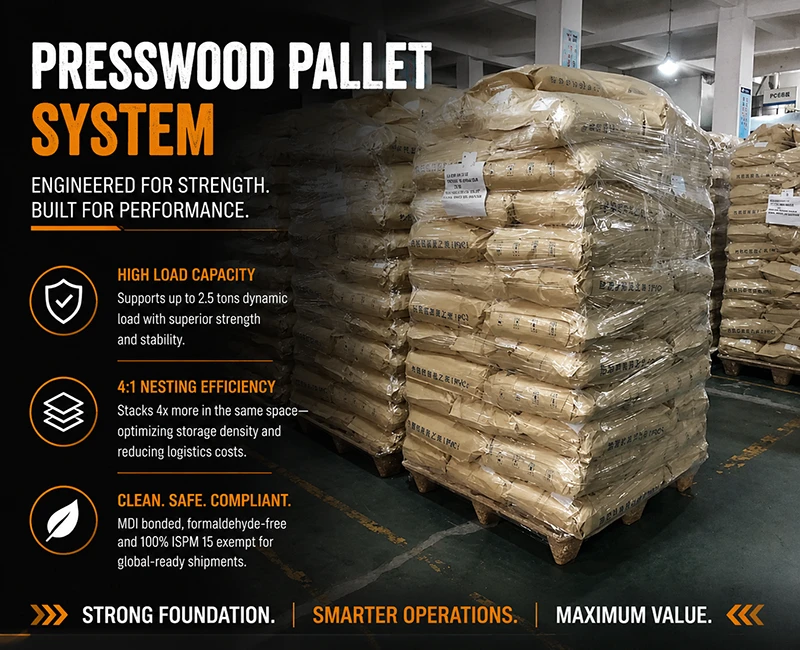
Design references put the 1140 x 1140 chemical drum size at 2500 kg dynamic and 7000 kg static load, with 92 to 96 mm fork entry height, guide slots and four-way entry so the drum bay can pick from any side; deck flatness repeats to about plus or minus 2 mm, which is what lets a palletizer, conveyor or AGV lane read the unit instead of correcting it. The first photo shows what the nesting geometry looks like in practice, nested stacks wrapped and consolidated in a warehouse with no air between units; the second shows the comparison a buyer actually wants, nestable molded units against a traditional wood pallet stack of the same count. Published positioning places empty pallet storage saving near 70 percent and storage capacity at about 2.5 times on the same floor, with delivery frequency for empty pallets down by roughly 75 percent once a nested stack replaces repeated truckloads. The result on site is floor released back to production, a rent and forklift-hour line that falls instead of tracking pallet volume, and a pallet pool that can be rebalanced between plants without booking a chamber or a full truck for air. Limits are stated plainly: the nestable single-face unit is not a racking pallet, and load, nesting ratio, flatness and floor saving are recalculated per site, mold and lane.
- Nesting ratio, stack height and floor saving are recalculated per site and per mold; the 4 to 1 ratio, about 70 percent storage saving and 2.5 times capacity are positioning references, not guarantees.
- The 2500 kg dynamic and 7000 kg static load figures belong to the 1140 x 1140 chemical drum size and are confirmed per project rather than carried across every specification.
- The nestable single-face unit is not a racking pallet, so beam racking keeps its own pallet specification rather than being replaced by this unit.
- Fumigation-free use follows the processed wood material position and stays subject to destination plant protection rules and forwarder confirmation, with MDI named as the binder on the material sheet.