Automated warehouse pallet tolerance
The Takt That Stops When One Pallet Is 6 mm Out
A chemical site that has moved its internal moves onto AGV fleets, an automatic store and a palletizer does not buy a pallet as a platform any more, it buys it as a tolerance. Nailed wood pallets arrive with several millimetres of spread in length and width, a deck plane that moves between units, and boards that split under a drum load, so a lane that is set up perfectly still stops: a fork cannot square to a pallet that is 6 mm out, a photo-eye reads a load that was not there, a roller misses a broken board and the whole takt waits for a person. Ampallet compressed wood pallets are molded one piece in a steel mold from wood fibre and MDI adhesive, with the specification sheet holding height at plus or minus 2 mm and corner height difference under 3 mm, four-way entry with guide slots, no nails and no separate feet to come loose. This page follows the problem through one automated chemical warehouse, then sets out the structure, the numbers and the limits a lane can actually be specified against.
Where a Nailed Wood Pallet Breaks an Automated Lane
The old scheme at a site like this is the heat treated solid wood pallet, bought on price and graded by eye. Its length and width are not held to a tool; a nailed deck sits on blocks that are assembled by hand, so one unit squares and the next one does not, and the spread only grows when the pallet has been wet and dried twice. Then the failure modes arrive in the order the automation meets them. A protruding nail head or a board that splits along a nail line catches a roller, the load stops short of the photo-eye and the line faults out. A pallet that has swollen or warped sits down unevenly in the AS/RS slot and the crane refuses it. Loose slivers and broken board ends end up in the conveyor pit, where they are cleaned by hand at the weekend. Every one of those events costs production time, and the cost does not show up on the pallet invoice. It shows up as a stopped line, a missed dispatch window and a load someone has to re-stack.
Why a Molded One-Piece Pallet Holds the Tolerance
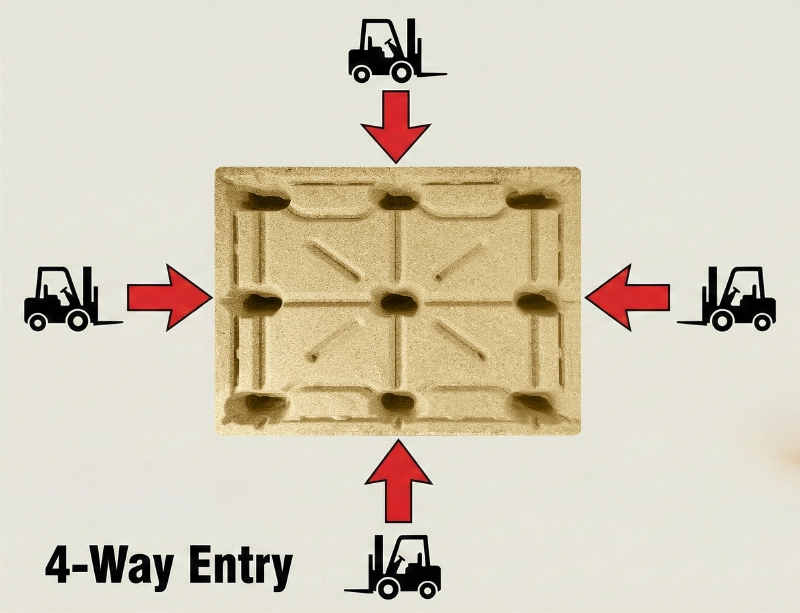
Ampallet takes the pallet out of the assembly shop and puts it into a mold. Wood fibre and MDI adhesive are pressed one piece at high temperature and pressure, so the deck, the ribs and the nine conical support feet are a single body of material with no nails, no bolts and no separate blocks to shift. The tolerance therefore comes from the tooling rather than from a repair bench: the specification sheet holds overall height at plus or minus 2 mm, corner height difference at 3 mm or less, and round corners at R25 or R35 plus or minus 2 mm, which is the difference between a pallet an integrator can design a lane around and one that has to be sorted before it is loaded. The finished moisture content sits at 9 percent or below, so a unit does not swell into a slot after a humid sea leg. Entry is four-way with guide slots, so a fork, a pallet jack or an AGV lift can approach from any side and self-align on the slots instead of hunting for a gap, and the flat, nail-free deck gives the vacuum cups, the gripper pads and the flow-wrap film nothing to tear on.
The Numbers a Lane Can Be Specified Against
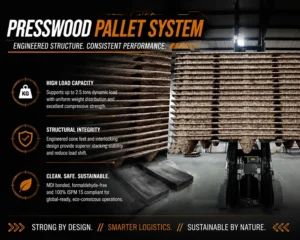
The references below come from the Ampallet specification sheet and are stated per model, not for the range as a whole. The 1200 x 800 x 125 nine-leg unit runs 14 kg with a 2000 kg dynamic and 6000 kg static reference and 92 plus or minus 3 mm fork entry; the 1140 x 1140 x 135 nine-leg drum unit runs 17 plus or minus 1 kg with 2500 kg dynamic and 7000 kg static and 96 plus or minus 3 mm fork entry; the 800 x 600 x 125 six-leg unit for small cartons runs 6 plus or minus 1 kg with 1000 kg dynamic and 3500 kg static and 95 plus or minus 3 mm entry. Length and width carry a 5 mm minus and 8 mm plus allowance by the sheet, which is why a lane drawing should be built on the tolerance column and the mold, not on the nominal figure. Two limits are worth stating plainly. This is a nestable single-face molded pallet, so it is not a long-term racking pallet, and where a store books pallets into beam racks a block pallet stays a complementary item. And the pallet interface at the AGV fork, the roller section, the pin stop and the load presence sensor is confirmed with the integrator and the site per project, because tolerance and load are re-checked against each lane rather than assumed from one installation. Read the two images above as structure evidence: the four-way entry pockets and ribbed underside, and the one-piece molded deck with its reinforced rib pattern. Get the tolerance into the lane drawing and the takt stops depending on which pallet the shift happened to load.
- Tolerance and load figures are quoted per model from the Ampallet specification sheet, not as a fleet-wide guarantee.
- No claim is made that the pallet is a long-term racking pallet; block pallets remain a complementary category for beam racks.
- AGV fork, roller, pin stop and sensor interface are stated as project-confirmed with the integrator and site.
- No jam-reduction, downtime or OEE percentage is claimed; the benefit is described as structural and dimensional, not measured.