One-way export pallets
The lane that creates the cost: chemical drums and jumbo bags that ship one way
A chemical exporter that ships drums, jumbo bags and bagged mineral filler into ninety-plus countries pays for the pallet twice: once on the outbound lane and once again on every empty unit that has to be stored, repositioned or written off. Ampallet is a nestable presswood pallet pressed in one piece from wood fibre and MDI adhesive, so an empty unit stacks into the next one at about a 4 to 1 nesting ratio, return volume drops to roughly a quarter of the solid wood equivalent, a 1200×800 unit runs about 13 to 14 kg, and one-way export cost lands near a third of a comparable plastic pallet. This page follows one such flow from the chemical drum loading bay to the overseas empty pallet yard, then back to the structure that makes the saving possible.
The old arrangement: solid wood and plastic both get paid for on the return leg or on the unit price
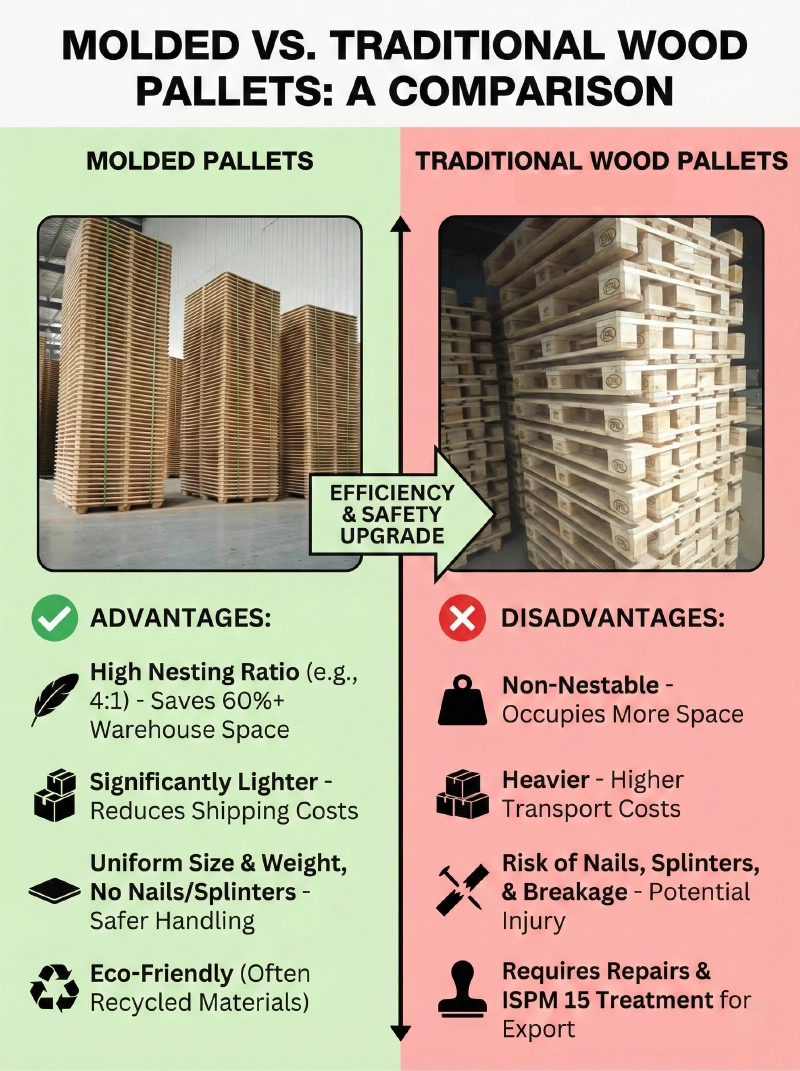
The incumbent options each carry a structural penalty on this kind of lane. A nailed solid wood pallet or a GMA style pallet does not nest: an empty stack runs to roughly 2.7 m for the count that a nested stack covers in about 0.75 m, so every returned or stored empty consumes trailer capacity and warehouse height. It also drags a treatment file with it, heat treatment and marking, plus the paperwork a buyer or a plant protection authority asks for at destination. A plastic pallet removes the treatment question and is genuinely reusable, but that reusability is exactly what makes it wrong for a one-way flow: a unit quoted around USD 40 to 120 has to come back to earn its cost, and it is heavy enough that the outbound freight pays for the plastic as well as the chemistry. Where a pooled plastic unit does come back, the lane pays return freight on a heavy, non-nestable, high-value asset. The result is that a chemical B2B exporter ends up maintaining a pallet pool it never asked for: empty pallet stacking in the yard, inspection rounds, lost units in distributor warehouses, and a monthly reconciliation that does not close.
Why a nestable pressed wood pallet fits the flow instead of fighting it
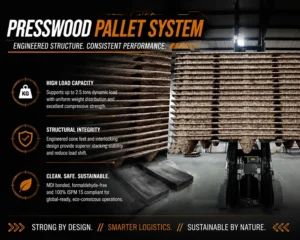
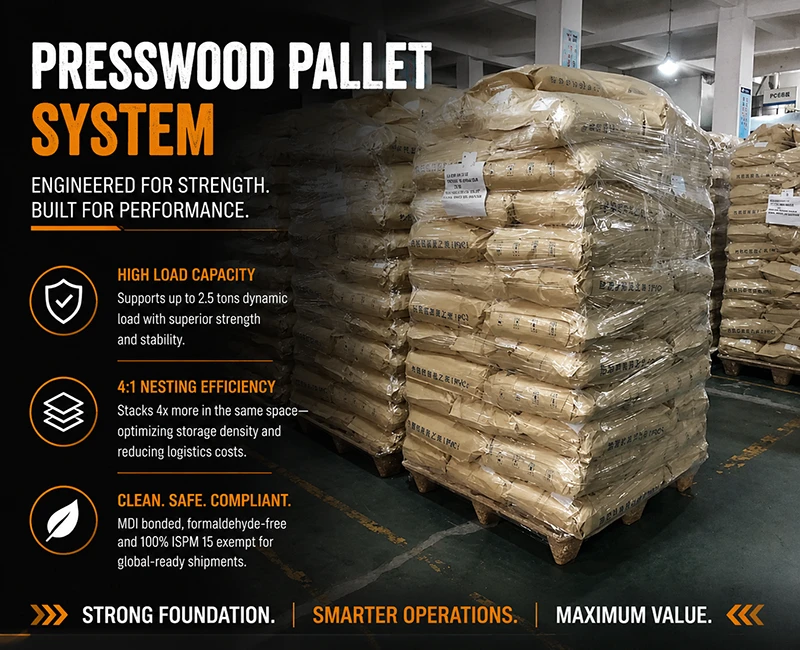
Ampallet is a molded wood pallet, not a nailed assembly and not a plastic moulding. Wood fibre is blended with MDI adhesive and pressed in one piece at high temperature and pressure, so there is no nail head and no separate board to work loose. The feet are molded into the deck as inverted cone supports, which is what makes the nestability real: each empty unit settles inside the one below instead of resting on top of it, and the empty stack grows slowly. That single geometric fact is what changes the economics of a one-way lane, because the pallet is designed to be consumed, not retrieved. Design records for the range place a 1200×800 corrugated carton project at about 13 plus or minus 1 kg, which is a lightweight pallet a single operator can handle and an outbound container does not have to carry across the ocean; the 1140×1140 size used on chemical drum transport is recorded at 2500 kg dynamic load and 7000 kg static load, with a 1200×800 variant at 2000 kg dynamic and 6000 kg static. Fork entry is 92 to 96 mm across those sizes with guide slots, and the deck takes 4-way entry, so a standard forklift or a pallet truck picks the unit without a special attachment. The material sits in the processed wood category, which is why a fumigation-free position is recorded for it: no heat chamber booking, no stamp custody, no segregation lane in the yard. That ISPM 15 exemption reading still has to be confirmed against the destination country rule and the freight forwarder before a contract is signed.
What the evidence shows, and what the flow looks like afterwards
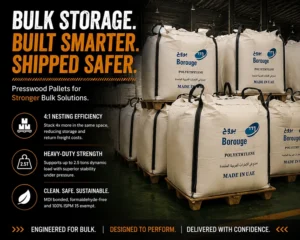
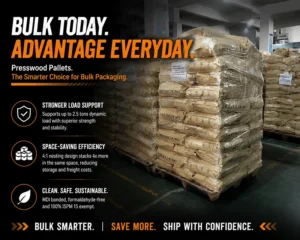
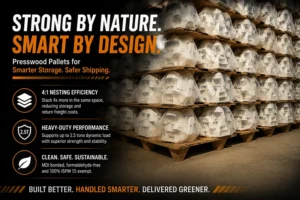
The two photos above are the argument in one frame. The hero image is a real warehouse stack of finished presswood pallets wrapped for export, where the thin deck edges and the shallow step between units show what nesting does to stack height; the comparison photo sets a nested molded stack beside a stacked traditional wood pallet at the same count, which is the storage and return volume question in a single view. Published positioning for the product puts the 4 to 1 nesting ratio at roughly a 70 percent saving on empty pallet storage space, a 60 percent reduction in return freight and a one-way unit cost near a third of a plastic pallet, with a total cost of ownership below a solid wood pallet once treatment, repair and empty handling are counted. In practice that means an exporter stops sizing a pallet for how many times it will survive and starts sizing it for the load, the drum pattern and the container. A 40HQ carries about 1320 units of 1140x1140x135 in nesting configuration according to loading records, which is a stock level rather than a shipment, so the pallet yard shrinks at the same time as the return leg. Two limits are worth stating plainly. Those percentage figures come from product and traffic records rather than a third-party lane study, so a return freight number has to be recalculated on your actual lane, container rate and destination empty pallet cost. And a molded pallet is not a racking pallet: the 7000 kg static load is a stacking figure, not a beam racking rating, so a warehouse that stores loaded units in selective racking keeps a block pallet for that duty. Send the drum or bag spec, the destination ports and the monthly unit count, and the team will size the presswood pallet against that lane.
- Business logic follows customer scenario, old solution cost, product fit, structural and parameter evidence, then result.
- Keyword nestable presswood pallet is carried in the title, intro, body and image alt text.
- Traffic profile terms are used: one way export pallet, empty pallet stacking, return logistics, chemical drum transport, 4 to 1 nesting ratio, fumigation-free, ISPM 15 exemption.
- All quoted load, weight and nesting figures are marked as design or record figures, and the racking limit is stated explicitly.