 | Stop paying for “dead air” and damaged chemical bags. In the chemical and raw material export sector, the sticker price of a pallet is deceptive. If you are shipping FIBC bulk bags or 208L drums, a $2 saving on a traditional wood pallet often costs you thousands in punctured packaging, leaked product, and rejected shipments at customs. It’s time to calculate the real Total Cost of Ownership (TCO). |
The Hidden Math: Why “Cheap” Solid Wood Costs More in Chemical Logistics
If you are a logistics manager handling carbon black, mineral sands, or polymer resins, you know that the compressed wood pallet price is often lower than a standard GMA wooden pallet. However, the real battle isn’t on the invoice—it’s on the shipping dock and inside the container.
Traditional wooden pallets are assembled with approximately 80-100 nails. In high-humidity transit or during rough forklift handling, wood shrinks and twists. The result? “Nail pops.” For a lumber yard, this is a nuisance. For a chemical exporter shipping high-value bagged goods, a single protruding nail head means a punctured FIBC bag, product leakage, and a potential safety hazard cleanup that halts operations.

Figure 1: Ampallet molded wood pallets supporting heavy carbon black tonnage without the risk of nail punctures.
1. The “Zero-Damage” Integrity Logic
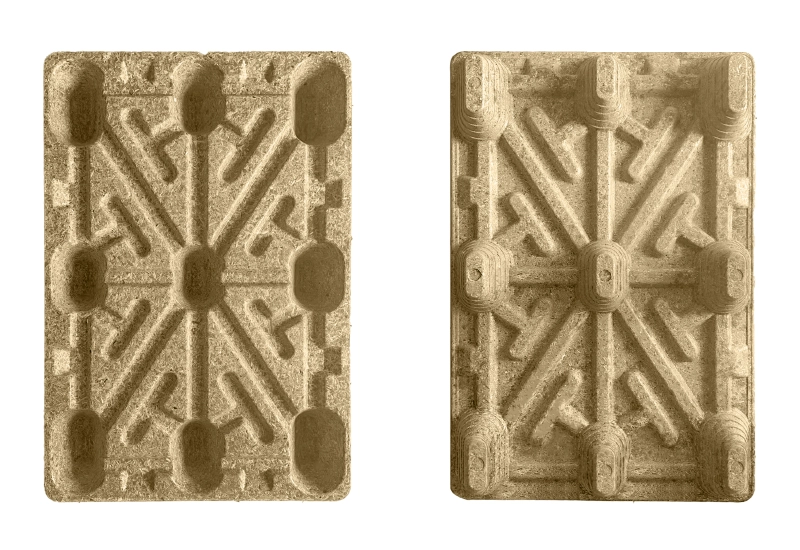
Unlike traditional pallets constructed from slats and nails, our molded wood pallets are manufactured using a 1600-ton hydraulic press. This “monoblock” design is created in a single shot.
- No Nails, No Staples: The design is 100% metal-free. There is zero risk of a fastener working loose and tearing a hole in your bottom layer of sacks or scratching the coating of a steel drum.
- Rounded Edges: The high-pressure molding process allows for smooth, rounded corners that prevent “bag snagging” during placement and removal.
For industries exporting bagged goods like PVC resin or fertilizers, switching to a smooth-surface pallet reduces packaging damage rates by approximately 18%. That is direct profit protection.
Freight & Storage: The 4:1 Density Advantage
Space is the second biggest cost driver after the product itself. In a standard warehouse or a return-logistics scenario, solid wood pallets are “space hogs.” They cannot nest. A stack of 50 solid wood pallets towers over 7 meters high—unstable and dangerous.
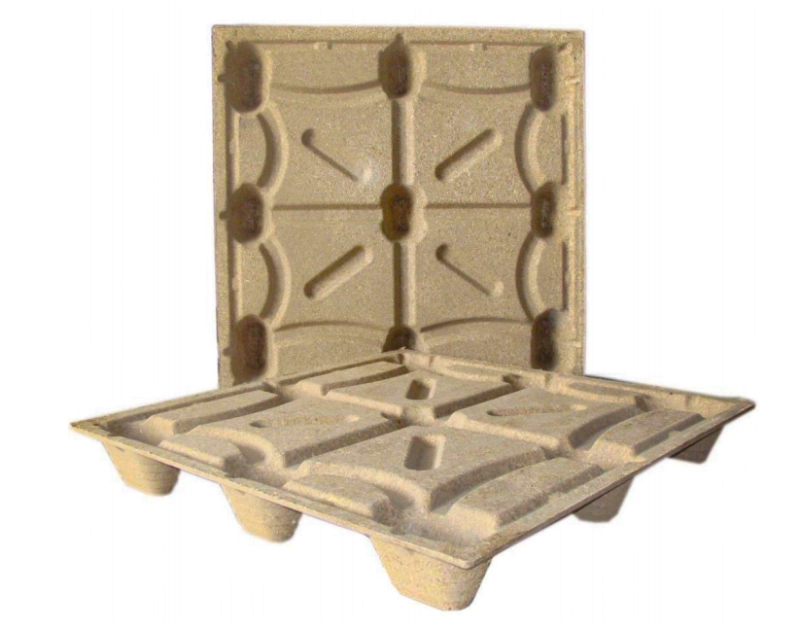
Because Ampallet uses a nestable pallet design with inverted cone feet, we change the physics of storage.

Figure 2: Visual proof—50 nested Ampallets take up the same vertical space as roughly 12 traditional wooden pallets.
The Logistics Impact:
- Warehouse Efficiency: You can store 2,500 Ampallets in the same footprint that used to hold only 1,000 wooden pallets.
- Freight Savings: For one way pallet shipments or return logistics, you can fit over 1,500 empty pallets in a single truck, compared to roughly 400 standard wooden pallets. This slashes your per-unit transport cost by nearly 60%.
The Compliance Cost: ISPM 15 & Customs Risk
Time spent in customs quarantine is money lost. Traditional wood requires heat treatment and specific stamps to meet ISPM 15 regulations. If a stamp is faded, or if mold develops during a sea voyage (common with standard timber), your chemical shipment could be detained at the port of entry.
Ampallet export pallets are classified as “processed wood.” The high heat (220°C) and pressure used during manufacturing sterilize the wood fiber completely. They are ISPM 15 exempt pallets globally. No fumigation certificates are needed. No risk of quarantine due to timber pests. This makes them the ultimate cheaper alternative to wooden pallets when factoring in the risk of demurrage charges.
Head-to-Head: Solid Wood vs. Pressed Wood
| Feature | Traditional Solid Wood (GMA) | Ampallet Pressed Wood |
|---|---|---|
| Purchase Cost | High volatility (Lumber market dependent) | Stable & Lower (Uses wood waste/fiber) |
| Damage Risk | High (Nails, splinters, loose boards) | Zero (One-piece, metal-free) |
| Storage Ratio | 1:1 (Cannot nest) | 4:1 (Nestable, saves 70% space) |
| Export Compliance | Requires Heat Treatment & Stamps (ISPM 15) | Exempt (Processed Wood) |
| Moisture Resistance | Absorbs water, prone to mold | High (MDI resin makes it water-resistant) |
For chemical manufacturers dealing with bulk bags or sensitive drums, the choice isn’t just about the pallet price tag. It’s about ensuring your product arrives intact, without customs delays, and without wasting warehouse space.
Frequently Asked Questions (Chemical & Industrial Logistics)
1. Can pressed wood pallets support double-stacked 208L chemical drums?
Yes. Our Heavy Duty molded wood pallets are engineered with high dynamic load capacities (up to 2.5 tons). The stiff, dense surface prevents the “sagging” often seen with softwood pallets, ensuring stable double-stacking of drums or FIBC bags inside containers.
2. We export to Europe. Do these pallets require fumigation certificates?
No. Ampallet products are considered “processed wood” under international law. They are fully ISPM 15 exempt pallets. You do not need a fumigation certificate, and they will not be stopped by customs for wood pest inspections.
3. How do these pallets perform in high-humidity environments?
Unlike cheap particle board that swells, we use high-grade MDI (isocyanate) adhesive. This creates a water-resistant bond. While not waterproof like plastic, they maintain structural integrity in high-humidity sea freight conditions where standard urea-formaldehyde pallets might fail.
4. Are these suitable for “clean” chemical environments (e.g., food additives)?
Absolutely. Because we use MDI adhesive, our pallets are formaldehyde-free and meet CARB-NAF standards. They are ideal for transporting food-grade chemicals or pharmaceutical ingredients where contamination is a concern.
5. Can forklifts access these pallets easily?
Yes. Our design features precise 4-way entry with guided slots. This allows forklift operators to engage the pallet quickly from any side without damaging the pallet legs, which is crucial for high-speed loading docks.