AUTOG | AUTOMATIC PALLET TAKE-OUT ROBOT
Customer pressure: consistency must continue beyond the molding cycle
Vacuum suction pallet pick-up robot for manufacturers under pressure to hold tight dimensional consistency and improve first-pass yield. AutoG repeats the take-out position and palletizing sequence after molding, reducing drops, orientation differences, and manual handling variation before AI defect monitoring and downstream inspection.
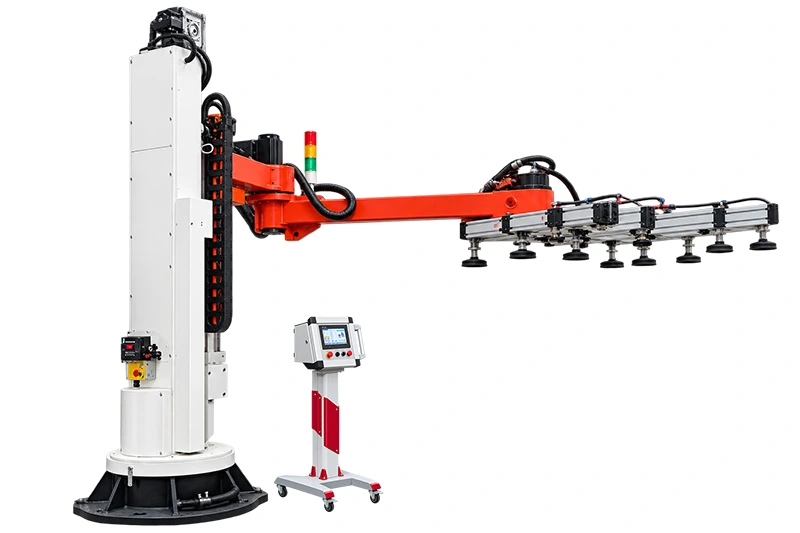
Why manual take-out weakens an otherwise controlled process
Manual removal and palletizing introduce two avoidable sources of variation: product movement during handling and inconsistent placement in the stack. A dropped pallet can create damage or a hidden defect; a changed orientation can complicate inspection and downstream handling. Even without a visible incident, repeated differences in posture and placement make the production data less stable. AI inspection can identify defects, but it cannot remove the upstream variability caused by a non-repeatable handling method. The old approach also ties a skilled operator to a repetitive, physically demanding station.
Why AutoG fits the quality-control objective
AutoG is designed to make the transfer step repeatable. Its vacuum pick-up end effector engages the pallet through a defined suction pattern, while the robot follows a programmed path from take-out to palletizing. Repeated positioning reduces the chance of a fall and keeps the pallet orientation more consistent from cycle to cycle. The system can be integrated around the molding or pressing station so that take-out, transfer, and stacking operate as one material-flow sequence. This makes AutoG a suitable automation layer for producers that need to support AI quality control rather than introduce another uncontrolled handoff.
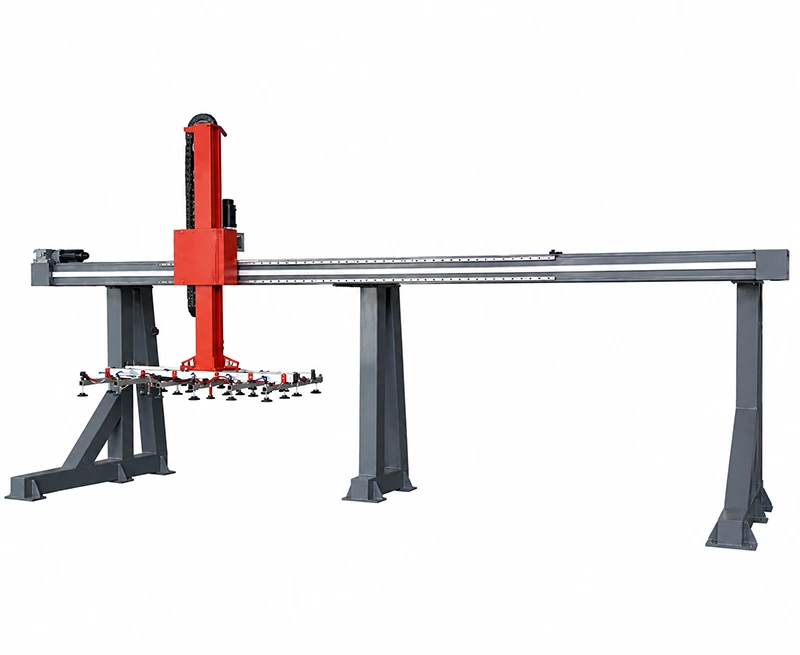
Structure and evidence: repeatable motion, repeatable placement
The AutoG asset set shows the hardware behind that repeatability. The floor-mounted configuration combines a long articulated arm, multi-cup handling beam, cable-chain routing, stack light, and a mobile control pedestal. A separate gantry configuration shows the long-span frame, guided moving carriage, vertical lift, cable routing, and array-style vacuum gripper used for automated sheet or pallet handling. These structures provide a defined movement envelope and a stable contact method instead of relying on manual lifting and release. In production planning, the final gripper layout, stroke, payload, cycle time, pallet dimensions, and interface signals should be confirmed against the customer’s molded-pallet line. The expected operational result is straightforward: fewer handling-related drops, less posture variation, more stable stacking, and a cleaner process input for AI defect monitoring and yield improvement. To discuss a take-out and palletizing layout for your line, contact the AutoG team.
- Use Vacuum suction pallet pick-up robot in the title, SEO title, slug, H1, first-screen summary, and both image ALT fields.
- Follow the required sequence: customer and application context, old-method problems, product fit, structural and image evidence, then final results.
- Use two distinct images from the resolved AutoG designer gallery with the supplied WordPress upload URLs and source paths.
- Include the required EMP blog markers and a /contact/ call to action in the rendered body.


