INDUSTRIAL RECYCLING PROJECT GUIDE
Start with the feedstock and the pallet market
For industrial recycling project buyers, the first question is not whether a 1,600-ton press can make a pallet. It is whether the complete AutoML process can convert an available fiber stream into saleable, consistent pallets at a utilization rate that supports the investment. AutoML is a modular production system covering material preparation, drying, adhesive mixing, dosing and spreading, hot pressing, demolding, and stacking. The appropriate configuration depends on labor cost, feedstock quality, plant infrastructure, target output, end-market requirements, and available capital.
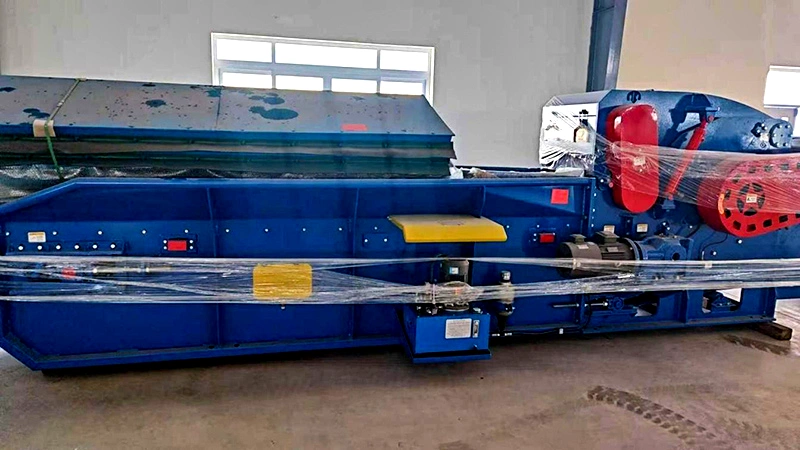
Choose the automation boundary around local economics
AutoML can be configured as a semi-automatic or fully automatic line. A semi-automatic project may retain the core glue mixer, weighing equipment, and hydraulic press while purchasing prepared, dried material and using operators for spreading and takeout. This can reduce the initial capital requirement to roughly RMB 2 million in the referenced project range, but it requires more labor and leaves greater exposure to variation in weighing, spreading, demolding, and long-term operating discipline.\n\nA full line can add crushing, drying, automatic spreading, robotic demolding, and stacking. The referenced investment range is around RMB 4 million, with the potential to reduce manual handling and support a more data-controlled process. It is not automatically the better choice: low labor costs, limited order volume, uncertain feedstock, or restricted cash flow may favor a staged configuration. Treat automation as an upgrade path linked to utilization and labor economics, not as a default specification.
Verify process, layout, and adhesive compatibility
The hot-press room should be physically separated from crushing and drying areas. Dust from front-end preparation can damage PLC cabinets, sensors, servo components, and hydraulic equipment if it is allowed to enter the forming area. The project should also verify floor space, press-room height, electrical capacity, dust collection, ventilation, material storage, and safe access for forklifts and maintenance.\n\nA 1,600-ton press is a recurring reference for this product family, while other projects may use approximately 1,200T, 1,250T, 1,800T, or 2,200T equipment depending on pallet size, structure, and load target. Typical file references include 150–180°C forming temperature, 15–20 MPa pressure, and approximately 180–240 seconds per cycle, but the final values must be confirmed for the selected mold and adhesive. MDI can support strong, water-resistant bonding with lower typical dosage around 8–10%, but it costs more and increases mold-sticking and cleaning sensitivity. UF or PF may use roughly 10–12% in common references, yet UF has weaker water resistance and formaldehyde-related market restrictions. Select the adhesive from the end-use requirements, trial results, cost model, and compliance needs.
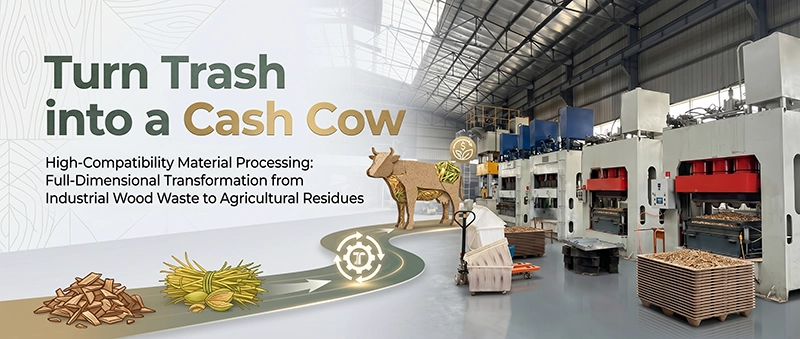
Build the ROI case before approving the line
Calculate the project using realistic utilization rather than maximum nameplate output alone. Include feedstock purchase or collection, electricity and heat, adhesive consumption, labor by shift, molds, maintenance, dust control, packaging, financing, rejects, downtime, and the selling price accepted by the target market. Compare at least three operating cases: planned utilization, reduced utilization, and a downside case with higher material or energy costs.\n\nProject notes reference a full-automatic line at around RMB 4 million and a semi-automatic line at around RMB 2 million. Static payback is cited at about 1.3–1.8 years in ideal conditions, with weaker cases extending to about three years; these are planning references, not guarantees. Before factory acceptance, verify pressure stability, temperature control, cycle time, material distribution, demolding, pallet density, stacking, safety interlocks, and actual labor requirements. A staged project that proves feedstock quality and customer demand before adding front-end or downstream automation can protect cash flow while preserving a route to higher throughput.
- The content treats AutoML as a modular industrial production system rather than a standalone press.
- Investment and payback figures are presented as project references with utilization and market caveats, not guarantees.
- Adhesive, moisture, pressure, temperature, cycle, mold, and output requirements are identified as project-dependent and subject to trials or technical agreement.
- The new SEO slug is presswood-pallet-recycling-line-sizing, and the article is written for industrial recycling project buyers in en-US.


