SAWDUST DRYER FOR MDF AND PARTICLEBOARD FURNISH
The hot-press problem starts with unstable furnish moisture
MDF fiber and particleboard furnish do not enter the hot press with a uniform moisture history. A Dryr rotary sawdust dryer provides continuous hot-air drying for wood chips, sawdust, and wood shavings, helping bring variable pine or eucalyptus residues toward a process-defined moisture range before gluing and pressing.
Why sun drying and experience-based adjustment break down
Natural sun drying and manual open-air drying depend on weather, season, yard space, and operator judgement. They may reduce surface moisture, but they do not provide a consistent continuous feed to mixing, gluing, and hot pressing. A small airflow dryer can suit some fine, low-throughput applications, while a hand-welded low-end drum machine may leave concerns about drum geometry and flight consistency. When initial moisture changes from batch to batch, setting the line by experience alone makes both wet defects and over-drying more likely.
Why a rotary drum dryer fits board furnish preparation
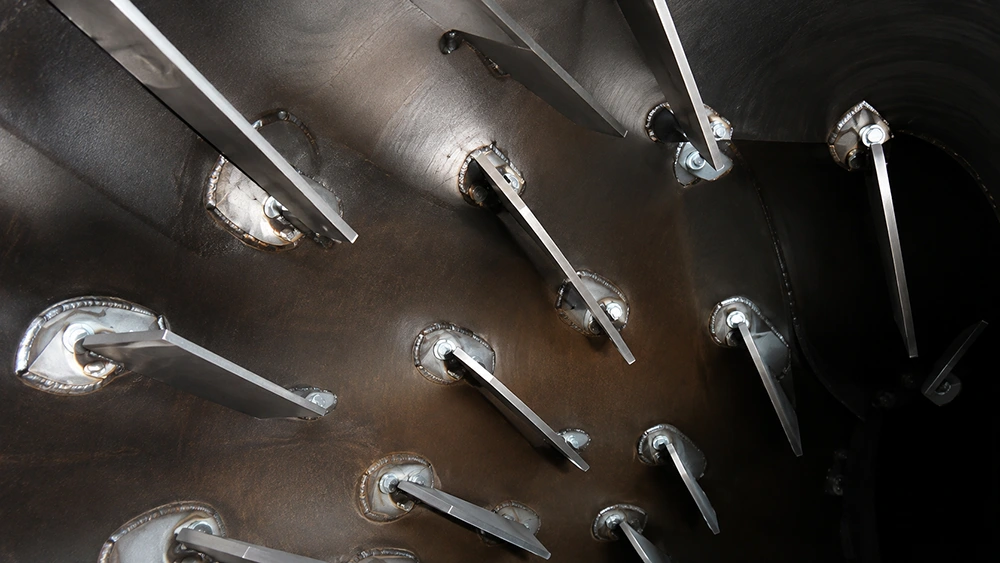
Dryr is a rotary sawdust dryer built around continuous hot-air contact and controlled material residence. A screw conveyor or belt conveyor feeds the wet furnish into the rotating drum. Internal lifting flights pick up and disperse wood chips, sawdust, and wood shavings so more material contacts the hot air before moving toward the discharge. Temperature monitoring supports operating adjustment, while the final moisture target still needs to be checked against the board process. This rotary drum arrangement fits lines that need a steadier feed to adhesive preparation and the hot press rather than an intermittent drying yard.
Structure, sizing, and evidence for a controlled drying line
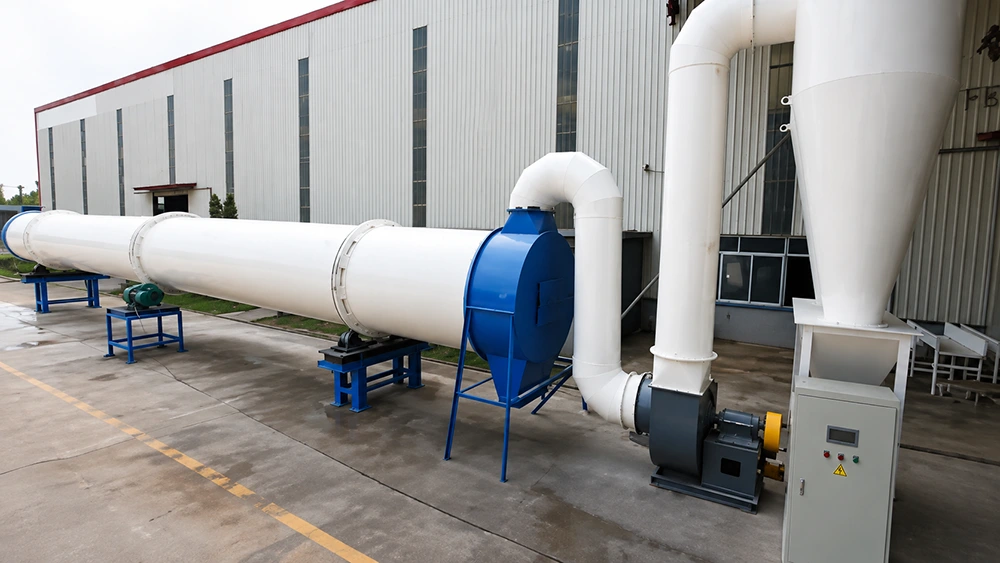
The Dryr range includes H-1010 at approximately 0.8–1 tonne per hour with a 1000 mm drum, H-1212 at 1–1.2 tonnes per hour with a 1200 mm drum, H-1512 at 1.2–1.5 tonnes per hour with a 1500 mm drum, and H-1815 at 1.5–2 tonnes per hour with an 1800 mm drum. The product brief lists dried sawdust moisture below 10 percent under stated conditions, not as an unconditional result for every furnish. The documented drum-temperature figures require engineering confirmation because source materials use different temperature definitions. The gallery evidence shows staggered internal paddle bars, welded mounts, a segmented drum, process ducting, cyclone separation, a blower, and a control cabinet. With the correct feed rate, heat source, dust collection, and commissioning checks, the sawdust drying machine can turn variable residue into a more predictable continuous feed for gluing and hot pressing.
- For MDF fiber, an indicative process target may be around 8–12 percent, subject to the board recipe and downstream press conditions
- The rotary drum uses lifting flights to repeatedly raise and disperse furnish through the hot-air stream
- Four Dryr sizes cover approximately 0.8–2 tonnes per hour, subject to feed moisture, material size, heat source, and validated process conditions
- Cyclone or baghouse dust collection, temperature monitoring, conveying, and control equipment can be configured around the drying line


