Biomass fuel feedstock
Scattered Hardwood, Rubberwood and Crop Residue: The Fuel Spec Is Fixed Before the Feedstock Arrives
A biomass fuel supplier selling into a certified route cannot buy chip quality together with the order. Hardwood, rubberwood and agricultural residue arrive from scattered yards in different species, diameters, moisture levels and contamination profiles, while the fuel contract is written around one chip band and one documented intake. This page follows a single decision: where an industrial wood chipper machine sits inside a biomass fuel preparation system feeding a boiler or a wood chipper for pellet plant duty, how a drum wood chipper machine holds uniform chip size output across mixed feedstock, and where the equipment scope stops. Chip length uniformity and a machine-side intake record are what the chipping stage can hold. FSC chain of custody, supplier declarations and the certificate itself remain the fuel supplier's own supply-chain and documentation work.
Why Outsourced Chips and a Manual First Stage Stop Scaling
The legacy routes are familiar. Buy chips from a regional producer and postpone capital expenditure. Break oversized pieces on a manual saw bench. Move a diesel mobile chipper between sites. Or skip chipping altogether and push whole residue straight into a hammer mill. Each route works until volume grows. Outsourced chips tie the supplier's chip band to a third party's process, which the supplier cannot audit or correct on short notice, and the chain-of-custody file then references a process the supplier does not run. Manual breaking and a mobile unit sized for a different duty produce a wider size spread, more fines and more oversize, so the dryer absorbs a moving moisture load and the press or boiler absorbs a moving particle load. Skipping the chipping stage transfers that load to the mill, which is the most maintenance-sensitive machine on a wood chip production line. The cost does not appear as one line item. It appears as drift in the fuel spec, lower bulk density for the same transport, and loads that no longer match the band the contract was written around.
Why a Drum Wood Chipper Machine Fits Mixed and Irregular Feedstock
A drum type wood chipper is a size reduction stage built around a rotating knife roller, not around one log geometry. EMP Shred is an electric stationary industrial wood chipper platform for the first chip preparation stage: small diameter logs, branches, tops, slabs, edgings, broken veneer and irregular offcuts into roughly 30 to 35 mm chips. Three published tiers cover ordinary fuel and panel demand. X-215 runs 45 kW with a 600 mm knife roller diameter, a 400 by 180 mm feed opening, 160 mm maximum feed diameter and 4 to 5 tph. X-216 runs 55 kW with a 650 mm knife roller, a 540 by 240 mm feed opening, 200 mm maximum feed diameter and 6 to 8 tph. X-218 runs 110 kW with an 800 mm knife roller, a 680 by 310 mm feed opening, 300 mm maximum feed diameter and 8 to 12 tph. The feed side is what makes mixed intake practical. A hydraulic feeding system with a floating upper feed roller accepts varying billet thickness instead of stalling on the thick pieces, two feed roller sets drive material in under chain and sprocket synchronisation, and the variable frequency drive adjusts feed speed. The cutting side is a fly knife set bolted and clamped on the knife roller, working against a counter knife, with adjustable chip length. A chip screen inside the housing lets accepted chips fall through and returns oversize material for another pass, which is how a single stage produces a usable length band instead of a long tail of oversize pieces. The hydraulic system also lifts the upper feed roller to open the housing for knife change and knife gap adjustment, and the electric cabinet uses a 380 V soft start with wireless remote start and stop, so the stage matches a plant supply rather than a mobile duty cycle.
Images, Data and the Honest Boundary: What the Chipper Holds and What the Supplier Files
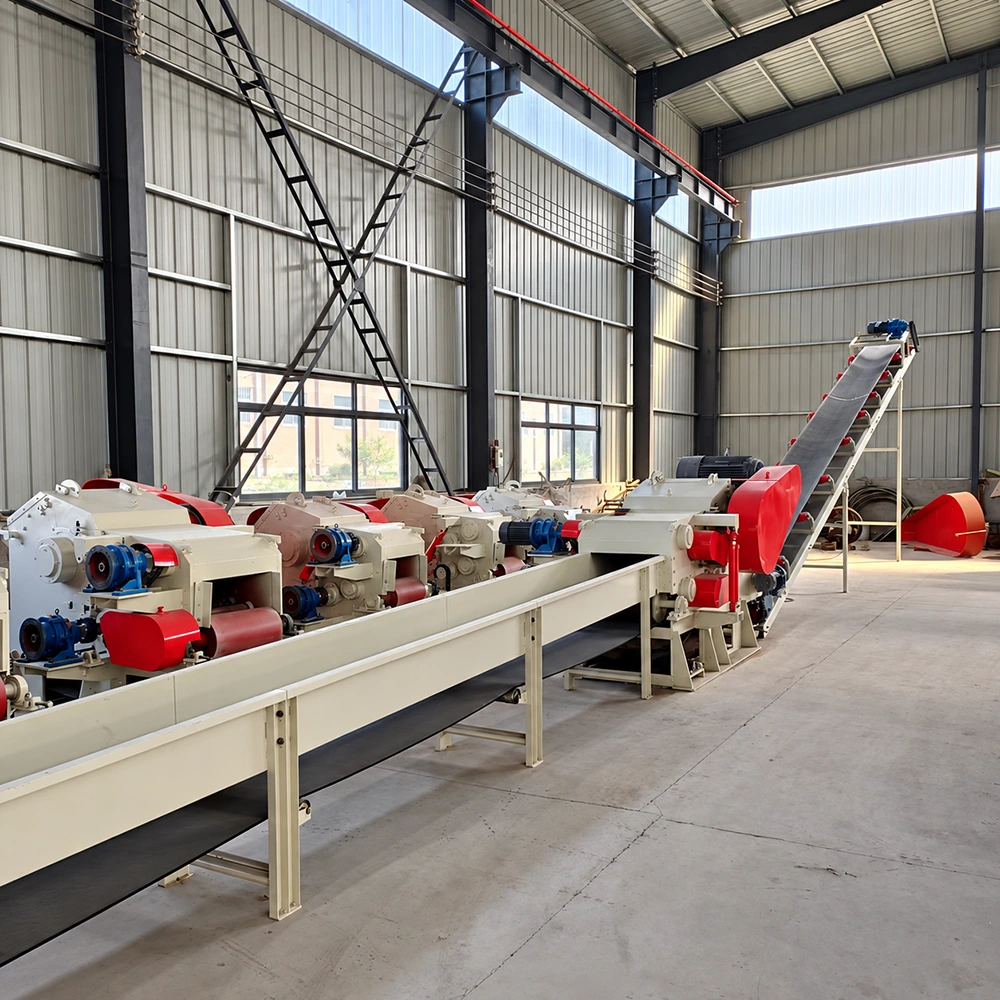
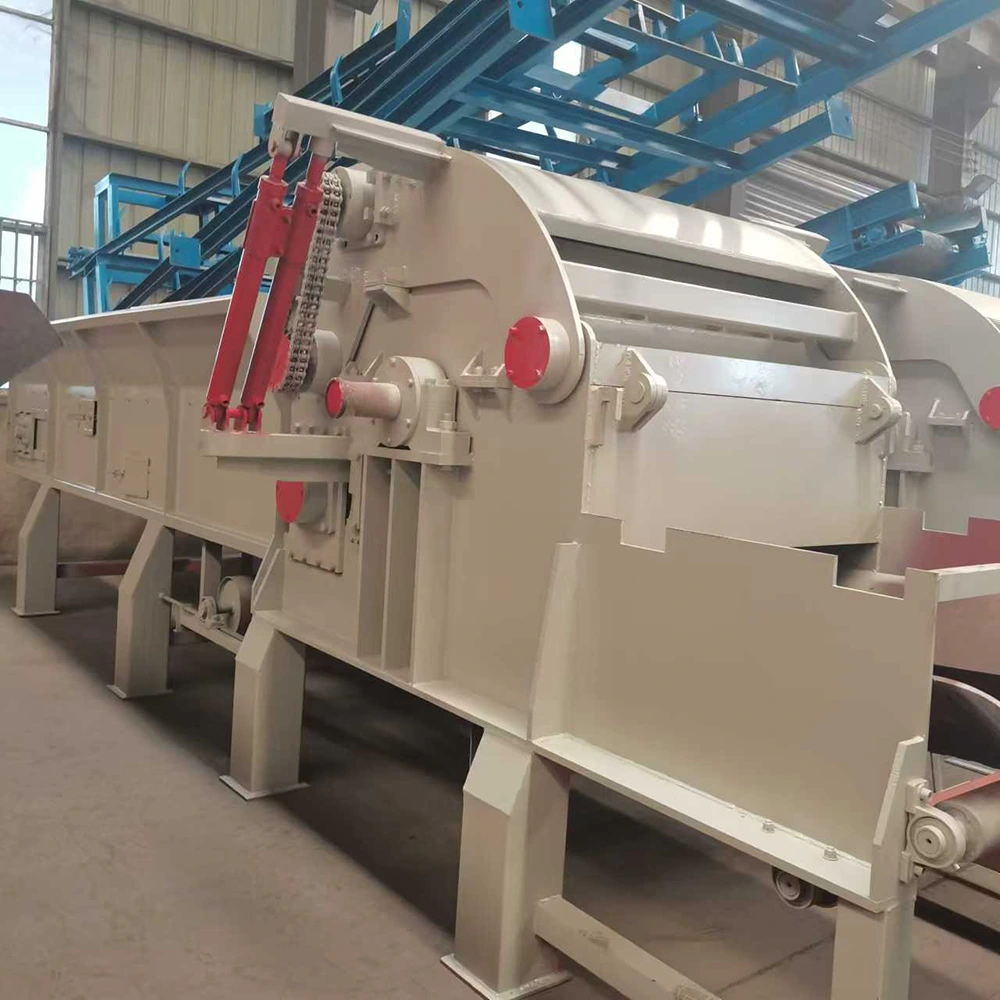
The two images on this page show the platform in plant context: a processing line with guarded drives and belt conveyors, and an enclosed unit with an exposed chain drive, bearing housings and a steel support frame. They are evidence for how a stage is fed, driven, guarded and maintained. They are not evidence for model, power or capacity, and those numbers should be read from the published table rather than from a photograph. One boundary decides the whole project, so it is stated plainly. EMP supplies the chipping stage. EMP does not hold or issue the buyer's certification. FSC chain of custody, supplier declarations, legality and origin documentation and the audit trail behind them are the fuel supplier's own supply-chain and documentation work. What the machine can support is narrower and more concrete: a repeatable chip length band, a fixed installation with a recorded knife gap, screen check and blade change log, and a machine-side intake figure that the supplier's own file can point at instead of pointing at a vendor. A second boundary is contamination. A drum chipper sets particle size, not purity: nails, staples, wire and grit that travel in with residue are still in the chips leaving the discharge end, and metal and stone removal is an upstream stage, not a chipper feature, so the intake rule has to be agreed with each source yard before material is tipped. A third boundary is the capacity figure itself. A tonnes per hour number is only comparable when species, moisture, density, chip length and feeding continuity are stated, and EMP has not published that test basis, so the basis should be fixed in writing before one supplier's tph figure is compared with another's. Settle those three points and the result is straightforward: 4 to 5, 6 to 8 or 8 to 12 tph of 30 to 35 mm chips from mixed hardwood, rubberwood and agricultural residue, feeding the dryer and then the press, pellet mill or boiler on a band the supplier defined, with the intake record generated at the supplier's own gate instead of inherited from a third party.
- Capacity, power, feed opening and chip size figures are quoted only from EMP published Shred data: 45, 55 and 110 kW, 4 to 12 tph, 30 to 35 mm, feed openings 400 by 180, 540 by 240 and 680 by 310 mm.
- No certification is claimed for or on behalf of the buyer: the text states that FSC chain of custody and the certificate remain the customer's own supply-chain and documentation work.
- No tramp metal protection, nail protection or CE certificate claim is made for the Shred chipper; metal and stone removal is described as an upstream stage.
- Both image source paths come from the resolved Shred designer gallery, and every section body is plain text with no banned weak words such as high quality, best solution or most efficient.


