CAPEX DISCIPLINE ON A BIOMASS FUEL EXPANSION
The buying scene: a fuel producer that has to add tonnage while the books are still red
A biomass fuel producer selling chips against coal cannot buy capacity the way a large board plant does, because the margin per ton will not carry an oversized line and the books may still be red while the offtake contracts keep growing. This page follows one expansion decision, from outsourced chips and an oversized imported line quote, through feedstock geometry and the drum chipper versus disc chipper question, to a drum wood chipper machine matched in three power tiers, 45, 55 and 110 kW covering 4 to 5, 6 to 8 and 8 to 12 t/h of roughly 30 to 35 mm chips, bought either as a single chipping stage or as a complete line supplying two granularities.
Why the old route keeps failing the thin-margin test
Three routes sit on the table, and each one fails a different part of the test. The first is staying on outsourced chips. Raw material purchase cost and supply stability then belong to a third party, and a producer that resells chips cannot pass a supplier increase to a utility boiler that already benchmarks its fuel against coal. The second is a European complete line. Publicly, those suppliers build for much larger scale and do not publish prices, so a plant at this tonnage cannot model the number at all, and the reference scope assumes a capital structure the yard does not have. The third is running a hammer mill as the first stage and skipping chipping, or buying a disc type unit because the entry price looks lower. Irregular branches, slabs and small diameter logs need a first cut that produces a defined length before any downstream stage can work at its rated tonnage, which is what the drum chipper versus disc chipper question really is, and it should be settled by feedstock geometry rather than by catalogue wording. Before any tons per hour table is compared, the more useful question is how to choose a wood chipper at all: maximum feed diameter and feedstock shape first, tonnage second. The labels in this market vary, industrial wood chipper, wood chipping machine, wood chip making machine, drum type wood chipper, and none of the labels is the decision.
Right-sizing a drum wood chipper machine to the tonnage the yard can actually sell
EMP builds the Shred platform in three power tiers, and the point of three tiers is that the yard buys the tier it can feed instead of the tier a brochure prefers. X-215 is the 45 kW wood chipper at 4 to 5 t/h with a 600 mm knife roller, a 400 by 180 mm feed opening and 160 mm maximum feed diameter. X-216 is the 55 kW drum chipper at 6 to 8 t/h with a 650 mm knife roller, a 540 by 240 mm feed opening and 200 mm maximum feed diameter. X-218 is the 110 kW wood chipper at 8 to 12 t/h with an 800 mm knife roller, a 680 by 310 mm feed opening and 300 mm maximum feed diameter. Published chip length is about 35 mm, inside the 30 to 35 mm window most downstream processes ask for. The same platform can be bought as a single chipping stage where the yard already owns milling and drying equipment, or as a complete line that pairs the chipper with a pulverizer and supplies two granularities, chips for fuel contracts and sawdust for a pellet plant, a presswood pallet production line or particleboard chip preparation. One honest note on the table: EMP published capacity without a moisture, density and species basis, so these tonnages should not be compared against another supplier's tonnages until the test conditions are confirmed.
What the structure and the shop floor photos evidence, and what changes at the gate
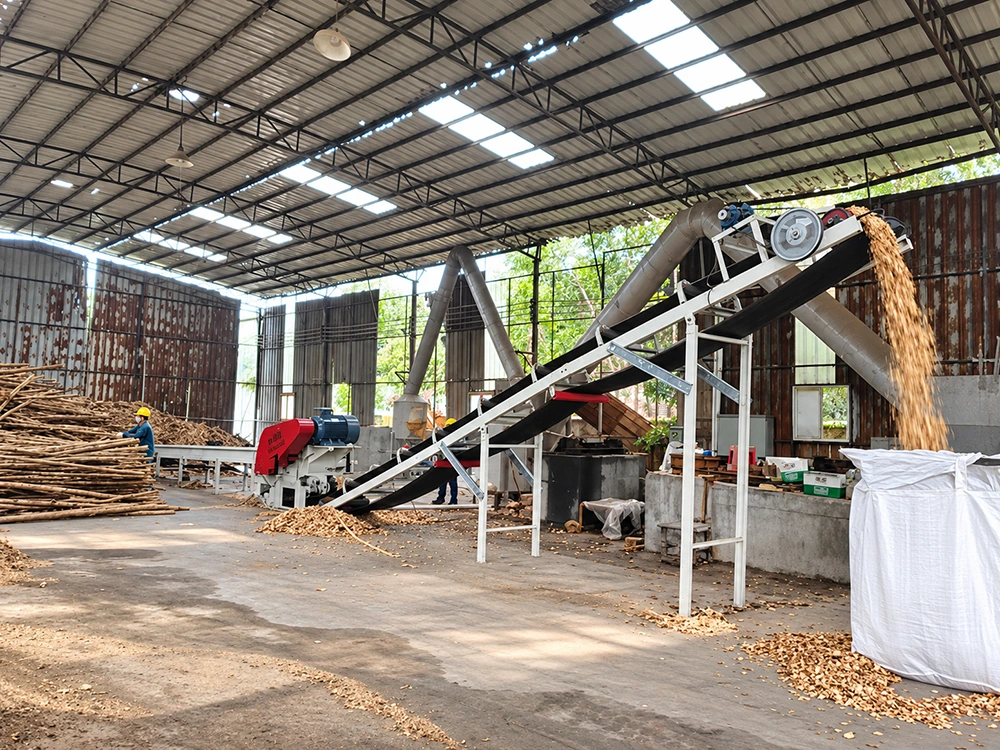
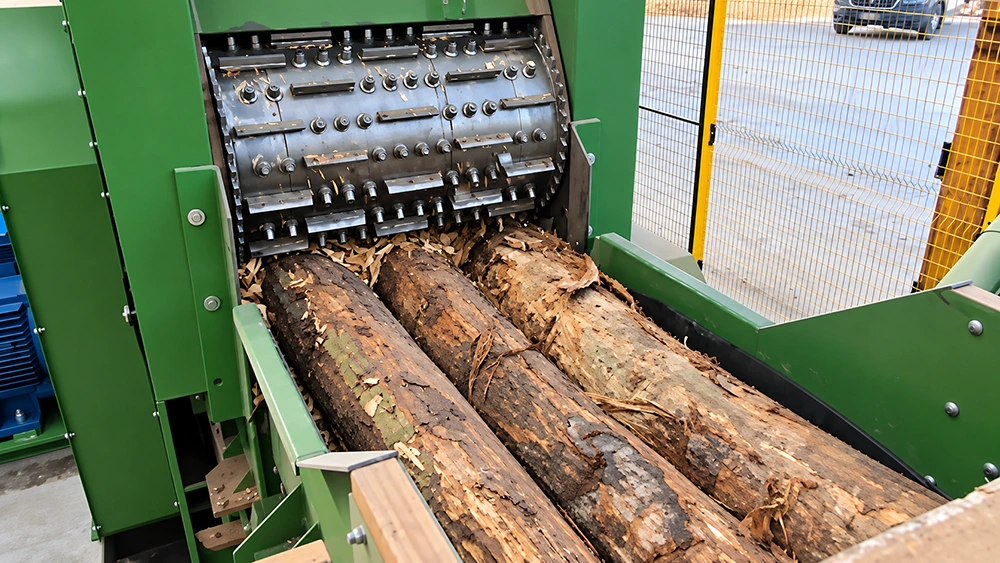
The body is a welded steel structure with a hydraulic feeding system, two chain-synced feed rollers and a floating upper roller that follows the thickness of the incoming material, so branch wood and slabs of uneven section keep moving instead of bouncing. Cutting happens on a knife roller carrying fly knives fixed with dedicated bolts and clamping blocks, with 2 knives listed as standard on all three models. A chip screen returns oversized material into the cutting zone until it falls through at the set length, and chip length remains adjustable at the screen. Maintenance is planned work rather than a rebuild: chipper knife sharpening, knife gap adjustment and drum chipper spare parts bought as consumables. The two photos on this page show the same facts from the plant floor. The first frame is a chipping line where an inclined conveyor lifts the cut material toward a collection point, which is what continuous chip preparation looks like immediately after the first stage. The second is the knife roller with its bolted knives sitting above the feed chute, the component that actually sets particle length. What changes at the gate is the raw material position: branch wood, slabs and the yard's own offcuts become a self-supply chip stream instead of bought chips plus a disposal bill for the same timber, and wood waste volume drops once irregular logs become a graded first cut. Two boundaries belong in the same paragraph. EMP does not publish a price comparison against a European line and this page does not invent one, so the comparison to make is scope against scope, not a headline number. And a buyer who is currently loss-making should expect the commercial process to run on credit assessment and staged terms rather than on a fast signing, because both the supplier and the finance side are pricing that risk.
- Capacity and power figures are EMP published values only: 45, 55 and 110 kW with 4 to 5, 6 to 8 and 8 to 12 t/h on X-215, X-216 and X-218; no competitor weight, blade grade or capacity basis is borrowed.
- No European price comparison figure is invented; the only public statement used is that European complete lines target much larger scale and do not publish prices.
- The loss-making buyer boundary is stated: flexible commercial terms are available subject to credit assessment, and longer decision and payment cycles are expected rather than a fast signing.
- Tramp metal and nail handling is not claimed as a machine feature; separation and feedstock inspection stay upstream and unverified scope stays out of the page.


