EMP Shred | Drum Wood Chipper Machine Platform
The Capex Decision on a Thin-Margin Biomass Fuel Plant: One Machine Now, Not a Plant
A biomass fuel plant expanding on a thin trading margin cannot spend like a plant twice its size, and a European brand turnkey line is not a like for like comparison: it is built around a much larger scale and does not publish pricing at all. This page follows one capex decision on a drum wood chipper machine, from outsourced wood chips and a hammer mill with no chipping stage ahead of it, through the X-215, X-216 and X-218 tiers at 45, 55 and 110 kW covering 4 to 5, 6 to 8 and 8 to 12 t/h, to what the plant pays for now, what stays in the verification and credit file, and how the same machine keeps its place when the chipper and hammer mill line is added later.
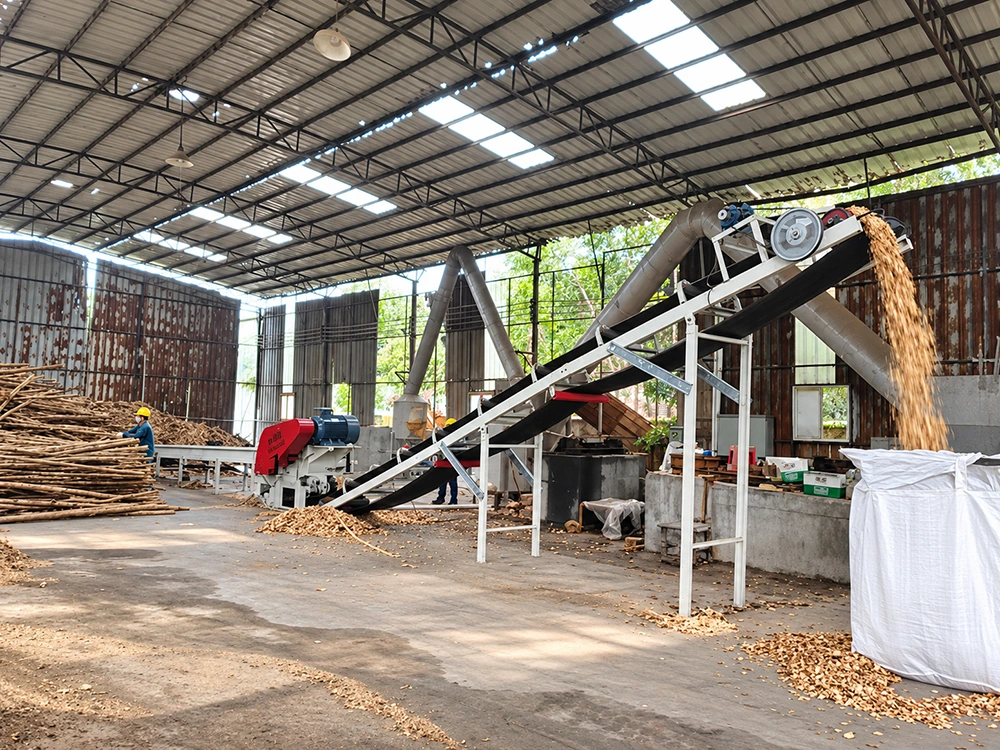
Why Outsourced Chips and a Hammer Mill Alone Both Stall a Thin-Margin Plant
Three legacy routes keep appearing on thin-margin fuel plants, and each one moves the cost problem somewhere else. Buying wood chips from outside puts raw material purchase cost and supply stability in a third party's hands, and the plant pays a margin on material it could prepare itself. Burning or landfill disposal of wood waste removes a cost line only by losing the material, and it does nothing for self-supply. Running a hammer mill alone, with no chipping stage ahead of it, means branches, slabs, small diameter logs and offcuts reach the mill as irregular pieces, so grinding load and output size swing with whatever arrived that week. A diesel mobile chipper replacement brings its own duty cycle and fuel cost to a fixed, electric plant layout. None of these is a claim about numbers this page can prove; they are the reasons the chipping stage is where the feedstock decision is actually made, and why an industrial wood chipper sized to contracted tonnage is the cheaper place to start than a complete line bought in advance.
Sizing the Drum Wood Chipper Machine to Contracted Tonnage: 45, 55 and 110 kW Across 4 to 5, 6 to 8 and 8 to 12 t/h
The Shred platform is a stationary electric drum wood chipper machine in three tiers, and the tier is chosen from feedstock geometry before tonnage. X-215 runs a 45 kW main motor at 4 to 5 t/h with a 400 by 180 mm feed opening and 160 mm maximum feed diameter. X-216 runs 55 kW at 6 to 8 t/h with a 540 by 240 mm feed opening and 200 mm maximum feed diameter. X-218 runs 110 kW at 8 to 12 t/h with a 680 by 310 mm feed opening and 300 mm maximum feed diameter. Selection therefore starts with the largest diameter and most irregular piece the plant can actually buy, then moves to the t/h target. Structurally the machine carries a knife roller with bolted fly knives, an upper feed roller that floats on the hydraulic feeding system, a synchronised upper and lower feed roller pair driven by chain and sprocket, and a chip screen that lets acceptable chips fall through while oversize pieces recirculate for another cut, giving a nominal chip length of about 35 mm that is adjustable. Feed speed is set by variable frequency drive, starting is through a soft start cabinet, and start and stop are on wireless remote. The same machine can be bought as chipping only, or as the first stage of a chipper and hammer mill line where the plant wants both the 30 to 35 mm first stage chip and the finer material in one supply. On cost, the honest statement is this: the investment sits below a European brand complete line, because those lines are built for larger scale and their pricing is not published, and EMP does not publish a comparison figure either. Capacity is always stated against wood species, moisture, density, chip length and continuous feeding, and EMP does not yet publish the test basis behind those tonnage figures.
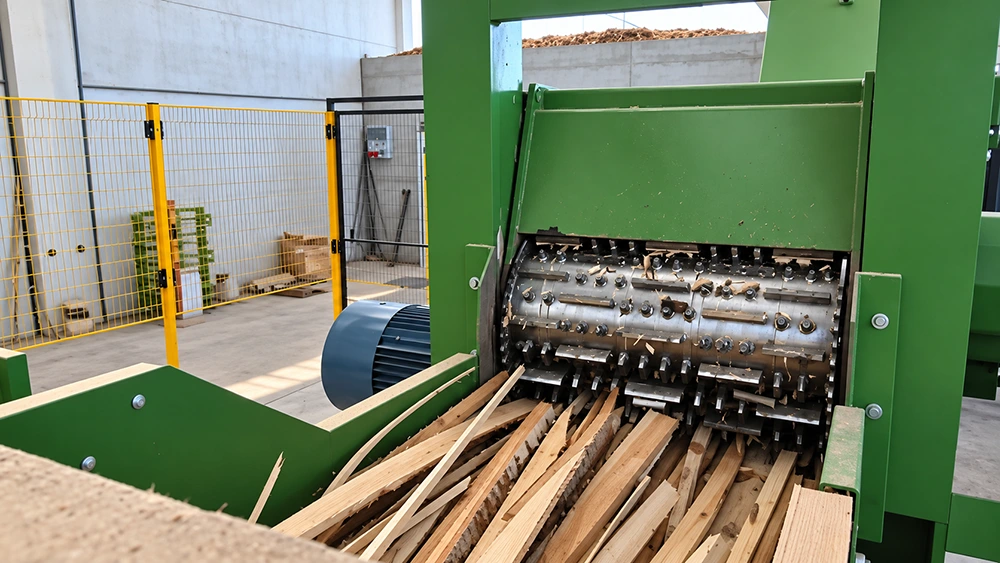
What to Verify Before Signing, and What the Phased Machine Returns
Before a purchase order, several parameters have to be requested rather than assumed. EMP does not publish machine weight, overall dimensions, hydraulic pump motor power, the complete voltage, frequency and phase list, knife and knife roller material or hardness, packing volume and units per container, and the published total power still needs engineering confirmation on whether the lower press roller and the hydraulic pump motor are included. Those items decide slab design, transformer sizing, inland freight and customs paperwork, so they belong in the technical clarification, not in the brochure. Material carrying nails, staples or grit needs its own engineering route as well, because metal separation is an upstream stage rather than a feature of the chipper body. On commercial terms, flexible options are available to a plant working through a loss-making expansion year, but the terms follow the customer's credit assessment and the decision cycle can be longer than a buyer expects, so no fast close is promised here. What the phased approach returns is straightforward: the plant pays for the chipping stage it can feed and sell now, keeps the same drum wood chipper machine when the chipper and hammer mill line is added, converts branches, slabs, small logs and offcuts into its own chip supply instead of buying chips at someone else's margin, and holds a uniform first stage chip that eases the load on the mill, dryer and press downstream.
- Three power tiers 45, 55 and 110 kW are mapped to 4 to 5, 6 to 8 and 8 to 12 t/h with the feed opening and maximum feed diameter stated per model X-215, X-216 and X-218
- No European price comparison number, no ROI percentage, no energy saving figure and no CE certified claim is used anywhere on the page
- Missing parameters such as machine weight, overall dimensions, hydraulic pump motor power, full voltage and knife material are named as buyer verification items instead of being invented
- Credit assessment and a possibly longer decision cycle are stated plainly for a plant running through a loss-making expansion year


