Pallet plant manning and line labor
A Pallet Plant That Cannot Fill Its Nailing Benches
A pallet plant that cannot staff its nailing benches pays for capacity twice: once for the machine and again for the crew it cannot hire. This page follows that problem onto a wood pallet hydraulic press line, where the crush, dry, glue and hot press stages run continuously, no nailing stage exists, and the Y-1250 to Y-2500 tonnage tiers are chosen against the crew the plant can actually keep. The boundary is stated plainly: about 5 mm particle size, drying to 8 to 12 percent moisture and even MDI adhesive mixing have to be in place before the press forms anything, and the press is not sold as a stand-alone machine.
Why a Wood Pallet Hydraulic Press Takes Labor Off the Nailing Bench
A wood pallet hydraulic press changes which stations need hands. Hot press molding is a short cycle automatic process: the automatic loading machine spreads glued wood particles into the lower mold, the slide brings the upper mold down, the material cures under heat and pressure, and the ejector releases one finished molded pallet per cycle. There is no nailing stage and no manual board sorting in that sequence, so the labor that used to sit on the bench moves to line supervision and quality checks. Upstream, the four stages run continuously: a crusher or grinder takes recycled wood, wood shavings, wood chip and agricultural residue down to about 5 mm, a dryer at 150 to 180 C brings it to 8 to 12 percent moisture, a glue mixer blends MDI adhesive, and the hot press forms the pallet. A semi-automatic pallet production line and a fully automatic pallet production line both sit on that same platform, so automatic molding can be entered in stages instead of all at once.
Structure and Tonnage Evidence: Y-1250 to Y-2500 on a Three-Beam Four-Column Frame
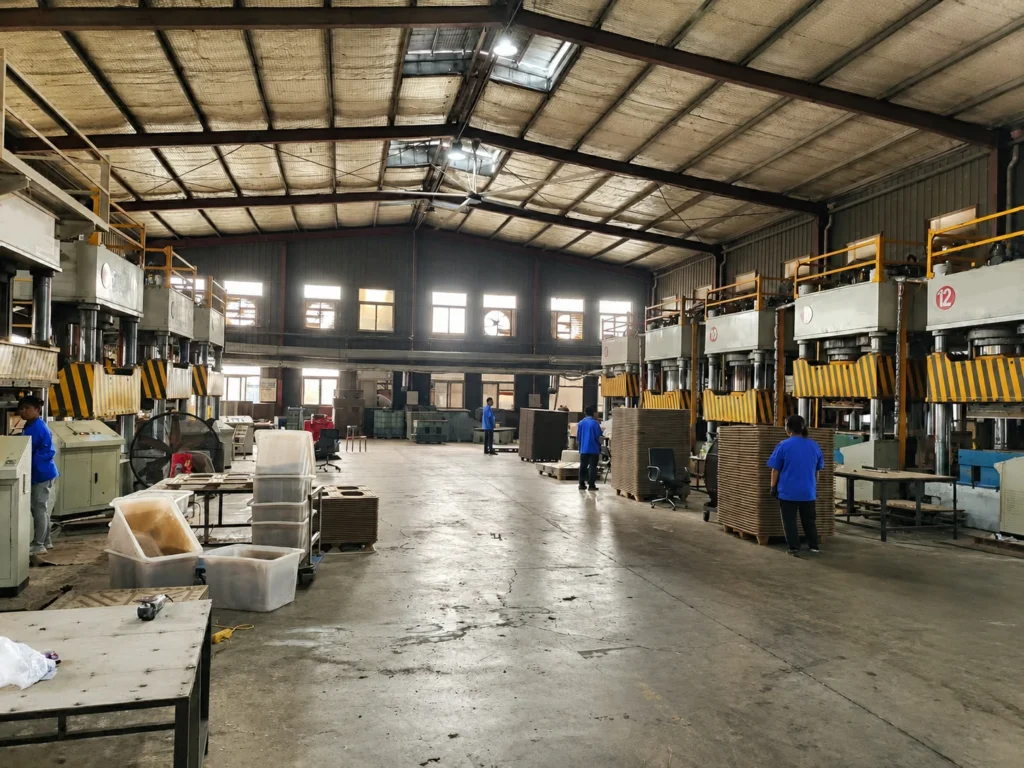
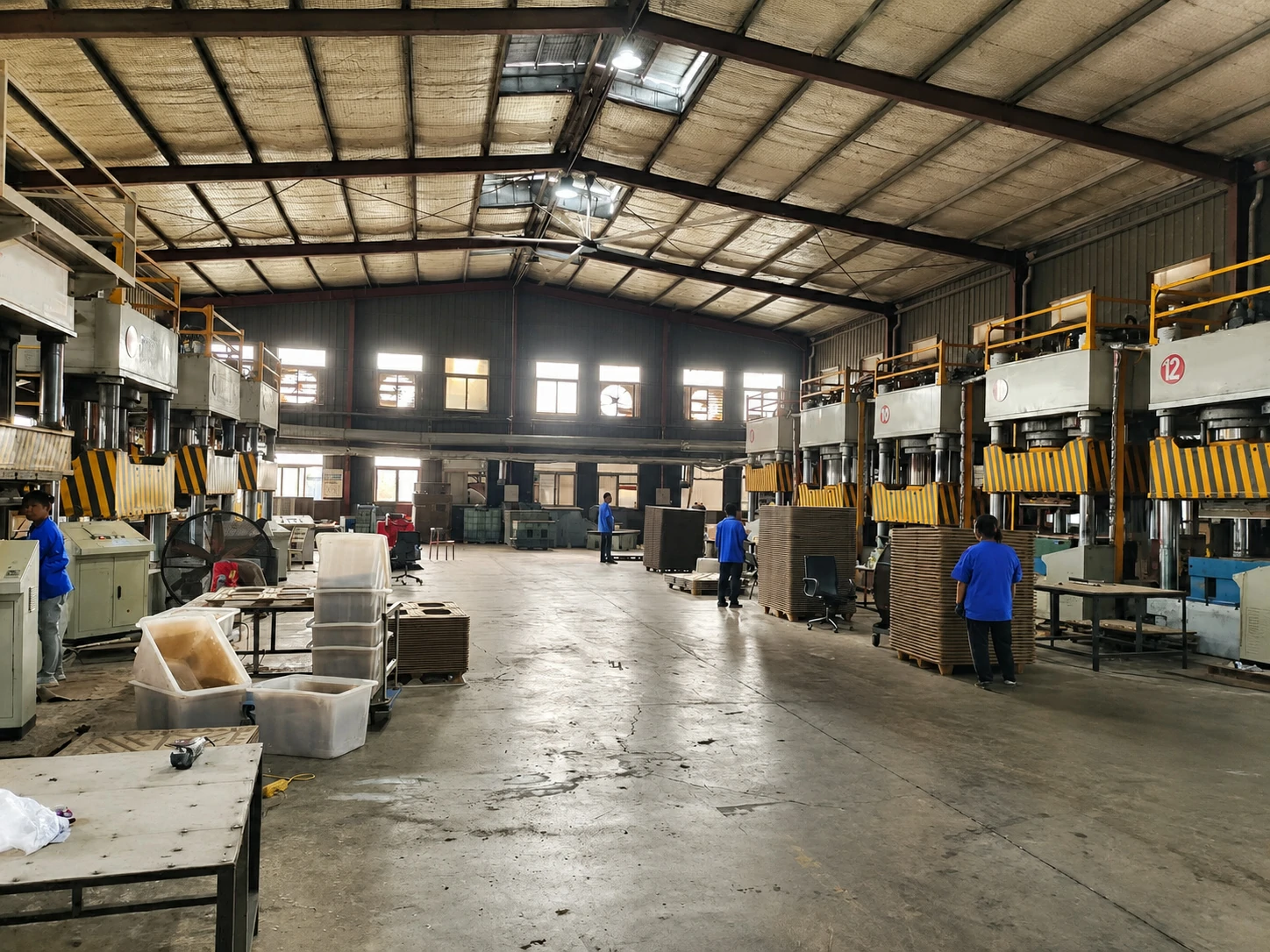
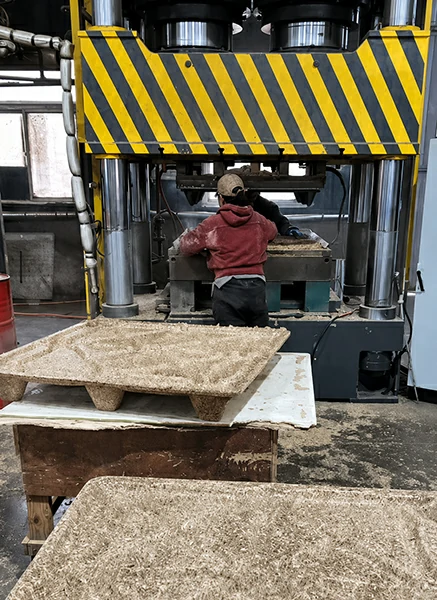
The machine itself is a Y32 type hydraulic press on a three-beam four-column frame: top beam, slide and worktable are the three beams, and the four solid columns guide the slide and lock the frame. Published parameters run from the Y-1250 at 12500 kN and a 1700 x 1400 mm platen through the Y-1600 and Y-2000 to the Y-2500 at 25000 kN and a 2500 x 1700 mm platen, with slide strokes from 700 to 900 mm, a system working pressure of 25 MPa and motor power from 55 to 75 kW. Mold changes cover nine-leg, grid base, Japanese and Sichuan style pallets, and the larger platens take smaller mold sizes. The frame can be split for sea freight, which is a shipping constraint rather than a finish preference. In the workshop photograph on this page, a row of heavy four-column presses with safety guards, independent control cabinets, stacked parts and operators shows line layout and guarding at the single station pallet press. In the forming station photograph, the four-column frame sits above a molded tray blank at the press head, which shows the pressing station itself. Neither photograph is presented as a named customer site, and neither replaces a factory acceptance test.
Sizing the Tonnage Tier to the Crew, and What Has to Be True Before the Press Forms Anything
Tonnage is the first sizing decision because it sets the platen and the cycle the line has to keep fed: Y-1250 for the smaller molded pallet formats, up to Y-2500 where the 2500 x 1700 mm platen is needed. The second decision is the automation tier. The semi-automatic tier keeps operators at loading and take-out; the fully automatic tier compresses that handling further on the same process platform, so a plant that starts semi-automatic does not have to tear the line down later. What the press does not do is run on its own. EMP does not sell the press as a stand-alone machine, and crushing to about 5 mm, drying to 8 to 12 percent moisture and even MDI adhesive mixing have to be in place before it forms anything. As a plant level screen, the line expects at least 600 square metres of floor, 6 metres of clear height and 200 kW of available power, and at annual demand below 10,000 pallets buying finished pallets is the cheaper route. Where those conditions hold, the result is a molded pallet that is nestable at roughly 4 to 1 for warehouse storage and return freight, nail-free and splinter-free for material handling, and positioned on the ISPM-15 exempt, fumigation-free route for export pallet shipments.
- Title, slug, first-screen summary and both image alt texts carry the phrase wood pallet hydraulic press
- Tonnage, platen, stroke, working pressure and motor figures come from the published MldP parameter table for Y-1250 to Y-2500
- The page states the boundary that the press is not sold as a stand-alone machine and that crush, dry and MDI glue stages precede it
- No per-shift headcount or payback figure is claimed because none is published


