Molded pallet line manning and automation tiers
The Roster Is the Constraint, Not the Order Book
A molded pallet plant in a tight labor market is not short of orders, it is short of people willing to stand at a nailing bench for a full shift. This page takes that roster problem onto a wood pallet hydraulic press, where a Y32 three-beam four-column machine at 1250 to 2500 ton forms one finished pallet per cycle with no nailing stage and no manual board sorting, and where a semi-automatic line and a fully automatic line sit on the same process platform, so capacity can be added by automation tier instead of by headcount. The boundary is stated plainly: crushing to about 5 mm, drying to 8 to 12 percent moisture and even MDI adhesive mixing have to be in place before the press forms anything, and the press is not sold as a stand-alone machine.
Why Hot Press Molding Carries Fewer Labor Stages Than Nailing
Molded pallet forming is a compression process, not an assembly process. Recovered wood fiber, sawdust, wood shavings, wood chips, recycled wood or agricultural residue is crushed, dried, mixed with MDI adhesive and dosed into the molding die; the slide closes, the heated platens hold pressure at temperature, and one-press forming delivers a finished pallet with a one-piece molded shape. There is no nailing stage, no manual board sorting and no joint to re-tighten later, which is why a molded pallet production line runs on a much smaller roster than a nailed pallet line of comparable output, and why the labor that remains sits on a few continuous stages rather than on benches: crusher, dryer, glue mixer, conveyor and press. Those stages are what makes an automatic pallet production line possible at all, because material moves through them on a flow instead of being handed from person to person. It also changes what the plant is buying. A nailing line adds output by adding operators; a hot press adds output by adding cycles, and the press cycle is set by tonnage, platen size and the molding window rather than by how many people are on the floor.
Two Automation Tiers on One Platform, Four Tonnage Steps
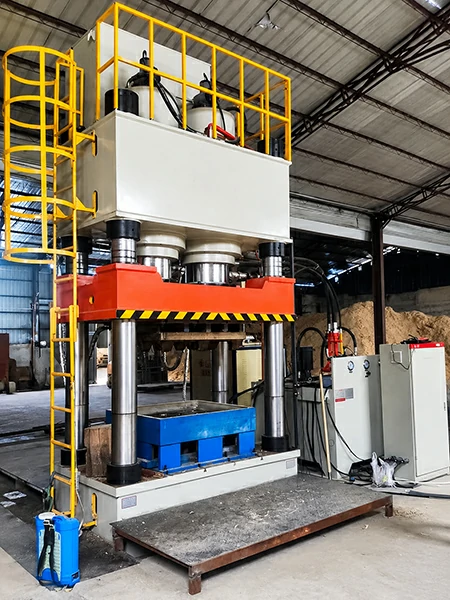
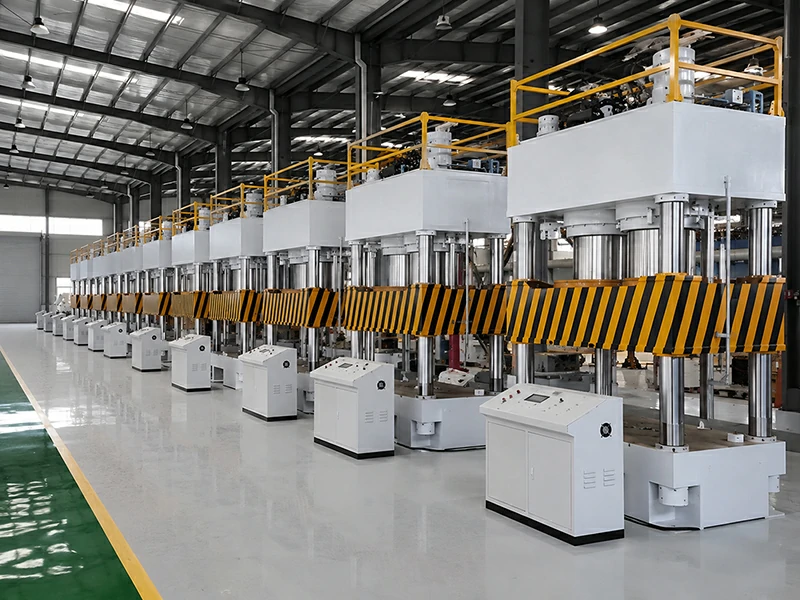
EMP builds this machine as a Y32 three-beam four-column hydraulic press: top beam, slide and worktable as the three beams, four solid columns at the corners, the hydraulic station mounted behind the top beam and a control console that can stand on the floor or sit on the operating lever. Tonnage is published in four steps, so the tier is chosen from pallet size and required output instead of from a sales conversation. Y-1250 is a 1250 ton hydraulic press at 12500 kN with a 1700 x 1400 mm platen and a 55 kW motor. Y-1600 is a 1600 ton hydraulic press at 16000 kN with an 1800 x 1450 mm platen. Y-2000 is a 2000 ton hydraulic press at 20000 kN with a 2100 x 1500 mm platen and a 65 kW motor. Y-2500 is a 2500 ton hydraulic press at 25000 kN with a 2500 x 1700 mm platen and a 75 kW motor. System working pressure is 25 MPa and slide speed runs 5 to 10 mm per second depending on model, with slide stroke from 700 to 900 mm and a single station pallet press layout. The selection table behind the line puts a semi-automatic pallet production line at roughly 30,000 to 80,000 pallets a year and a fully automatic configuration with more than one press above 200,000 pallets a year. The engineering point that matters for a wage decision is that both tiers sit on the same process platform: the crusher, dryer, glue mixer and press stay the same stages, and the automation difference lands on infeed, take-out and stacking. A plant that starts semi-automatic is not buying a different machine later, it is adding automation to a platform it already owns. The two photographs on this page show that platform from two angles. The first is the single press: four guide pillars, safety railings, the separate hydraulic power unit and the control cabinet beside the worktable. The second is a row of four-post presses with safety guards and independent control cabinets, which is what the floor looks like once capacity has been added at a higher automation tier. The Y32 frame is also split for shipping, so the machine travels as transportable sections and is reassembled during factory installation, which matters both for container shipping and for a building that was not designed around the machine.
What the Press Still Needs Before It Earns Its Place
The press is not the whole line and it is not sold as a stand-alone machine. Recovered wood has to be crushed to about 5 mm particle size, dried to 8 to 12 percent moisture and mixed evenly with MDI adhesive before it reaches the mold, and the published process window sits at 150 to 180 C, 15 to 20 MPa and roughly 180 to 240 seconds per pressing, with both fixed-distance and fixed-pressure molding and a dwell delay. A plant that skips the crusher or the dryer is not buying a cheaper line, it is buying a press that cannot form a pallet, and the site requirements say the same thing from the other side: at least 600 square metres of floor, 6 metres of clear height and available power in the 150 to 400 kW band depending on how many presses the line carries. With those stages in place, what the plant gets is a shorter roster and a flatter cost curve. One finished pallet leaves the press per cycle, formed in a single pressing rather than assembled from boards. The pallet is nail-free and splinter-free, so material handling stops feeding a repair bench. It is a nestable pallet that stacks about four to one, so empty pallet return volume and warehouse footprint come down. And because hot press molding is a deep processing step, the output is classed as a processed wood product and ships as a fumigation-free export pallet outside the ISPM-15 heat treatment and phytosanitary queue. For a pallet plant looking at another wage round, that is the difference between buying capacity with people and buying it with cycle time, on a platform that can be pushed one automation tier further without being replaced.
- Only values from the published parameter table and the MldP blog brief are used; no payback, ROI or headcount figure is invented
- The head keyword wood pallet hydraulic press appears in the title, slug, first-screen summary and both image alt texts
- The line boundary is stated: crush to about 5 mm, dry to 8 to 12 percent moisture, even MDI mixing, and the press is not sold as a stand-alone machine
- No weak words used: high quality, best solution, one-stop solution, advanced technology, reliable product


