Wood Pulverizer Machine · Residue Volume Reduction at the Sawmill Front End
The Residue Pile Is the First Cost Centre at the Front End of the Line
A sawmill or pallet plant rarely loses money on residue because the wood is worthless. It loses money on the shape the residue is in: slabs, edgings, trimmings and blocky chips stack loose and eat shed volume, the fines among them lift into the air and sit in the pile as a fire load, and every outbound tonne pays freight on air pockets. This page follows one Pulvz wood pulverizer machine placed at the point where that residue is generated, so bulky material becomes a conveyed fibre stream at a 5 mm target band instead of a pile waiting for a truck.
What Stacking, Dusting and Trucking the Raw Pile Actually Costs
The old handling route is cheap on paper and expensive in practice. Stacking raw slabs and blocky chips into bunkers and under roof buys shed volume with nothing: loose bulk density means most of the space under that roof is air, and the pile keeps growing while the usable floor shrinks. The fines do the second kind of damage. Sawdust that is fine and dry lifts off the pile as dust under any loader movement, which lands on neighbouring product, on roofs, on truck beds and on whatever the site's housekeeping routine is supposed to catch, and the same fines compact inside the pile and hold heat. A pile of loose dry fines is a standing fire load, and spontaneous heating inside a residue heap is an old and well-known problem in this industry, not a rare event. The third cost leaves on wheels. A truck loaded with bulky slabs and edgings is mostly paying for air, so the freight per recovered tonne rises exactly when the residue value is at its lowest, and a long haul to a buyer can absorb what the material was worth. Add the labour side: manual splitting by axe or saw cannot keep pace with the line, an old low-capacity single-roll crusher becomes the bottleneck by mid-shift, and every hour of unscheduled sorting is an hour the front end is not feeding anything.
Crushing Where the Residue Is Made, Not Where It Is Sold
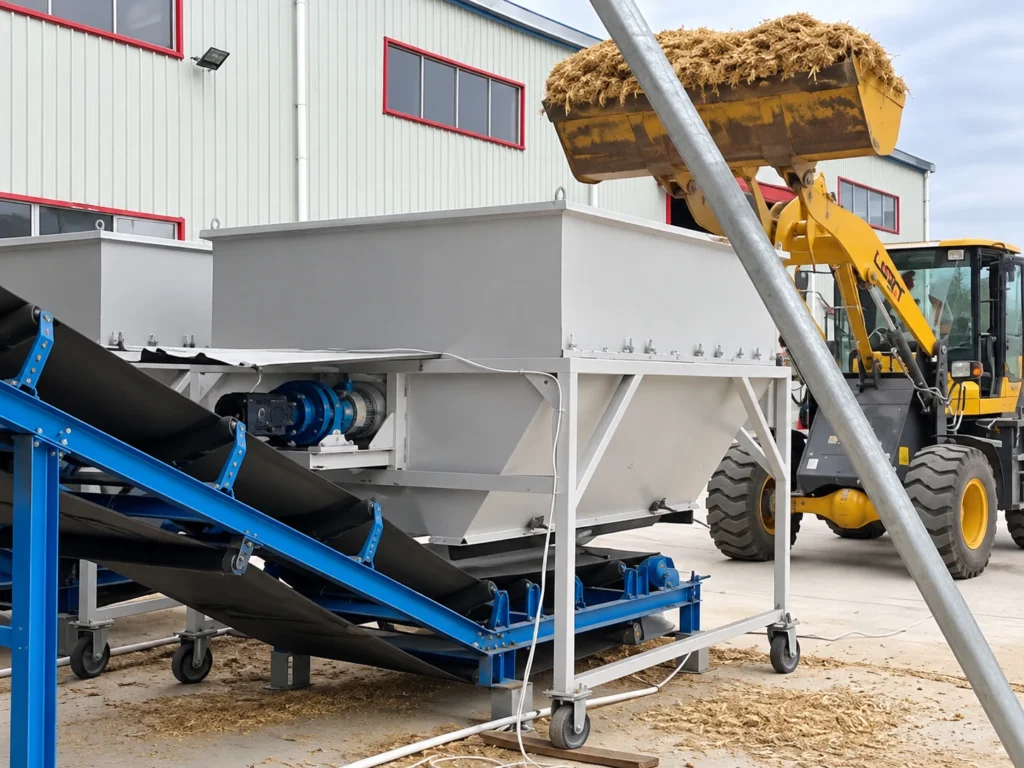
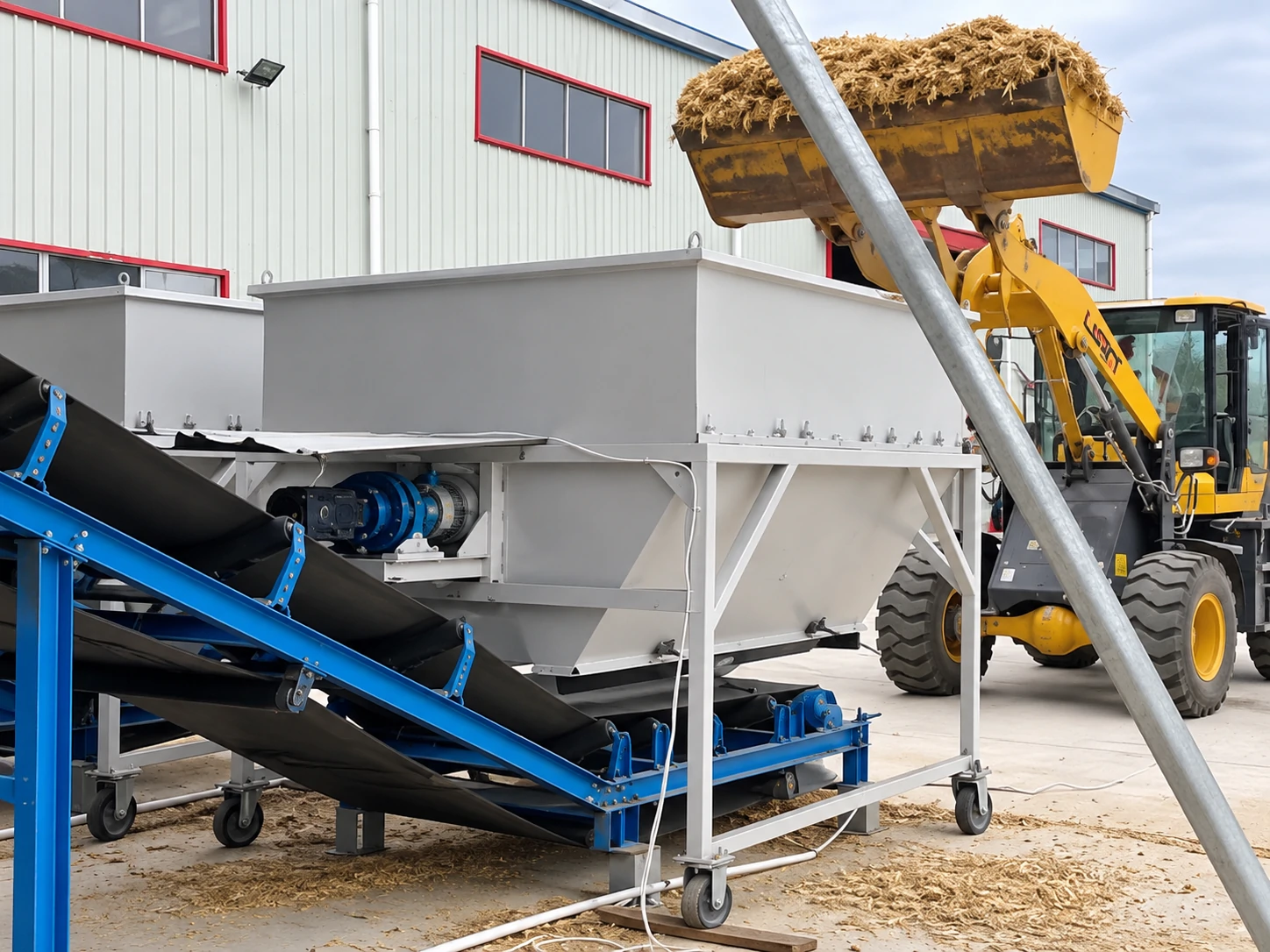
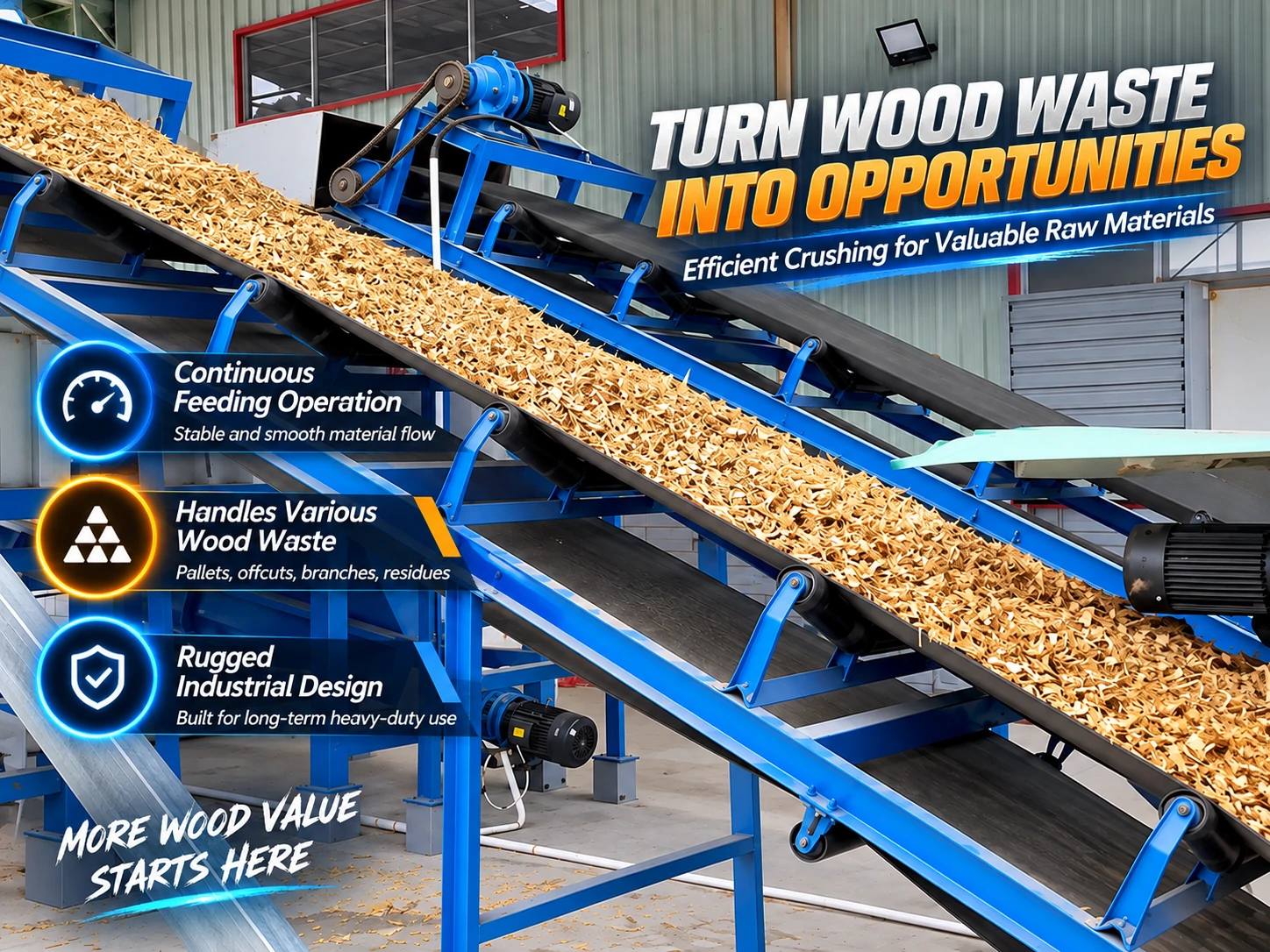
The fix is placement as much as it is machinery. A wood pulverizer machine sitting at the residue source, fed by belt conveyor, removes the pile instead of managing it: material goes from the discharge of the line into the crushing chamber and out as a particle stream, so the yard never holds a loose heap for a season and no loader has to relocate the same tonne twice. The Pulvz F series covers that decision in four tiers, with nominal 1 to 8 t/h on 45 kW, 55 kW, 75 kW and 110 kW drives, high-hardness replaceable screens from 780 mm to 1480 mm, and infeed openings from 680 by 380 mm up to 1350 by 450 mm, which is the number that decides whether whole slabs and block ends go in as they are or need pre-cutting. Above the screen the working parts are manganese steel hammer plates against a one-piece manganese steel liner, on a rotor built to dynamic balancing technology, and a hydraulic open cover lifts the chamber for hammer and screen access so maintenance is a planned stop rather than a teardown. A cyclone separator carries the airborne fraction out of the working area, and the discharge can drop straight onto a take-away conveyor for the drying stage. The two site photographs show the two halves of that arrangement: a wheel loader tipping loose biomass into a large-capacity steel hopper on a mobile wheeled base, and a multi-stage inclined belt conveyor moving crushed wood chips continuously into the line behind it. The design intent printed on the manufacturer's own overlay for that conveyor is the whole argument in four words: continuous feeding operation.
What the Yard Measures After the Change
The results show up in three places a plant already tracks. Floor and shed volume come back, because a crushed particle stream consolidates into a fraction of the space the same tonnage occupied as loose slabs and edgings, and the bunker stops being a permanent structure. Airborne dust and fire load both fall, because the fines that used to lift off the pile are captured at the discharge through the cyclone rather than resident in a heap that heats on its own. Outbound freight falls per recovered tonne, because trucks leave with denser material and a site that used to ship two loose loads can plan on fewer, better-loaded ones, or skip the haul entirely and feed the material into its own molded pallet line. The boundaries deserve the same space as the claims. The 1 to 8 t/h figures are nominal and move with species, moisture content, infeed evenness and screen condition; the 5 mm figure is a screen-set target band reached with a given mesh and material, not a guarantee for every input; magnetic separation of tramp metal is a project-confirmed stage and not a standard item on every unit; and the hydraulic cover, cyclone, wheeled base and screen range are configuration choices to be fixed model by model. Bring the residue mix, the moisture band and the particle size your downstream stage accepts, and the front end can be sized against your own yard instead of against a brochure.
- Every figure is traceable to the Pulvz product brief and traffic profile: four F-series tiers, 1 to 8 t/h nominal, 45 to 110 kW, 780 to 1480 mm screens, 680 x 380 mm to 1350 x 450 mm infeed, manganese steel hammer plates and one-piece liner.
- Nominal capacity, the 5 mm target band, magnetic separation and configuration extras are stated as bounded conditions, not as guarantees or standard equipment.
- Body sections contain plain text only and no heading is used as an H1; the theme template owns the H1.
- Images are the two newly imported attachments for this page with no repeated photo from earlier Pulvz publications, and the call to action points to /contact/.