Wood Pulverizer Machine – Scope of Supply for Line Integrators
The Integrator Who Has to Buy the Front End
An integrator that builds molded pallet lines rarely makes every core machine. The press, the dryer and the front-end crusher come from different suppliers, and the moment a line is handed over, the boundary between them becomes the integrator's problem: the crusher does not reach the tonnage the dryer was sized for, the discharge does not match the duct the drying stage was built around, or a fault appears in the seam between two vendors and nobody owns it. This page sets out what a wood pulverizer machine scope of supply has to name before the order, so the front end can be carried inside one bill of materials and one warranty envelope instead of being argued about at commissioning.
Why a Bought-In Wood Crusher Becomes a Handover Argument
Most front-end crushers are bought on a nameplate and a price sheet. Nominal tonnage is quoted without the raw material it was measured on, discharge size is described as fine or uniform instead of in millimetres, the infeed opening and the discharge height are drawn by nobody, and acceptance is whatever can be agreed on the day the truck leaves. The first wet or mixed load exposes all of it. Tonnage falls away because the machine was sized on dry offcuts, the discharge drifts coarse so the dryer has to give back residence time, and molding conditions move with it. By then the crusher supplier says the material was out of scope, the dryer supplier says the infeed was out of specification, and the integrator, holding the end-client contract, pays for both positions.
What the Scope of Supply Has to Name Before the Order
The F-series platform can be written as a single-machine technical protocol rather than a nameplate, because the numbers already exist in model terms. F-800 carries a 780 mm screen, a 680 x 380 mm infeed, 1200 rpm and a 45 kW drive over a nominal 1 to 2 t/h; F-1000 moves to a 980 mm screen, 880 x 400 mm, 55 kW and 2 to 3 t/h; F-1200 to a 1180 mm screen, 1050 x 420 mm, 2000 rpm, 75 kW and 3 to 5 t/h; F-1500 to a 1480 mm screen, 1350 x 450 mm, 2600 rpm, 110 kW and 5 to 8 t/h. Around those figures the protocol states the replaceable high-hardness screen that sets a 5 mm target band, thickened manganese steel hammer plates working against a one-piece liner on a dynamically balanced rotor, a hydraulic open cover for hammer and screen access, belt conveyor feeding, and a cyclone separator where the project calls for one. Magnetic separation is named as a project-confirmed stage, not a catalog item, and the protocol carries the acceptance standard, the warranty term and the fault response path.
Where the Front End Hands Over to Drying and Molding
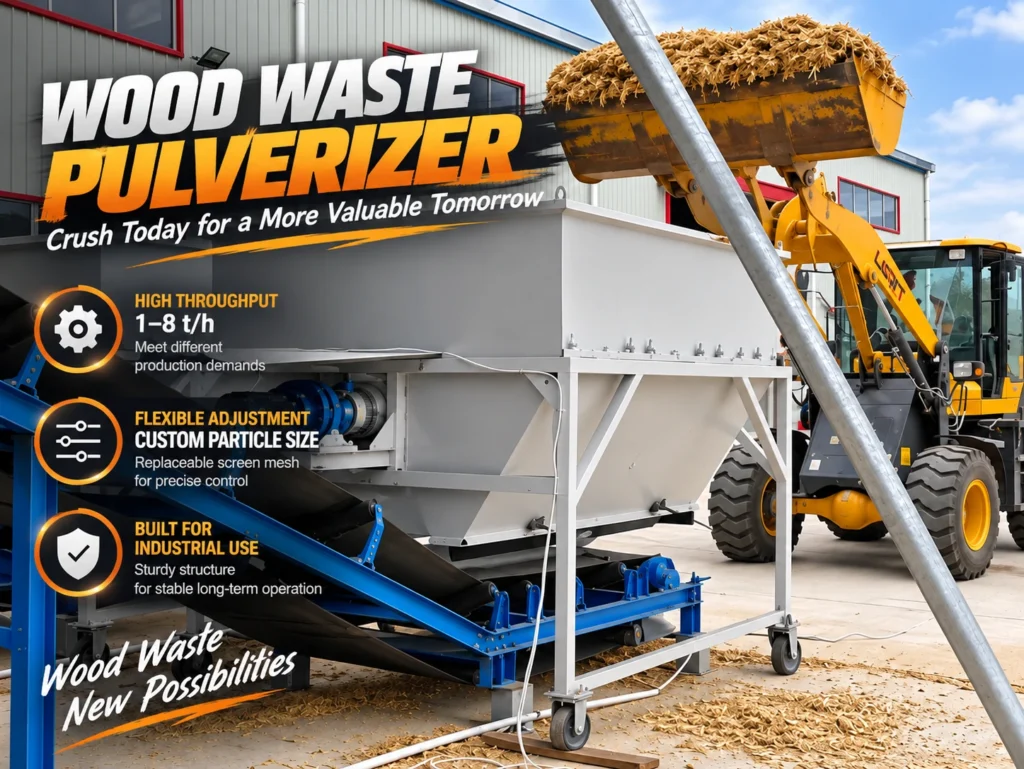
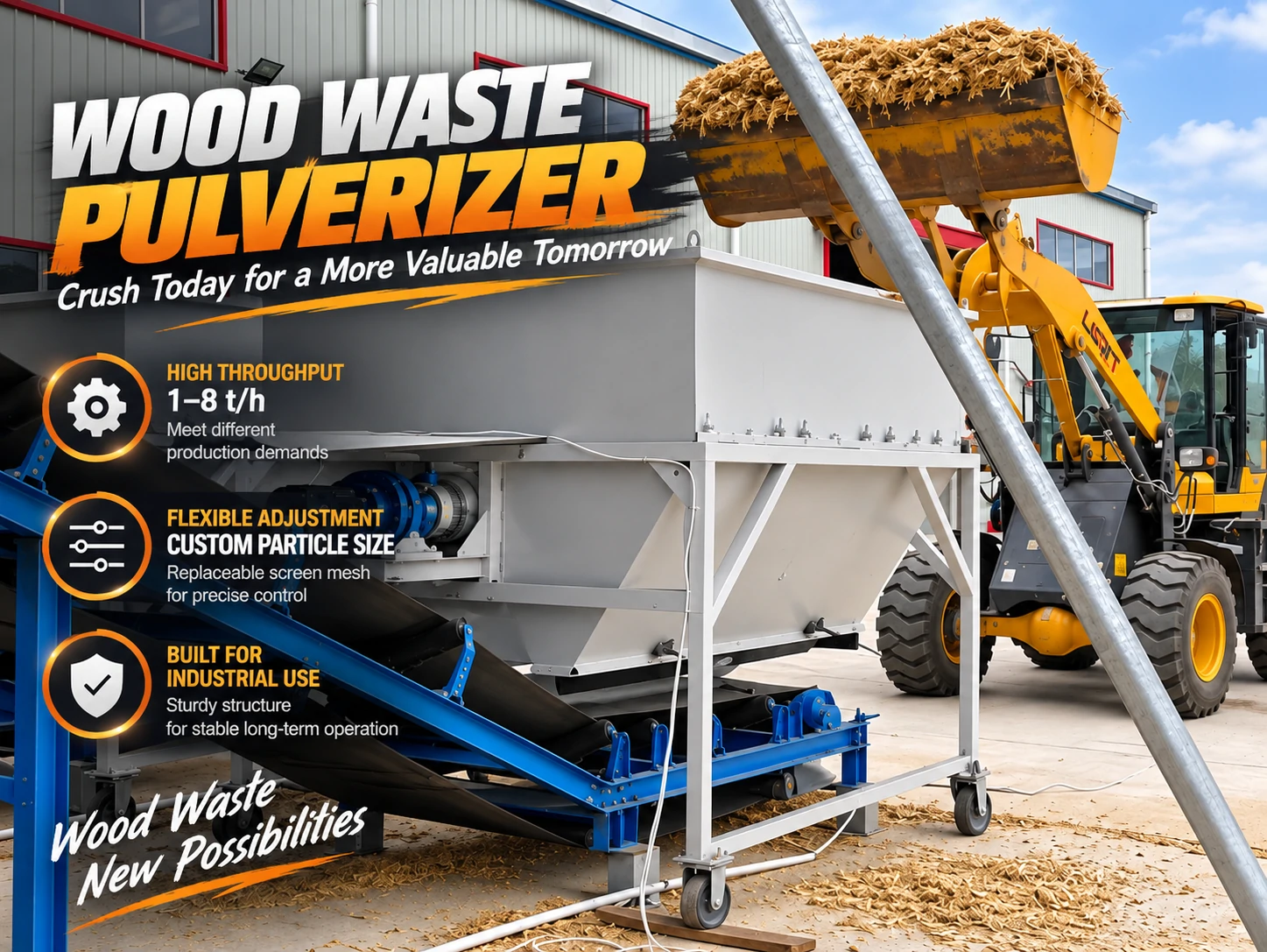
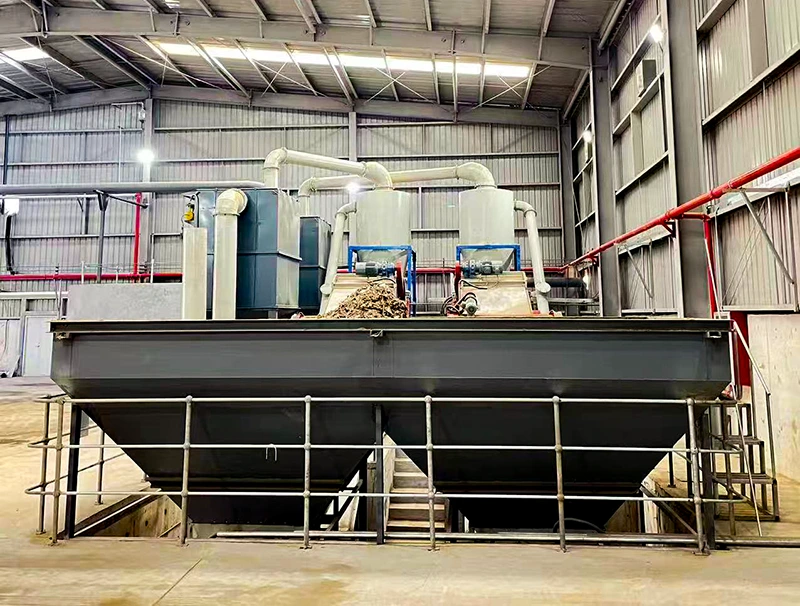
A crusher bought this way stops being an orphan in the line. Discharge height and duct connection are fixed in the protocol against the drying stage infeed, tonnage is fixed against the drying and molding rate the integrator has promised, and the 8 to 12 percent moisture context of the downstream drying section tells both suppliers what the crusher will and will not control. The first photograph shows the line-level infeed arrangement an integrator has to design around: a loader-charged hopper feeding an inclined belt conveyor into the crushing chamber, on a wheeled base. The second shows the plant-level hopper and ducting envelope around that machine, which is a project item sized by the integrator rather than a line in a crusher catalog. With those two boundaries written down, the integrator carries one tonnage figure, one discharge figure, one interface dimension and one fault response number into its own bill of materials and its own warranty. Nominal tonnage still moves with species, moisture, infeed evenness and screen condition, and 5 mm remains a screen-set target rather than a guarantee, but the line handover no longer depends on which supplier answers the phone first.
- Nominal 1 to 8 t/h across F-800 to F-1500 is presented as a nominal figure that moves with species, moisture, infeed evenness and screen condition.
- The 5 mm discharge figure is described as a replaceable-screen target band rather than a guaranteed result on every raw material.
- Magnetic separation is stated as a project-confirmed stage rather than a standard item on every unit.
- No price, delivery lead time, third-party test data or CE certification is claimed; tonnage, interface and acceptance values sit in the single-machine technical protocol for project confirmation.



