Wood pulverizer machine · multi-country feedstock fit
The order an integrator actually quotes: one front end, several countries, no shared raw material
A line integrator quoting molded pallet plants into several countries does not get to pick the raw material. This page follows one front end, the Pulvz wood crusher machine, through the feedstock spectrum an export order actually brings: sawmill chips and shavings in one market, bamboo and block offcuts in another, cotton stalk, hemp stalk, bagasse and coir residue in a third, all of which have to leave the crusher inside a 5 mm particle band. The claim made here is narrow and checkable. A wide infeed envelope, manganese steel hammer plates working against a one-piece liner, a replaceable high-hardness screen from 780 to 1480 mm, 45 kW, 75 kW and 110 kW drives over a nominal 1 to 8 t/h, and a screen set, not a second machine, as the only thing that has to change when the next country's raw material changes.
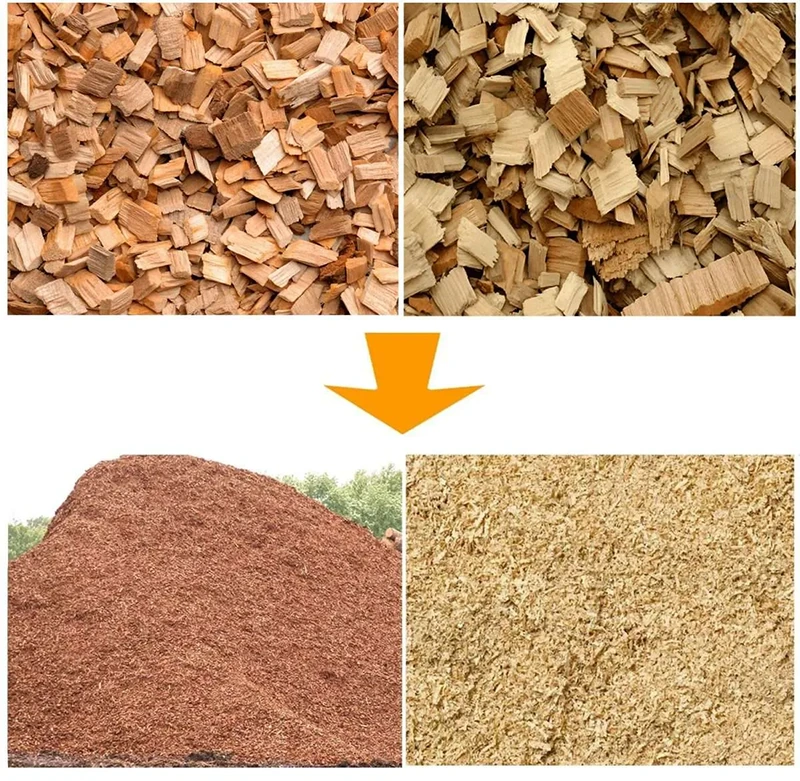
Where a single-material or fixed-aperture crusher closes the door on those orders
The cheap answers are the ones that shrink the order book. Buying ready-made sawdust works while a local supplier exists, and stops working the moment the project is 400 km from the nearest sawmill. Splitting and crushing by axe and hand saw is what many yards do before they own a machine, and it caps throughput at whatever the crew can swing. A drum chipper or disc chipper is often quoted in the same breath, but it cuts a first-stage chip in the tens of millimetres, which is a fuel or flake feed, not the fine furnish a molded pallet needs. A shredder reduces volume without sorting a particle band, so the dryer and the press absorb the variation instead. An old single-roll crusher with one worn aperture holds a single product and a single output. And an imported fixed-aperture hammer mill closes the loop, because changing the particle band means a second machine in the container. All four answers share one weakness: the machine, not the screen, becomes the thing that defines which countries the integrator can serve.
What lets one wood pulverizer machine hold a wide raw material pool: infeed, hammer plates and a screen you swap
Three structures decide whether the spectrum fits. The first is the infeed envelope and the feed arrangement: a belt conveyor feeding the crusher accepts an uneven, mixed, fibrous or splintered stream that a hand-fed chute cannot, and the loading hopper shown in the workshop photograph is built to take material dumped in by a wheel loader rather than pre-sorted by hand. The second is the wear set that survives that mix: thickened manganese steel hammer plates against a one-piece manganese steel liner, on a dynamically balanced rotor. The third, and the one that turns a wide pool into one product specification, is the screen. The high-hardness alloy screen is replaceable and runs from 780 to 1480 mm across the F-800, F-1000, F-1200 and F-1500 models, so particle size is controlled by the aperture that is fitted, not by the model that was bought. Around that core the machine is specified at 45 kW, 75 kW and 110 kW over a nominal 1 to 8 t/h, with a cyclone separator where the project calls for dust collection, a hydraulic open cover for hammer and screen access, and magnetic separation where the project confirms it as a stage. A chipper produces chips. A shredder produces volume reduction. This wood pulverizer machine produces a graded furnish that the next stage can meter.
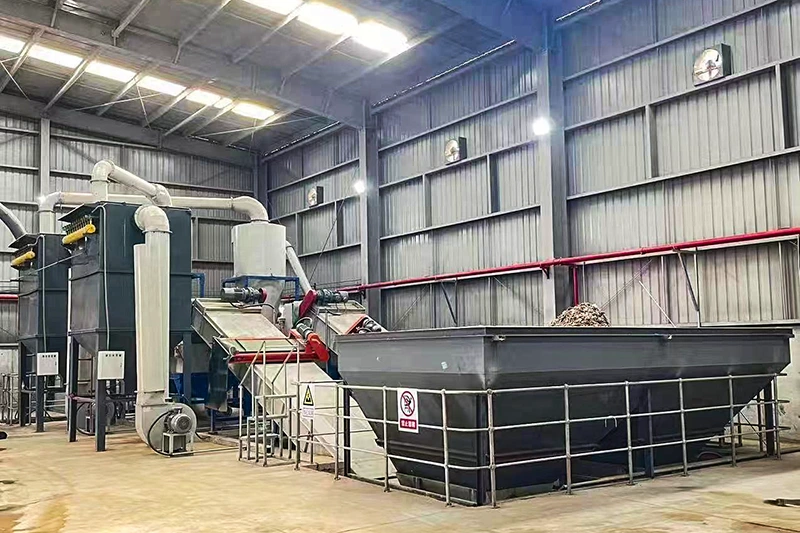
The evidence in the two photographs, and the boundary to quote on
The two images carry the argument without adjectives. The first shows the same job at both ends: coarse wood chips and blocks on one side, fine shredded biomass fibre on the other, which is what a screen change is for, one material family leaving at two particle bands. The second shows the receiving end of a real preparation section: a welded steel hopper with an inclined feeder and ducted dust collection behind it, taking a bulk material stream from a yard rather than a bagged input. That is the shape of work an integrator's front end has to absorb when the raw material arrives as bales, offcuts or chips. Then the boundary that keeps the quotation honest. The 5 mm figure is a screen-set target band, not a guarantee, and nominal tonnage moves with species, moisture, infeed evenness and screen condition. Magnetic separation is a project-confirmed stage rather than a standard item on every unit. Crop residue such as cotton stalk, hemp stalk, bagasse and coir is part of the demand an export order brings, and each new species still needs a screen and throughput trial before it goes into a contract tonnage. Within those limits the commercial result is simple: one front-end specification, one spare screen shelf, and a wider set of countries the same preliminary design can be quoted into. Send the raw material list and the target particle band to our engineers and they will size the model and the screen set against it.
- Feedstock spectrum including wood chips, bamboo, shavings, waste wood, offcuts, cotton stalk, hemp stalk, bagasse and coir is presented as the demand an export order brings, not as a guaranteed species list
- 5 mm is stated as a screen-set target band, never as a guarantee
- Tonnage is stated as nominal 1 to 8 t/h and dependent on species, moisture, infeed evenness and screen condition
- Magnetic separation is stated as a project-confirmed stage, and each new species still requires a screen and throughput trial