DRYR Sawdust Dryer – Recycled Wood and Yard Waste Feedstock
The Real Problem Is Batch Variance, Not One Wet Load
Recycled wood does not arrive dry and it does not arrive even. Demolition timber, used pallets, crates, garden and yard wood and sawmill residue sit in open yards, take rain in the wet season, and reach the hopper anywhere between soaked and half dry. A sawdust rotary drum dryer turns that uncontrolled intake into a controlled one: continuous hot air drying, combined lifting plates and temperature sensing monitoring hold the feedstock inside the 10 to 15 percent window that boiler fuel pellets and panel fibre filling are bought on, and can take it lower where the downstream process asks for it. This page follows one yard from open-air piles to a pellet mill and a board line, sets out the H-1010 to H-1815 model ladder at 0.8 to 2 t/h, and states the limits plainly.
What Sun Drying and a Small Airflow Dryer Cannot Deliver
Natural sun drying and manual open-air drying are the default on most of these sites, and they are the cheapest option only until a line has to run continuously. They depend on weather, season and yard area; in a monsoon or a long wet season they stop being a drying method and become a storage method, and the material that finally reaches the hopper is whatever the sky allowed. A small airflow dryer or a sawdust flash dryer is a legitimate choice on a fine, low-tonnage, single-species stream, and it is honest to say so, but a mixed recycled wood intake with wet lumps and oversized pieces is not that stream. Hand-welded low-end drum machines are the third common route, and their weak point is consistency: drum roundness, flange fit and lifting plate layout depend on the welder that day, so two units of the same nominal size do not dry alike. The common result is that drying stops being a process and becomes a judgement call. Someone decides by hand feel and by the look of the pile whether the material is ready, the mill or the board line receives a moisture it was not told about, and the plant manages the consequences instead of the moisture.
Why a Rotary Drum Fits Recycled Wood, Pallets and Yard Waste
A sawdust rotary drum dryer is a continuous hot air system rather than a batch dryer, and that is why it suits an intake that changes. Wet material is fed by screw conveyor or belt into an inclined rotating drum, hot air from the furnace is drawn through the drum by the induced draft fan, and combined lifting plates welded along the drum wall lift the material and drop it through the airstream as a curtain, so the hot air meets a large surface area instead of a wet mass. Drum inclination and rotation carry the material to the discharge end over roughly 10 to 30 minutes of residence time, which is long enough to even out a wet load and short enough to keep the line moving. Temperature sensing monitoring and controlled vibration keep the drying curve on a setpoint instead of on an operator's hand. Around that core, the machine is configured for the site: a self-insulation shell and a refractory-lined multi-fuel furnace that can burn coal, oil, gas, on-site wood waste or electricity, a sealed drum and inlet chute with a cyclone dust collector and optional baghouse filter, and optional PLC control. For a pellet mill or a board line the point is not that the dryer can dry one load. It is that the load leaving it is the same as the load before it, which is the only condition under which the mill and the press can be run to their own design.
The Structure and Numbers Behind a Stable 10 to 15 Percent
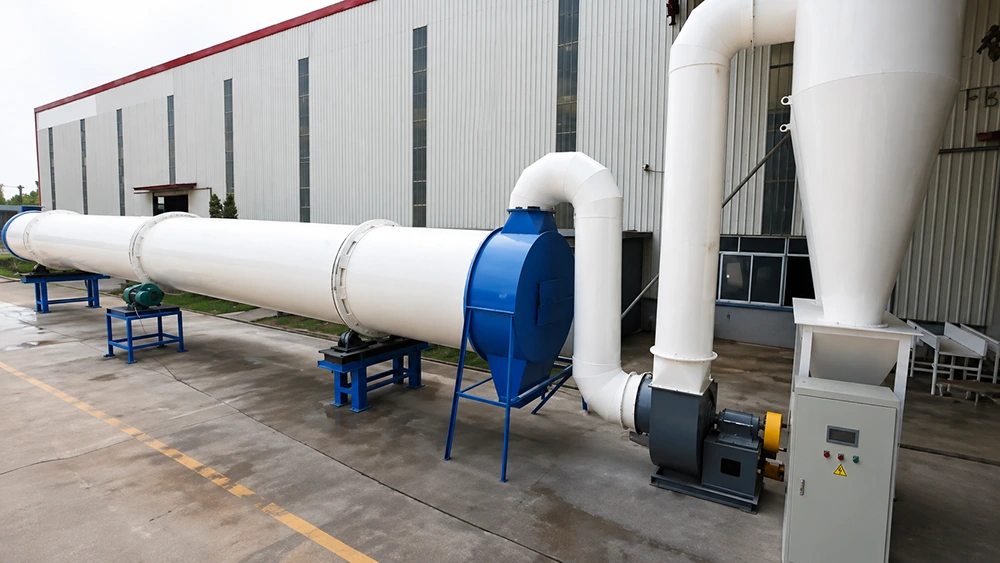
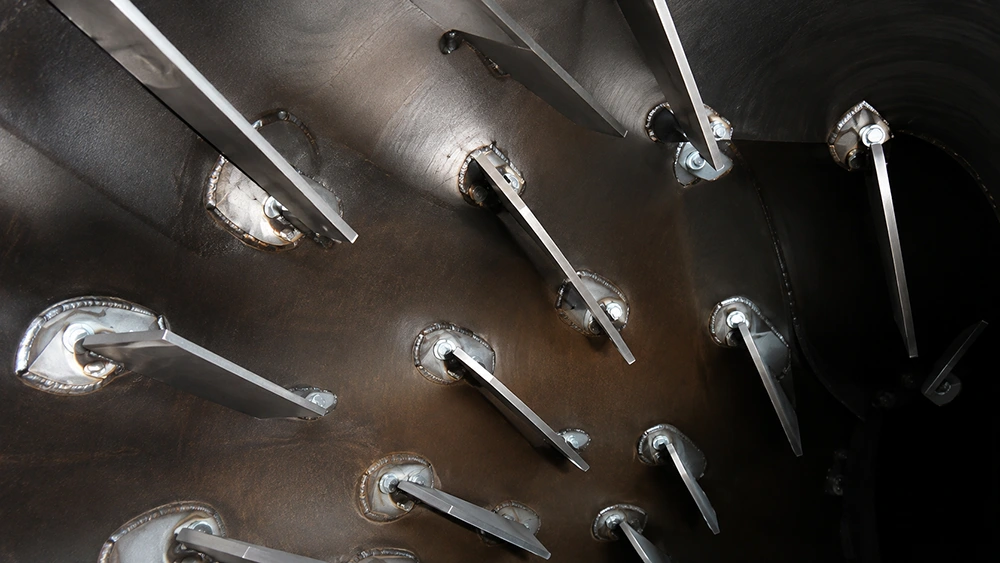
The DRYR platform covers four models across 0.8 to 2 tonnes per hour. H-1010 runs a 1000 mm drum on a 4 kW main motor and a 7.5 kW induced draft fan; H-1212 runs 1200 mm on 5.5 kW and 7.5 kW; H-1512 runs 1500 mm on 7.5 kW and 11 kW; H-1815 runs 1800 mm on 11 kW and 15 kW. Drum internal hot air is specified in the 200 to 500 degrees Celsius band, output sawdust moisture is stated below 10 percent with the setpoint taken lower, under 7 percent, where the downstream process requires it, and drying one tonne of material is quoted at under 8 kg of coal. Drive and support are external: a girth gear, pinion, gearbox and motor turn the drum, which rides on trunnion and roller supports, and long drums are built as bolted-flange sections so a 17 to 18 m unit ships split and is assembled and commissioned on site. Two photographs carry the structure claim. The first is a working system overview: a white drum on steel supports with segmented flange connections, ducting into a vertical cyclone separator, a centrifugal fan and a control cabinet, which is the drying, dust separation and air conveying loop in one frame. The second is inside the drying chamber, where staggered metal lifting plates sit on welded circular mounting plates with bolted hubs, and that is the geometry that actually builds the material curtain the hot air meets. The result at the gate is a boiler fuel pellet line or a panel fibre line receiving material at a moisture it can be priced and run on, rather than at whatever the yard delivered that week. The limits belong on the same page: 0.8 to 2 t/h, below 10 percent output and the under 8 kg of coal figure are quoted without published test conditions, so tonnage and final moisture move with species, initial moisture, particle size, fuel and site conditions, and every project is sized on its own material sampling. The figures above are a platform reference, not an unconditional guarantee.
- Image provenance: both photographs resolve to the Dryr designer gallery at /data/hot/vault/设计师图片库/Dryr and are published as real equipment photographs, not 3D renders.
- Parameters cited: the H-1010 to H-1815 drum diameters, main motor and induced draft fan ratings, 0.8 to 2 t/h range, 200 to 500 degrees Celsius drum internal hot air and below 10 percent output moisture are taken from the Dryr blog brief; the 150 to 180 degrees Celsius figure from the walkthrough video is deliberately not used.
- Moisture window: 10 to 15 percent is stated as the industry requirement for boiler fuel pellets and panel fibre filling, with below 10 percent as the DRYR output reference; no unconditional moisture guarantee is made and each project is sized on its own sampling.
- Image reuse: attachments 19243 and 19244 are reused media already held on the site, so this post makes no claim of newly sourced image provenance.



