Pulvz Wood Pulverizer Machine · Agricultural Residue
Where a baled crop residue pile breaks a wood-only front end
Baled corn stover, wheat straw and rice straw do not arrive at a plant the way sawdust does. A bale is a compressed matted block: long tough fibre pressed into a slab, field soil and grit still held in the butts, baling twine or net wrap wound through the layers, and a moisture level that sits wherever the field and the weather left it. A pellet mill or briquetting press cannot take that block directly, so the front end that has to break it open is a wood hammer mill set up for fibre, not a wood-only chipper. This page follows that front end on a Pulvz wood pulverizer machine: F-800 to F-1500 at 45 kW, 55 kW, 75 kW and 110 kW over a nominal 1 to 8 t/h, belt conveyor feeding for a bulky light stream, thickened manganese steel hammer plates working against a one-piece liner on a dynamically balanced rotor, and a replaceable 780 to 1480 mm high hardness alloy screen as the grading element that sets the discharge band.
What the old route does with a baled straw pile
Three routes are common before a proper front end exists. The first is manual: operators cut the twine, break the bale with a fork and feed a chute by hand, which works until throughput is measured, then becomes the bottleneck the whole line is paced by, and it still delivers lumps rather than an even curtain. The second is borrowing the wrong machine: a forage chopper or a knife-based chipper cuts length but needs a straight, single-stalk presentation, and a wet matted straw slab is the opposite of that, so long stringy fibre wraps, the rotor loses balance and the cut length scatters. The third is buying the problem away, contracting pre-ground biomass or sawdust, which returns the plant to a price it does not set and a particle band it cannot inspect. Honest boundaries belong here too, because a pulverizer is a size reduction machine and not a cleaning stage. It will not cut twine or net wrap off a bale, and it will not wash field soil out of the fibre: twine and wrap removal, destoning and metal separation sit upstream and stay project-confirmed stages, with magnetic separation quoted per project rather than assumed as a standard item. What the crusher can do is stop a matted bale from arriving at the mill as a lump, and hold the discharge inside a defined band so the next machine sees a repeatable stream.
Why a hammer pulverizer takes tough stalk fibre where a chipper does not
The reason is the reduction principle. A chipper depends on a clean shear cut and a straight presentation, which suits logs, slabs and offcuts with a grain direction, and it is why a chipper produces chips rather than the fine particle a pellet mill or molded pallet line needs. A Pulvz wood pulverizer machine reduces by impact and shear in the chamber instead, thickened manganese steel hammer plates against a one-piece manganese steel liner on a dynamically balanced rotor, so a matted straw slab does not have to be presented straight: it is broken open, rubbed and reduced inside the housing. That is the same mechanism that lets the machine cover wood waste, offcuts, branches, corn straw and wheat straw on one body, which matters to a plant whose feedstock mix shifts through the year between residue and wood. The grading element is the replaceable screen, a 780 to 1480 mm high hardness alloy screen across the four models, and it is the part that turns a variable fibrous stream into a defined one: material that reaches the band passes, material that does not is held and re-crushed. Belt conveyor feeding is part of the same answer for a bulky, low density material, because a conveyor carries a bale-broken straw stream into the infeed opening without the bridging that a hand-fed chute produces, and belt speed becomes a control the operator can actually adjust when the bale structure or the moisture changes. The hydraulic open cover is the maintenance side of the same argument: after a wet or contaminated lot, screen, hammer plate and chamber access is a planned stop rather than a dismantling job.
Structure, settings and what the two photographs actually show
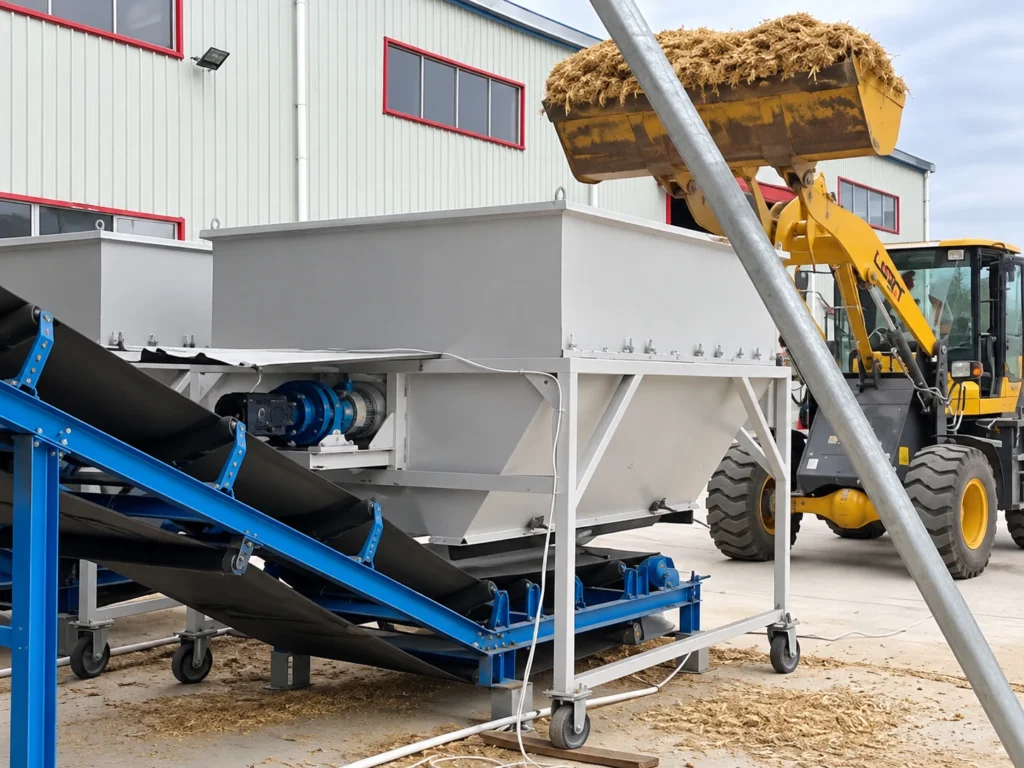
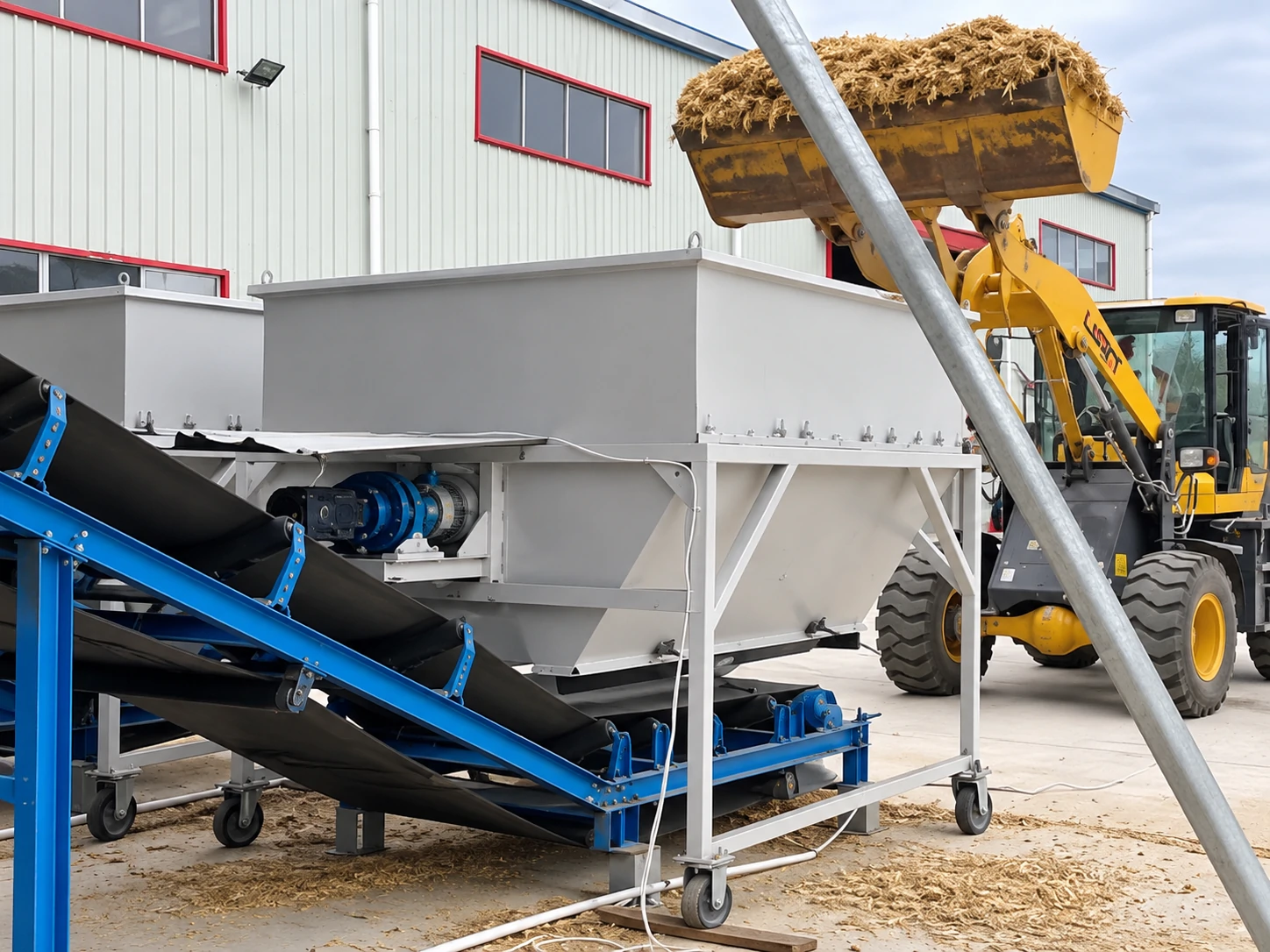
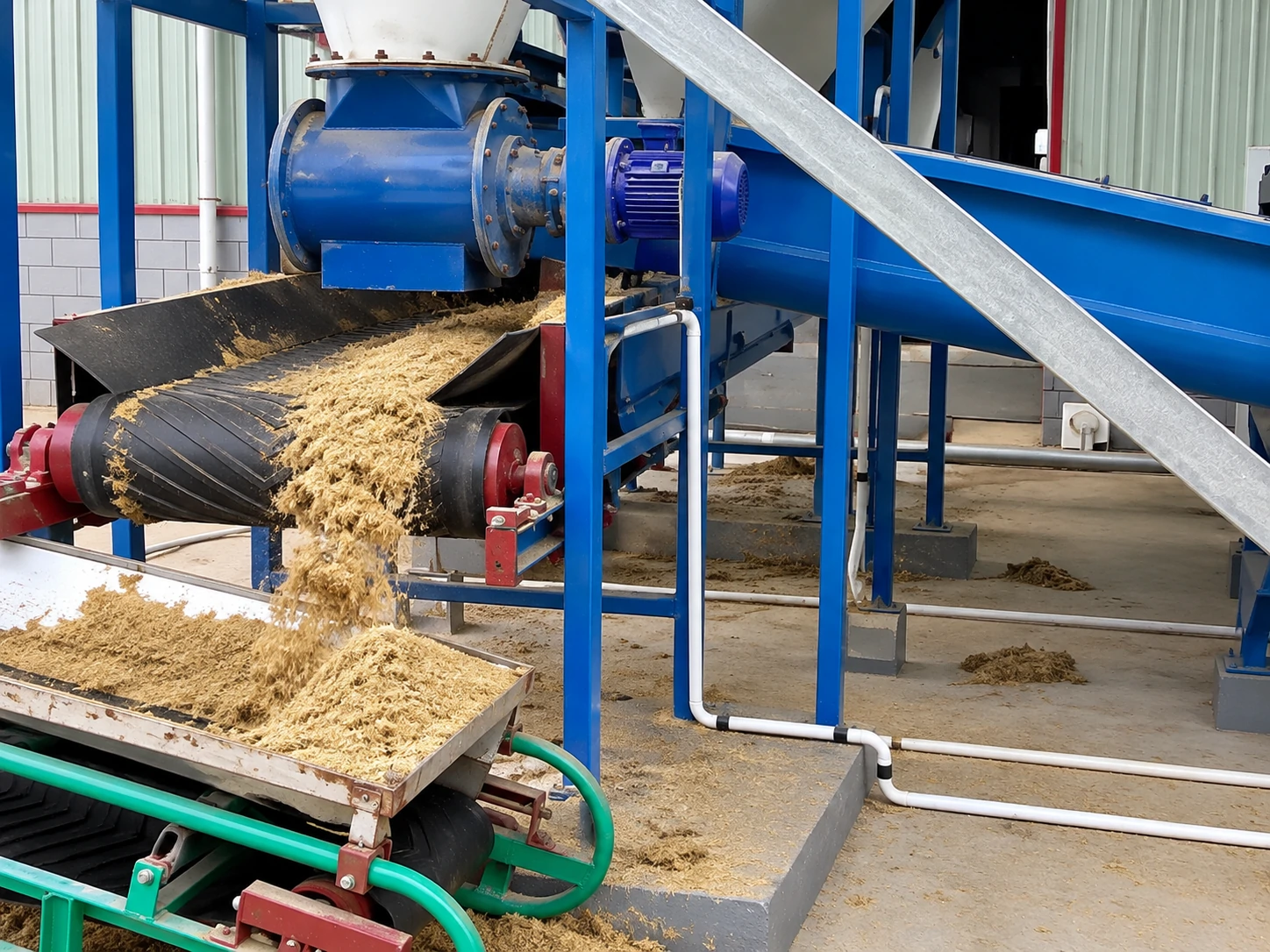
The setting ladder is published, not negotiated per enquiry: F-800 at 45 kW with a 780 mm screen, a 680 x 380 mm infeed opening and a nominal 1 to 2 t/h; F-1000 at 55 kW with a 980 mm screen, 880 x 400 mm and 2 to 3 t/h; F-1200 at 75 kW with a 1180 mm screen, 1050 x 420 mm and 3 to 5 t/h; F-1500 at 110 kW with a 1480 mm screen, 1350 x 450 mm and 5 to 8 t/h. The first photograph shows the infeed side of the job as it looks in a plant: a wheel loader tipping agricultural residue into the steel hopper while the inclined belt conveyor behind it carries the stream toward the chamber, which is the arrangement that removes the hand-fed chute from the residue route. The second photograph shows the discharge side: crushed fibre leaving through a rotary valve onto a conveyor on the blue Q235 steel frame, in the 2 to 5 mm range the manufacturer labels on this material, which is the evidence that the screen, not the operator, is setting the band. Both images are manufacturer site photographs, so they document arrangement and material condition rather than acting as a test report. The limits are stated the same way: nominal tonnage moves with species, moisture, infeed evenness and screen condition, a 5 mm figure is a screen-set target band rather than a guarantee on every species, and each new residue needs its own screen and throughput trial before a tonnage is promised. What a line gets in return is the thing the old routes could not supply, a crop residue that reaches the pellet mill, dryer or densifier as a metered stream with a known particle band, harvested in a few weeks and fed out across the year, instead of a bale that has to be fought into the chamber. If your feedstock mix is moving into baled stalk, we will size the model against your species, moisture and target band at the contact page.
- Four body sections follow the required chain: customer scenario, old-route problems, why the machine fits, then structure, parameters, image evidence and result.
- Only published Pulvz parameters are used: F-800 to F-1500 on 45, 55, 75 and 110 kW over a nominal 1 to 8 t/h, screen widths 780 to 1480 mm, infeed openings 680 x 380 to 1350 x 450 mm, replaceable high hardness alloy screen, manganese steel hammer plates and one-piece liner, dynamic balancing, belt conveyor feeding, hydraulic open cover.
- Scope boundaries stated in the copy: 5 mm is a screen-set target band, nominal tonnage moves with species, moisture, infeed evenness and screen condition, twine and wrap removal, destoning and magnetic separation are upstream project-confirmed stages, and both images are manufacturer site photographs rather than test reports.
- Title, slug, eyebrow, intro, section copy and both image alts carry the traffic-profile product, scenario, problem and result terms without any banned generic marketing wording.