Remote and inland delivery, split sections, on-site assembly
The inland plant, and the transport bill nobody quotes in the dryer price
A sawdust dryer for a molded wood pallet line or a biomass pellet plant is bought against a moisture target, but in Australia, inland Southeast Asia and other remote lanes it is priced and scheduled against a transport problem first: a rotary drum built out to 17 to 18 m does not fit a container as one welded shell, and a plant hundreds of kilometres from the port cannot absorb an oversized cargo move plus a crew flown in to commission. This page follows one buying decision, a rotary sawdust dryer for a plant drying wood sawdust, wood chips, shavings, straw or rice husk to a stated output moisture below 10 percent, shipped as bolted flange sections and re-assembled on site. The DRYR drum ships in pieces, the assembled structure reduces plot footprint and civil work against comparable models, and the commissioning step happens at the customer site instead of at the port of discharge. Tonnage, temperature and final moisture figures below are quoted from the product parameter table without published test conditions, so they move with species, initial moisture, particle size, fuel and local climate.
Why the drum route stays, and what split shipment changes about it
An airflow sawdust dryer or a flash dryer answers some duties, but on wet, bulky and variable biomass, the rotary sawdust drum dryer remains the working machine across the sector, and a three pass rotary dryer is a variation on the same principle rather than a replacement. So the DRYR answer is not a shorter machine, it is a differently shipped one. The drum is built as bolted flange sections and the unit ships split, one container at a time, when a single container cannot take the whole assembly. The same logic is already visible in the product: an assembled structure rather than a monolithic welded body, combined lifting plates installed and bolted inside the shell, and roller supports with a separate girth gear and pinion drive on a steel base frame. The value of that choice lands in three places. Freight is planned per section instead of per oversized cargo move. Civil work is lighter because the assembled structure reduces plot footprint and foundation investment by about 50 percent against comparable models, which is where an inland site saves real money. And commissioning happens on the customer site, with assembly then adjustment then a moisture check on the customer's own material.
The structure and the numbers that make the split work
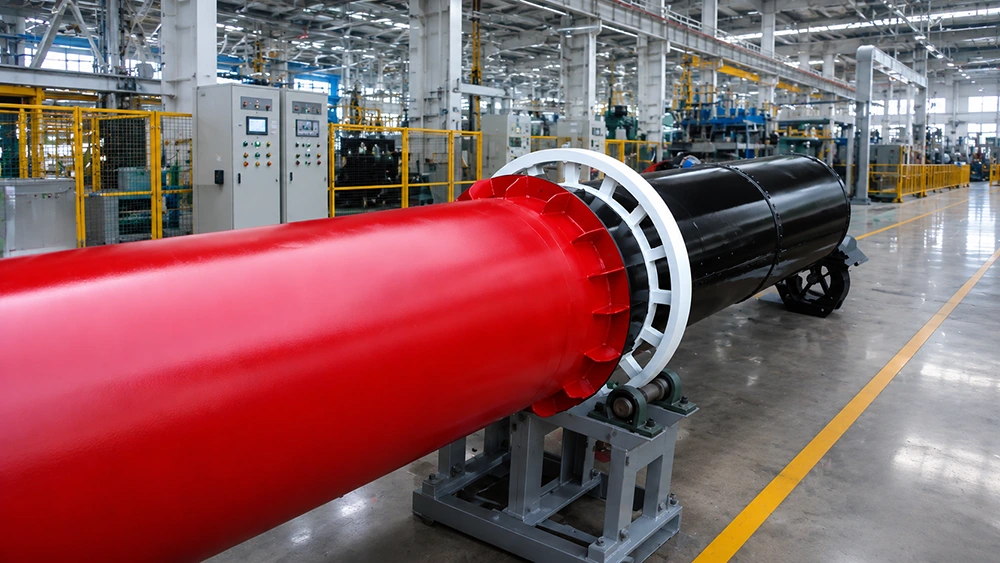
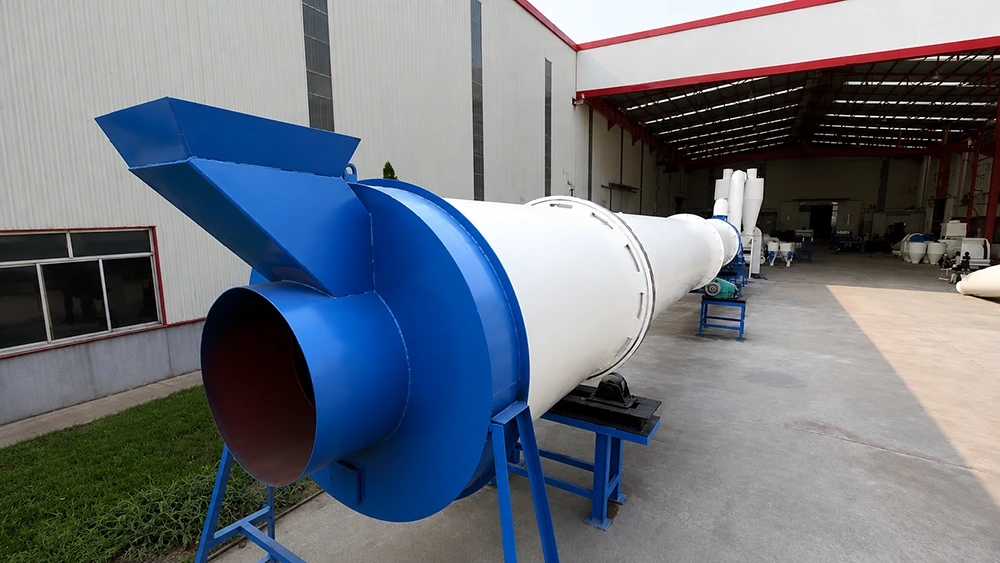
The ladder runs H-1010 on a 1000 mm drum with a 4 kW main motor and 7.5 kW induced draft fan covering 0.8 to 1 t/h, H-1212 on 1200 mm at 5.5 kW and 7.5 kW covering 1 to 1.2 t/h, H-1512 on 1500 mm at 7.5 kW and 11 kW covering 1.2 to 1.5 t/h, and H-1815 on 1800 mm at 11 kW and 15 kW covering 1.5 to 2 t/h. All tiers quote drum internal hot air at 200 to 500 degrees Celsius and an output moisture below 10 percent on dried sawdust. Around the drum sit a refractory brick lined multi-fuel hot air furnace taking coal, oil, gas or the plant's own sawdust, chips and pellets, a self-insulation shell quoted above 80 percent thermal efficiency and under 8 kg of coal per tonne dried, temperature sensing with a sealed drum and inlet chute, a cyclone dust collector with a baghouse filter where the project asks for it, PLC control, and a screw conveyor at the feed. The two photographs on this page are the argument: the drum body broken at bolted flanges and carried on steel roller supports, and the feed end with its blue hopper, inclined chute and roller support frame, which is exactly the set of pieces that travels in sections and is lifted back together on the slab.
What the customer actually ends up holding
The result is a drying stage that can be bought from a long way away without the delivery plan becoming the largest line in the budget. The pallet, pellet, briquette or board plant receives a commissioned sawdust drying machine on its own concrete, holding an inlet moisture it can plan against and an output moisture below 10 percent, with lifting plates, sealed drum, temperature sensing and dust collection all verified in place rather than in an assembly hall on another continent. Sizing still starts from the plant, not the machine: raw material type, initial moisture, particle size, target output moisture, hourly tonnage, fuel and emission rules, and the site and transport conditions decide whether the answer is an H-1010 or an H-1815, whether the drum runs to 17 to 18 m, how many sections ship, and how many days assembly and commissioning take. Send those figures through the contact channel and the split shipment plan, the plot requirement and the moisture duty are worked out against your own material instead of a generic brochure line.
- All tonnage, drum diameter, motor, fan, temperature and output moisture figures are taken from the DRYR parameter table and are quoted without published test conditions, so they vary with species, initial moisture, particle size, fuel and climate.
- The 50 percent reductions in plot footprint and civil foundation investment are stated against comparable models, not as an absolute guarantee, and are confirmed per project layout.
- Both images are real site photographs of the Dryr drum body and feed end; no 3D rendering is used as measured evidence on this page, and section counts, transport plan and commissioning days are verified per project.
- Split shipment, on-site assembly and commissioning are standard route for oversize drums; site-specific foundation loads, lifting plan and crew requirements are confirmed on the approved drawings before dispatch.