Sawdust dryer drum precision and moisture traceability
The plant that has to prove moisture instead of just reaching it
An export-oriented molded pallet, pellet or briquette plant usually inherits its drying stage instead of choosing it: a rotary drum welded up on site, a moisture check done by squeezing a fistful of sawdust, and a batch record that lives in one operator's memory. This page follows a single procurement decision on the DRYR rotary sawdust dryer, from what an out-of-round field-welded shell does to girth gear teeth, support rollers and bearings, through the factory-machined assembled structure, bolted flange sections and PLC control that replace the guesswork, to the figures the buyer can put in a file: H-1010 to H-1815 at 0.8 to 2 t/h on 1000, 1200, 1500 and 1800 mm drums, drum internal hot air quoted at 200 to 500 degrees Celsius, output moisture stated under 10 percent, self-insulation above 80 percent thermal efficiency, and a cyclone dust collector with an optional baghouse filter.
What a hand-welded drum costs before it dries a single tonne
A low-end rotary drum assembled and welded in the yard looks like a dryer and behaves like a variable. Shell roundness is not measured, so the tube runs out of true and the girth gear and pinion mesh on a moving centre line, which shows up first as noise, then as tooth wear, then as a support roller that will not hold its band. Lifting plates are set by eye and by whatever straight edge is on site, so the material curtain varies along the drum and part of the load simply rides. None of it fails on the day of commissioning, which is the problem: the plant absorbs bearing changes, weld repairs and unplanned stops as normal operating cost, and it absorbs the other half of the cost silently. Moisture is still decided by experience. Two operators on two shifts read the same fistful of sawdust differently, the batch moisture swings between loads, and the press or the pellet mill absorbs the difference in glue consumption, cracked units, roller slip and re-feed tonnage. Open-yard sun drying and manual open-air drying carry the same signature: throughput follows the weather, and nothing is recorded that a buyer could audit.
Why a standardized assembled drum and PLC control fit that line
The alternative is not a bigger drum, it is a drum that was manufactured to a drawing and can be checked. DRYR is brought to the site as an assembled structure: the shell is built in machined, bolted flange sections, so the tube that arrives has the roundness it left the works with, the sections are re-bolted on site instead of re-welded around a plumb line, and the equipment can be split for container shipment and reassembled without turning the yard into a fabrication shop. Combined lifting plates are positioned in the works rather than by eye on the slab, which is what makes the material curtain repeatable from one drum to the next. Temperature sensing, uniform vibration and a sealed drum and inlet chute take the rest of the guesswork out of the run, and PLC control ties feed rate, furnace and induced draft fan into one setting instead of three operators. Mulitple fuel options, coal, oil, gas, biomass solids and pellets, powder or electric, let the same platform answer whatever the local fuel market and emissions rules allow. The point is not automation for its own sake: it is that the drying set point stops being a person's judgement and becomes a number written down per batch.
The parameters, the picture evidence and the result that survives the audit
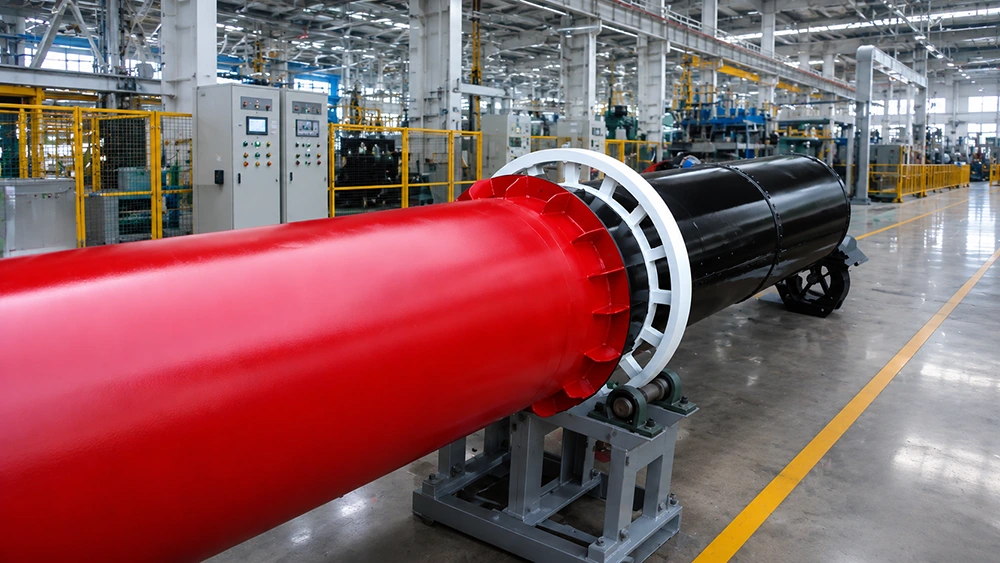
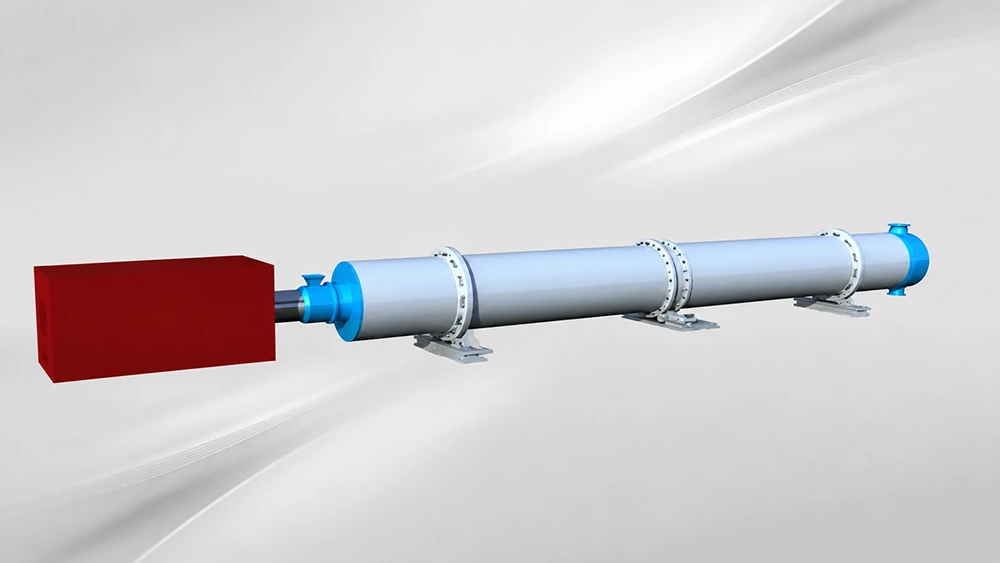
The platform runs as a selection ladder rather than one model: H-1010 on a 1000 mm drum with a 4 kW main motor and 7.5 kW induced draft fan at 0.8 to 1 t/h, H-1212 on 1200 mm at 5.5 and 7.5 kW for 1 to 1.2 t/h, H-1512 on 1500 mm at 7.5 and 11 kW for 1.2 to 1.5 t/h, and H-1815 on 1800 mm at 11 and 15 kW for 1.5 to 2 t/h. Across the range the drum internal hot air is quoted at 200 to 500 degrees Celsius, output sawdust moisture is stated under 10 percent, the self-insulation shell is quoted above 80 percent thermal efficiency with under 8 kg of coal per tonne dried, and the exhaust routes to a cyclone dust collector or an optional baghouse where the project asks for one. Where residence time rather than heat is the constraint, high moisture feed and monsoon sites, the drum is built out to 17 to 18 m in bolted sections. The photographs show what the difference looks like: the segmented shell joined by bolted flange rings, the drum carried on steel roller supports with the control cabinet at the building wall, and the assembled structure of the drum, drive motor, bolted flanges and support saddles. Two honest notes belong on the same page. The assembled drum and bolted flange view is a 3D rendering, not a site photograph, and the published moisture, efficiency and fuel figures are quoted without published test conditions, so tonnage and final moisture still move with species, initial moisture, particle size, fuel and climate, and each project is sized on its own sampling. What the plant ends up with is narrower than a guarantee and more useful than a claim: one drying set point, one recorded moisture per lot, fewer unplanned stops on the drum, and a stack of batch figures an export buyer or a certification auditor can actually read.
- Both selected images come from the resolved Dryr designer gallery and the second image is labelled as a 3D rendering rather than site evidence.
- Every technical figure matches the Dryr product brief: H-1010 to H-1815, 0.8 to 2 t/h, 1000 to 1800 mm drums, 4 to 11 kW main motors, 7.5 to 15 kW induced draft fans.
- Output moisture under 10 percent, thermal efficiency above 80 percent and under 8 kg of coal per tonne are stated as quoted figures without published test conditions.
- All four section bodies are plain text with no HTML tags, attributes, markdown or angle brackets, and the title does not repeat a previously published Dryr post.