Drying module sizing for pellet lines
Where the drying stage sits in a 1 to 20 t/h pellet line
An EPC contractor quoting a biomass pellet plant signs one tonnage and inherits every stage that has to hold it. Ring die mills in the small and mid band run at roughly 0.9 to 3 t/h, and each of them asks for sawdust inside a moisture window of about 10 to 15 percent before it can press anything, while fresh felled wood in tropical and monsoon markets arrives at 30 to 50 percent. The drying stage is what turns that intake into a pressable feed, and it is the stage most often sized last, after the mill, the pulverizer and the conveyor layout are already fixed. This page follows one procurement decision on the DRYR rotary sawdust dryer as a standardized drying module for a sawdust dryer for pellet production line, from the tonnage the mill can actually hold through the four tiers of 0.8 to 2 t/h, the drum built out to 17 to 18 m where residence time rather than heat is the constraint, and the structure and figures a buyer can file.
What the old approach costs when the dryer is the last item on the list
The cheapest drying stage is still open yard sun drying and manual turning, and it works until the weather stops cooperating. Feed becomes discontinuous, moisture swings with the season, stockpile dwell time sets the plant throughput instead of the pellet mill, and a rain week empties the feed bin. A small airflow dryer is the next step up, but it suits a narrow particle band and a modest tonnage, so a line that adds wood chips, shavings, straw or rice husk finds the dryer setting the ceiling. A hand welded low end drum machine carries a different problem, because shell roundness and lifting plate position vary with the welder, and an out of round shell wears girth gear teeth, support rollers and bearings while the material inside simply does not turn over evenly. The other common mistake is the opposite one, a single oversized drum bought as one capital bet, which locks the plant into one tonnage and one moisture band and leaves nothing to add when a second shift or a second contract arrives. None of these failures appears on a quotation sheet, because they all surface as tonnage the line never reaches.
Why a 0.8 to 2 t/h rotary drum module matches a 0.9 to 3 t/h ring die mill
DRYR is built as a standardized drying module rather than a one off machine, and it covers the mill band in four steps instead of one size. H-1010 runs a 1000 mm drum with a 4 kW main motor and a 7.5 kW induced draft fan at 0.8 to 1 t/h, H-1212 a 1200 mm drum with 5.5 kW and 7.5 kW at 1 to 1.2 t/h, H-1512 a 1500 mm drum with 7.5 kW and 11 kW at 1.2 to 1.5 t/h, and H-1815 an 1800 mm drum with 11 kW and 15 kW at 1.5 to 2 t/h. That ladder is what lets an integrator pick a tier against the pellet mill tonnage and the measured raw material moisture rather than buying capacity the line cannot feed. Where the constraint is residence time rather than heat, which is the normal case on 40 to 50 percent intake, the drum can be built out to 17 to 18 m in bolted flange sections, so the material stays inside the hot gas stream longer instead of the furnace being pushed harder. The module integrates as a subsystem: screw conveyor feeding, a hot air furnace for the dryer, a cyclone dust collector with a baghouse filter where the project asks for one, temperature sensing with uniform vibration and a sealed drum, and PLC control that ties feed rate, furnace and induced draft fan into one loop. Multi fuel firing on coal, oil, gas, biomass pellets, powder or electricity is what allows the same module to be quoted into markets with different fuel costs and emissions rules, and the assembled structure with bolted flanges is what allows a long drum to ship in sections and be re-assembled and commissioned on site.
Structure, parameters and image evidence, and the result the line is handed over on
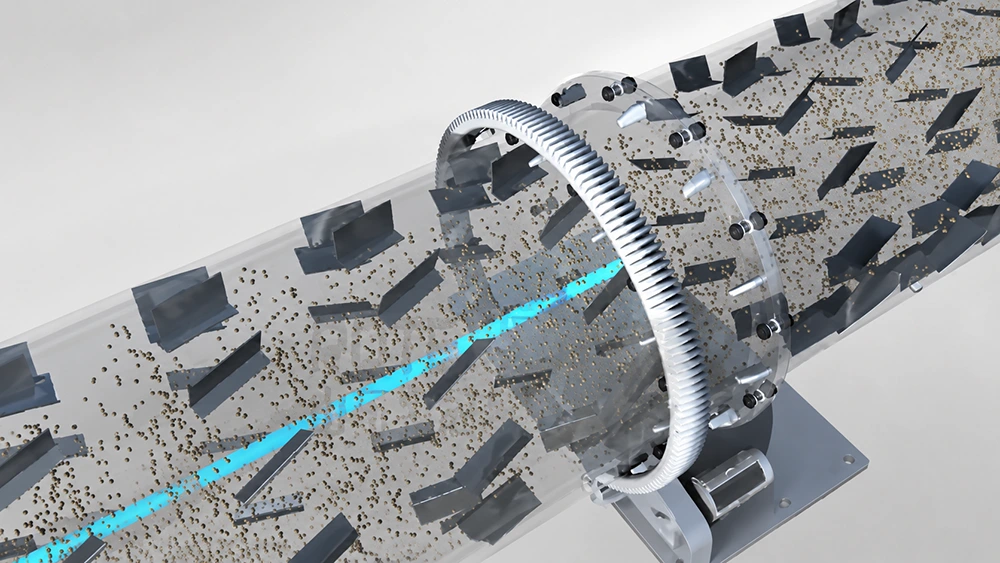
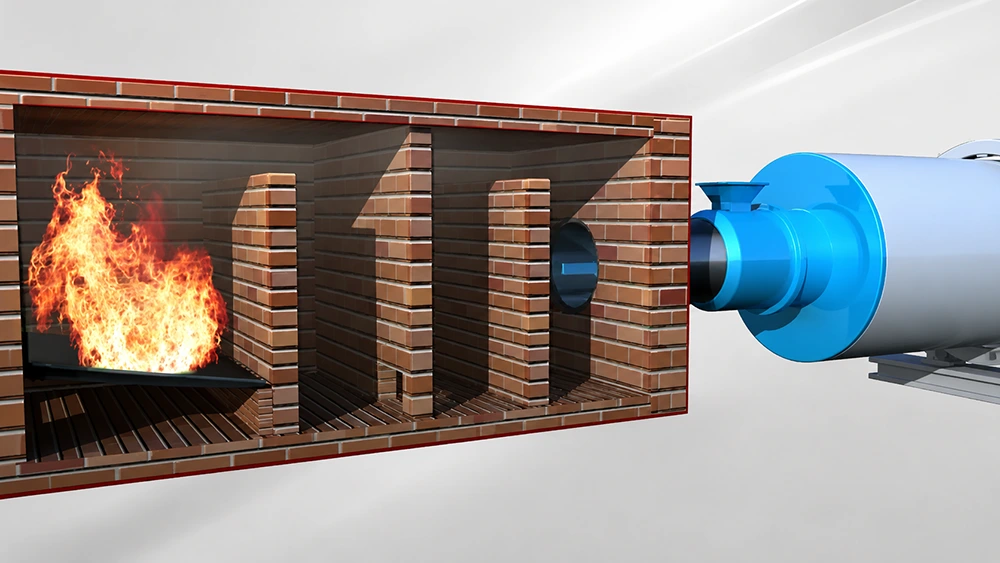
The structure behind those numbers is visible in two engineering renderings on this page. The first shows a rotary drum in cutaway, with the lifting plates arranged along the shell, the external ring gear and drive unit, and the granular material turning over as the drum rotates; the lifting plates are what form the material curtain the hot gas passes through, which is why plate layout and drum length matter more than furnace temperature once the feed is wet. The second shows the combustion side of the module in cutaway, a brick lined chamber with internal baffle walls forming a folded flue path and the burner assembly on the right, which is how the heat for the hot air furnace is generated and how the gas path is kept inside the chamber. Both images are 3D engineering renderings, not site photographs, and are labelled as renderings. The published figures the module is quoted on are drum internal hot air in the 200 to 500 degrees Celsius band, output moisture stated below 10 percent, self insulation quoted above 80 percent thermal efficiency with under 8 kg of coal per tonne dried, and a cyclone dust collector with an optional baghouse for dust control. The result an integrator is handed over on is a drying stage that runs continuously and holds the mill feed inside its moisture window, so the line is accepted on tonnage instead of on the dryer being nursed. The limits are stated plainly: these figures are quoted without published test conditions, so tonnage and final moisture move with species, initial moisture, particle size, fuel and climate, the renderings are not field evidence, and every project is sized on its own sampling of the actual raw material.
- Every figure on this page is taken from the DRYR product brief and image index; no test conditions are published for them, so tonnage, output moisture, thermal efficiency and fuel burn move with species, initial moisture, particle size, fuel and site climate.
- Both images are 3D engineering renderings rather than site photographs and are labelled as renderings in the alt text and in the body; they are used as structural illustration, not as performance evidence.
- The drying stage is presented as one module of a pellet or molded pallet line, sized per project against the pellet mill tonnage and the sampled raw material moisture, not as a stand alone guarantee of line capacity.
- No banned weak wording is used: high quality, best solution, one-stop solution, advanced technology and reliable product do not appear, and no competitor is named or disparaged.



