Sawdust dryer moisture control
The Pellet Mill Gets Blamed for a Dryer Problem
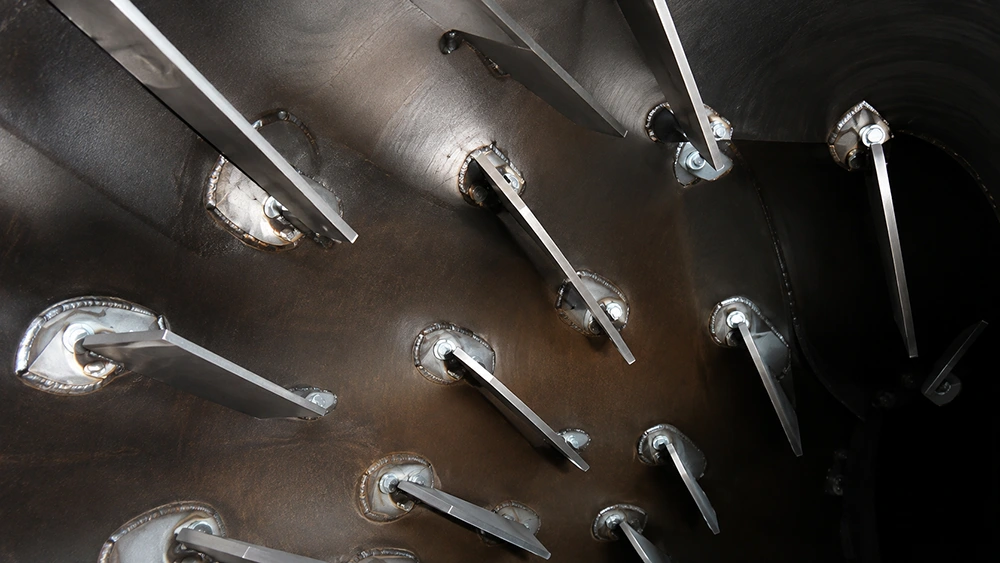
Sawdust that arrives at a different moisture every load turns one drying stage into a moving target, and the machine that pays for it is usually the pellet mill or the molding press downstream. This page follows the DRYR rotary sawdust dryer through that intake problem: temperature sensing monitoring on the drum, combined lifting plates that break the wet feed into an even curtain for full heat exchange, and an output moisture stated below 10 percent and taken lower to under 7 percent where a pellet or molded pallet process asks for it. The same unit covers wood sawdust dryer duty from 0.8 to 2 t/h across four drum diameters, so a pellet line or a molded pallet production line dryer is sized on its own moisture record rather than on one average figure.
What Sun Drying and One Fixed Furnace Setting Cannot Do
The common alternatives are natural sun drying and manual open air drying, a moisture check taken by squeezing a fistful of sawdust, and a single furnace setting left in place for every load. Each one loses the same argument. Sun drying stops in the rainy season, so feed continuity is decided by weather, and material that sits wet can mold or ferment before it is pelletized. A hand check is a lagging number that never reaches the furnace in time, so the drying stage answers a moisture the drum stopped seeing an hour earlier. The obvious correction, raising drum heat, runs into the material itself: wood dust carries an ignition temperature at or below roughly 280 degrees Celsius, inside the 200 to 500 degrees Celsius band the drum is designed to run at, and open drum ends and an unsealed inlet chute pull cold air into a shell that was set hotter to compensate. Drying cost climbs and the moisture record still swings.
Temperature Sensing and Combined Lifting Plates: Holding the Drying Stage
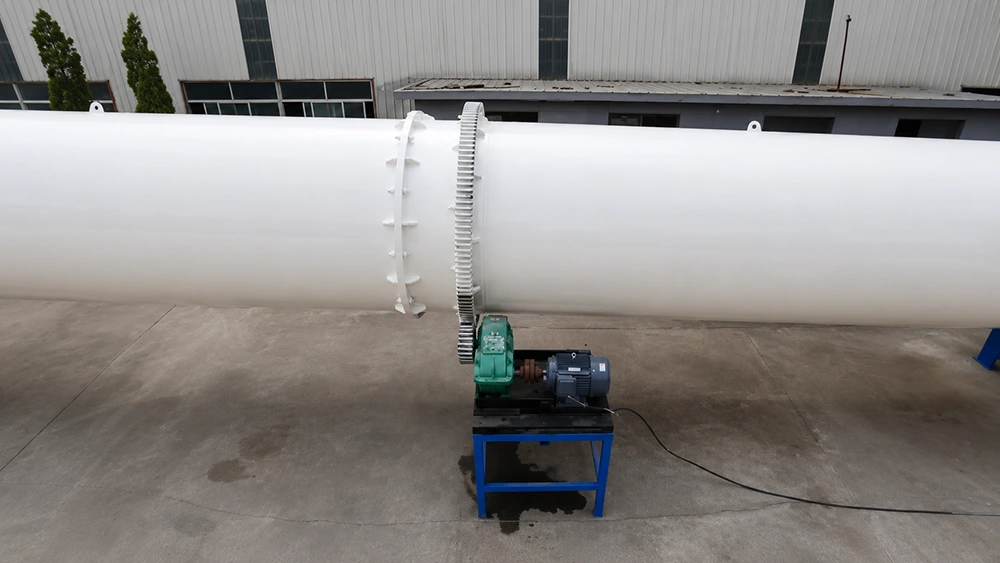
The DRYR rotary sawdust dryer answers the variance inside the drum instead of at the furnace dial. Temperature sensing monitors the drying stage, combined lifting plates lift and drop the wet feed into a repeated curtain so hot air meets every particle rather than a surface layer, uniform vibration keeps the bed moving, and the drum and inlet chute are sealed so the hot air path is closed. PLC control ties feed, furnace and induced draft fan to the same signal, so a wetter load is met by residence time and airflow rather than by guesswork. The chamber photograph shows the combined lifting plates as staggered paddle bars on welded mounting plates across the shell, and the second photograph shows the external girth gear and pinion drive that hold drum speed steady on a steel base frame. Four tiers cover the range: H-1010, H-1212, H-1512 and H-1815 on 1000, 1200, 1500 and 1800 mm drums at 0.8 to 2 t/h, with 4, 5.5, 7.5 and 11 kW main motors and 7.5, 7.5, 11 and 15 kW induced draft fans, and drums built out to 17 to 18 m in bolted flange sections where residence time rather than heat is the limit.
The Figures a Buyer Can File, and Where They Stop
Stated output is sawdust dried below 10 percent moisture, with the target taken lower to under 7 percent where a molding or pellet process asks for a tighter window, on drum internal hot air quoted at 200 to 500 degrees Celsius. Exhaust is routed to a cyclone dust collector with a baghouse filter where the project specifies one, so dry fibre that would otherwise settle on the yard and roof structure is captured. Self-insulation is quoted above 80 percent thermal efficiency, with under 8 kg of coal per tonne dried, and the refractory lined hot air furnace takes coal, oil, gas or biomass fuel according to local supply and emissions rules. Limits are stated plainly: those figures are quoted without published test conditions, so tonnage and final moisture move with species, initial moisture, particle size, fuel and climate. Selection therefore runs on your own numbers, raw material type, incoming moisture range, particle size, target output moisture, hourly tonnage, fuel and site conditions, and each project is sized on its own sampling rather than on one average.
- Only DRYR figures from the bound product material are used: 0.8 to 2 t/h across H-1010, H-1212, H-1512 and H-1815 on 1000, 1200, 1500 and 1800 mm drums, 4, 5.5, 7.5 and 11 kW main motors, 7.5, 7.5, 11 and 15 kW induced draft fans, drum internal hot air 200 to 500 degrees Celsius, output moisture below 10 percent and lower where the process asks, self-insulation above 80 percent thermal efficiency, under 8 kg of coal per tonne, drums to 17 to 18 m in bolted sections.
- Both images are real site photographs from the bound Dryr designer gallery, 1 (6) for the combined lifting plates in the chamber and 1 (10) for the girth gear and pinion drive; no rendering is presented as measured evidence.
- Every published figure is marked as quoted without published test conditions, and final moisture and tonnage are tied to species, initial moisture, particle size, fuel and climate, with sizing confirmed on project sampling.
- Banned weak phrases (high quality, best solution, one-stop solution, advanced technology, reliable product) are absent, and no competitor is named or disparaged.



