Sawdust dryer fuel cost
The plant: a tropical line where drying is the fuel bill
On a tropical pellet, molded pallet or panel line, drying is the largest single energy step and the one that decides whether a fuel price swing passes through to the plant's cost per tonne or stops at the furnace. The DRYR rotary sawdust dryer answers that with a self-insulation shell quoted above 80 percent thermal efficiency, under 8 kg of coal per tonne of material dried, and a refractory brick lined combustion chamber that takes coal, oil, natural gas or the plant's own biomass, powder and pellets, so an EPC line in a wood rich region can burn local residue instead of buying every tonne of heat. What follows is one procurement decision, followed from the fuel bill to the drum.
The old arrangement: a bare shell, one fuel, and a hotter furnace
Three habits keep that bill high. The first is a drum with no insulation package, where heat leaves through the shell before it meets wet fibre and the furnace is asked to make up the loss with more coal. The second is a coal only or gas only combustion chamber, which converts every fuel price move and every local supply interruption into a plant wide cost event, while a wood rich site burns none of its own residue and pays retail for heat. The third is the answer most sites reach for when output moisture drifts, namely raising furnace temperature, which shortens usable residence time and pushes drum internal air toward the 280 degrees Celsius band where wood dust stops being a product and starts being a fire load. Open air sun drying on a pad is the fourth option and the least controllable: it carries the dry month, stops in the wet one, and hands the press or the mill a different furnish every week.
Why the DRYR drum fits: insulation, coal per tonne, flexible fuel
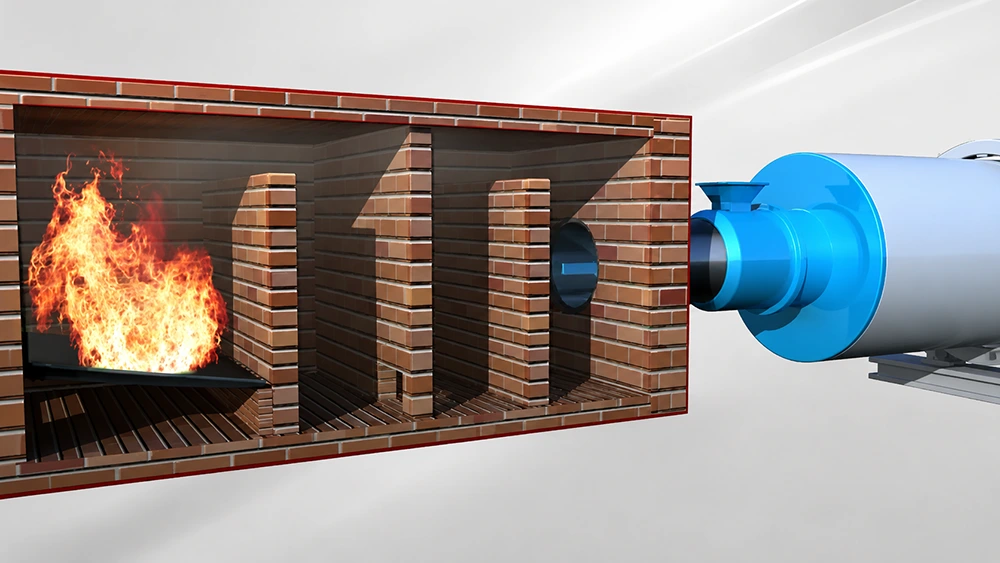
DRYR is a continuous rotary drum dryer, and its answer to the fuel bill is thermal rather than electrical. The shell carries a self-insulation design quoted above 80 percent thermal efficiency, so most of the heat the furnace makes reaches the material instead of the yard, and the published figure is under 8 kg of coal per tonne of material dried, which is the number a plant needs before it can put a drying stage into a costing sheet. The combustion chamber is refractory brick lined with a baffled flue path, and it accepts coal, oil, natural gas and other dry solid, granular and powder fuel including biomass, so an EPC plant in a wood rich region can fire its own sawdust, chips, crushed offcuts or pellets where local environmental rules allow, and keep bought fuel as the backup instead of the base. Inside the drum, combined lifting plates form the material curtain, temperature sensing tracks the working condition, and a sealed drum with a sealed inlet chute keeps the drying stage closed, so fuel spend and output moisture are read from the same instrument instead of being guessed from the stack.
Structure, parameter evidence, and the result a plant can price
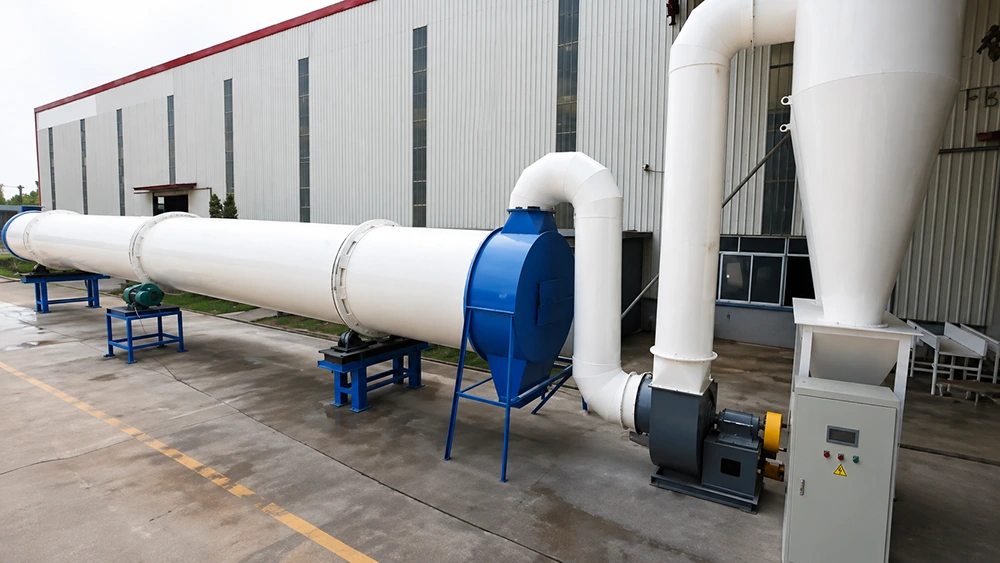
The platform is four tiers, H-1010 to H-1815 on 1000, 1200, 1500 and 1800 mm drums, covering 0.8 to 2 t/h with 4 kW, 5.5 kW, 7.5 kW and 11 kW main motors and 7.5 kW, 7.5 kW, 11 kW and 15 kW induced draft fans, drum internal hot air quoted at 200 to 500 degrees Celsius and output moisture stated below 10 percent, exhausted through a cyclone dust collector with a baghouse filter where the project asks for one, and driven from an electrical cabinet that ties feed, furnace and fan together. The first image is an engineering cutaway of the brick lined combustion chamber, the burner connection and the internal baffles, and it is a rendering rather than a site photograph. The second is a field photograph of a drum on roller supports with process ducting running to a cyclone separator, a centrifugal blower and the control cabinet, which is what the drying and dust stage looks like as built. The result at the gate is a drying stage the plant can price in advance: one moisture number below 10 percent going into the press or the mill, one fuel line that can be filled from its own yard when the market moves, and a shell that is not heating the neighbourhood. Limits are stated plainly, because these figures carry no published test conditions: tonnage and final moisture move with species, initial moisture, particle size, fuel and climate, fuel burn moves with the same variables, and every line is sized on its own sampling.
- Self-insulation quoted above 80 percent thermal efficiency and under 8 kg of coal per tonne of material dried, stated as supplier figures without published test conditions.
- Combustion chamber is refractory brick lined with a baffled flue path and accepts coal, oil, natural gas and dry solid, granular or powder fuel including biomass.
- Four tiers H-1010 to H-1815 on 1000, 1200, 1500 and 1800 mm drums at 0.8 to 2 t/h, drum internal hot air 200 to 500 degrees Celsius, output moisture below 10 percent.
- Image one is a 3D cutaway rendering of the furnace; image two is a field photograph of drum, ducting, cyclone separator and control cabinet.