Press Exit Take-Out · AutoG
The take-out post on a molded wood pallet line
A presswood pallet production line has one post that is still staffed rather than automated: the press exit. This page follows the takt problem on a plant running 1250 to 1600 ton molded wood pallet presses, where a pallet leaves the mold at about 80 degrees Celsius and one operator stands at each press to pull it out. AutoG is the automatic pallet take-out robot from EMP that takes the freshly pressed pallet on the press open signal without a cooling wait, transfers it by vacuum suction and stacks it where it leaves the gripper, so the press stops waiting for a person.
Why manual take-out costs cycle time, not just headcount
A person cannot be synchronized with a press the way a machine can. The press opens on its own schedule and closes on its own schedule, and between those two signals somebody has to reach into the die, grip a hot pallet and clear the mold area before the press closes again. In practice the press waits: the operator arrives late from the second press, or waits for the pallet to cool enough to handle, or the night shift runs one person across two press stations. Every second a press holds open for a person is machine time that is not producing a pallet, and on a line measured in pallets per shift that lands as lower OEE and a higher unit cost, which goes straight at price competitiveness. Two operators per shift at the press exit also mean a post that has to be staffed continuously, nights and peak season included, at a station with high temperature and MDI off gassing beside the die.
Why an 80 degrees Celsius take-out robot fits this post
AutoG is built for the gap between the open signal and the close signal on a presswood pallet production line. A vacuum suction end effector takes the pallet at about 80 degrees Celsius directly out of the mold, so hydraulic press pallet take-out no longer depends on a cooling wait before the unit can be touched. The sequence is triggered from the press rather than from a person: with the open and close signals wired into the line PLC, the die open position issues the take-out command and the robot returns to the next cycle, which is what makes the handshake repeatable press after press instead of operator after operator. One arm alternately tends two presses, so a single robotic cell carries dual press tending instead of one unit per press, and the same configuration is how a semi-auto to full-auto line upgrade closes the last manual post on the line. The boundary is stated plainly: AutoG is the press exit take-out and stacking device, not the hydraulic press, not the crush, dry or glue stage, and not a line that runs on its own.
What the picture shows, what the numbers still owe, and the result at the press
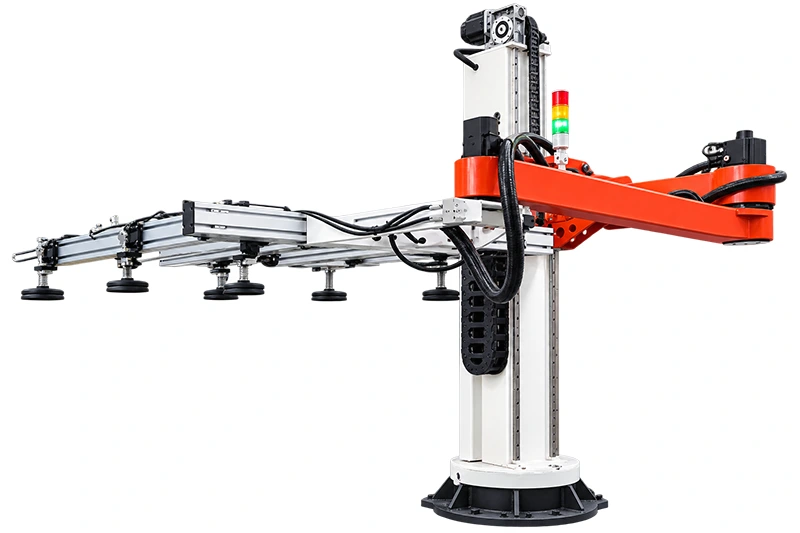
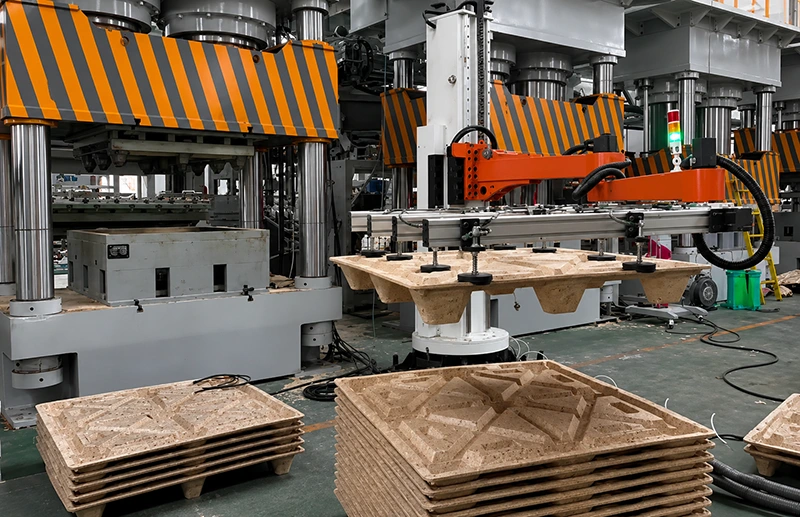
The white background unit in the first image shows the parts that do the work at this post: a column mounted base, a long articulated arm reaching into the press area, a multi suction head sized to a pallet face rather than a carton, cable chain routing and a stack light for operator status. The press side view in the second image shows the same interface from the line: a four-post hydraulic press with a robotic vacuum gripper and stacked molding panels at the exit, which is the layout a take-out cell is fitted into. What images cannot settle is specification. Rated load, working radius, repeat accuracy, suction and vacuum configuration, footprint, power and air demand, robot body source and the control interface stay project confirmed, no ROI, payback or hourly output is claimed, the 80 degrees Celsius handling figure is quoted from the EMP equipment centre description, and the six-axis articulated arm description comes from supplier material while the photographs show the column mounted vacuum arm and the press side handling structure, so that description stays a supplier statement until the configuration is confirmed per project. What the configuration does settle at line level is where the time goes: the press exit is covered from the open signal to the close signal without a person inside the cycle, press waiting for manual take-out is removed, take-out headcount is set per press pair instead of per press, and automatic stacking and palletizing of the hot pallet happens where it leaves the gripper, so the line keeps its cadence and the unit cost keeps the manual post out of it.
- Limits: rated load, working radius, repeat accuracy, suction and vacuum configuration, footprint, power and air demand, robot body source and control interface stay project confirmed, not published specifications.
- No ROI, payback period or hourly output is claimed for AutoG anywhere on this page.
- AutoG is the press exit take-out and stacking device on a molded wood pallet line, not the press itself, not the crush, dry or glue stage and not a stand-alone line.
- The 80 degrees Celsius handling figure is quoted from the EMP equipment centre description; the 1250 to 1600 ton press range, the 4 to 5 minute MDI cycle and the 24 hour running statement are supplier statements rather than published specifications.